THE CHURCH AND SAME-SEX MARRIAGE, by Ron Nicolson. Cluster Publications, Pietermaritzburg. 2008. 74pp
Reviewed by Anthony Egan SJ
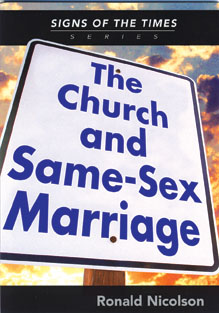 Same-sex marriage is increasingly a global controversy. Legal in some countries (including South Africa), the call for non-discrimination in marriage on the grounds of sexual orientation is also a source of deep division and controversy in the churches.
At the heart of the problem is the question of the meaning of marriage and the legitimacy of homosexuality. In an all too short volume in the innovative Cluster “Signs of the Times” series, theologian and ethicist Ron Nicolson tries to present the conflicting Christian views on the matter. Central to the question is the dispute over the moral legitimacy of homosexuality. For many Protestants, the question of the Bible comes into play. Clearly, the Christian conservatives say, the Bible condemns homosexuality — or at least homosexual acts.

True, counter other more liberal Christians, but that’s not the whole story. Firstly, the references are few in number, ergo not a preoccupation of the authors. Secondly, the texts referring to homosexuality are often tangential to, or part of, a sweeping list of sins or cultic prohibitions — many of which even the most conservative believers no longer adhere to.
Why do we accept some of the prohibitions but reject others? Clearly our decisions are not motivated by these rules being “in the Bible”, but because they meet other moral criteria we accept independent of the text.
Thirdly, the Bible as a text is a product of, and limited by, its context. Human knowledge of the natural world, biology, psychology and sexuality has developed dramatically since 500BC or 100AD. This leads to another argument often raised against homosexuality: that it goes against natural law (or “natural theology”).
Homosexual activity is unnatural, the argument goes, because it violates the purposes for which the sexual organs were made; also, many say, because it goes against what is observable in nature. Nicolson points out that this approach is also highly disputed among theologians who work in this area. Much of “natural law” depends on what is (chosen to be) observed. Many arguments are raised that homosexuality is itself “natural”, that is, an integral part of the physiology and psychology of a significant minority of persons. Here Nicolson is perhaps a little briefer than I’d have liked, particularly since this is central to the Catholic rejection of homosexual acts (though not, it must be stressed, persons). Similarly there is tension over the meaning and purpose of marriage. Is marriage merely for procreation? If so, same-sex marriages would be clearly a contradiction of purpose.
Surely not, argues Nicolson, pointing out how a wide range of churches have reached broad consensus that although marriage includes the idea of procreating and raising children, procreation is not the only purpose. He shows historically how other key elements — from control of lust and the temptation to promiscuity through to love and mutual support — have all been part of the idea of marriage from early in the Christian tradition. Indeed, one might add that these ideas have in fact pre-dated the formal definition of marriage as a sacrament in the 11th century.
In many churches, Nicolson argues, the dominant understanding of marriage has become that of love, fidelity and companionship. This understanding, it might be argued, opens up the possibility for same-sex marriages. To further complicate matters, Nicolson points out, there is no clear and united stance within the gay and lesbian communities (Christian or otherwise) as to the desirability of same-sex marriage. Some clearly desire it—in particular the blessing of such unions by the Christian community. Others see the need for it from a legal perspective (such as same pension and health insurance rights as straight couples). Still others reject the idea, arguing that same-sex relationships are indeed different from traditional heterosexual marriages.
The division within the churches over dealing with this question is highlighted by Nicolson. As an Anglican this is particularly important for him, given the conflict that has arisen recently within the Anglican Communion which is unlikely to be resolved in the near future. How might one address such tensions, in such a way that the interests of conservatives and liberals are met? Strategies Nicolson examines (all too briefly) include adiaphora, penultimate ethics, probabilism, conscience and the notion of the “lesser evil”. Adiaphora, meaning “things that are indifferent”, is an attempt to fudge the issue by declaring the problem something for local communities to decide for themselves. This, he argues, will appeal to few Christians, particularly as the debate is already so heated.
The Lutheran notion of “penultimate ethics”, ethics that are not part of core doctrine that are open to different interpretation without different sides breaking fellowship with each other, is perhaps another way to go. But, once again, this may lead to differences over what constitutes core doctrine — do you see the Bible as inerrant, literal and infallible or, if not, how do we reconcile differences over it?
Catholic probabilism offers another possibility. While recognising the “conserving” and traditional nature of Church and teaching, it proposes that if one comes up with an argument counter to the official line that is at least as good as the official position, such a decision might be taken in conscience to follow the new approach.
Again, one wonders whether such a step would pacify rival factions. Indeed, as Nicolson does not point out, probabilism in the Catholic Church is a highly controversial form of casuistry that has often been condemned as moral laxity. And strictly speaking, what he practically advocates here is in fact what’s called equiprobabilism. Certain forms of probabilism would, after all, argue that one could proceed with an action so long as the reasoning was reasonable, even if it may not be as well reasoned as the official line. Similarly, his appeal to following conscience may not be as effective as one might hope. It is easy for one side to condemn the other for “bad conscience” or “bad faith”.
The notion of lesser evil offers a pragmatic direction: homosexual actions are wrong, but it is better for homosexual persons to “sin” with one person in a loving, faithful relationship than to sin promiscuously, seems to be the underlying argument. This, of course, Nicolson points out, may still not satisfy either side. In short, there are no easy answers to the problem.
Although this is a very short book — far too brief to do justice to the material or to the breadth of Ron Nicolson’s knowledge — this is an erudite yet simple introduction. It is by the nature of its subject controversial and while the author clearly has certain sympathies in the debate he is scrupulously fair in his presentation of both sides. Such balance makes it well worth reading.
The book also suggests that the subject deserves a far longer, more detailed scholarly work. One hopes that Professor Nicolson will oblige us.
- Saint Paul and the Bible - July 29, 2019
- Religious Orders: Then and Now - November 6, 2018
- A Brief History of Religious Orders in South Africa - October 25, 2018