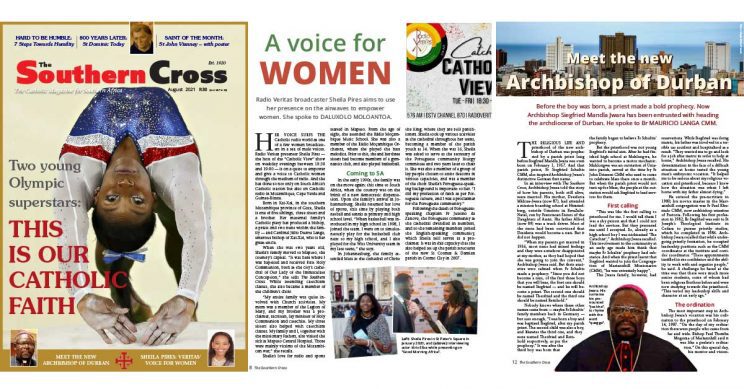
As South Africa’s only Catholic weekly, The Southern Cross enjoys a particular benefit, but one that also presents certain challenges.

Unlike Catholic publications in countries where the Church is bigger than it is in South Africa, various Catholic newspapers serve readers of distinct schools of thought.
In Britain, for example, The Tablet is read mostly by progressive Catholics, while their conservative counterparts tend to prefer the Catholic Times or Catholic Herald.

In the United States, the National Catholic Reporter serves the faithful of progressive mind, the National Catholic Register conservatives, Our Sunday Visitor the middle-ground and The Wanderer traditionalists.
Not so with The Southern Cross, which accommodates the whole range of ideologies in South Africa’s Catholic spectrum, as well as a broad set of demographics.
It is a perennial challenge to try to get the balance right; the reader will have to be the judge of how well we succeed in meeting it.
At the same time, the broad diversity of our readership provides The Southern Cross with an advantage: it is a meeting point for fellow believers who otherwise might not encounter one another.
In terms of demographics, this finds expression on the local news pages and, especially, on the popular page of community photos.
The letters page clearly does not give a representative picture of the demographic composition of our readership. It does, however, cover the range of philosophies and opinions held by South African Catholics.
Correspondence comes from bishops and parishioners, from theologians and devotees to particular venerations. It comes from reformers and ultra-traditionalists, from those who address miscellaneous issues and those who address only one — and most letters fall in between these points.
This rich diversity of opinion can make for a lively letters page which can then serve as a forum to get people talking, sometimes energetically, and might even inspire illuminative discussions beyond the printed page.
Invariably, there will be some letters which confirm one’s views, and others which one may strongly disagree with.
Hopefully, exposure to such a diverse exchange of opinion helps us understand one another better.
The Southern Cross cannot publish all the letters it receives, but we try to run as many as possible. In selecting letters for publication, this newspaper tries to be fair in giving a voice to a broad range of opinion.
This means, of course, that we will publish some letters with which the editor or the staff of The Southern Cross disagree, sometimes strongly so. However, the personal views of the staff of this newspaper can have no bearing on the selection of letters that are published.
It is not within The Southern Cross’ remit to reject letters simply because the editor or staff differ with their content, and no letter published in the newspaper bears the implied approval of the editor or staff.
Readers understand that the letters page is not a source for catechism, and this permits the publication of viewpoints which some people might consider contentious.
The Southern Cross does not allow the publication of letters that challenge the deposits of our faith under the guise of expressing Catholic thought. We trust that our readers are aware that, as our boilerplate at the foot of the correspondence page puts it, “letters must not be understood to necessarily reflect the teachings, disciplines or policies of the Church accurately”.
Letters that are critical of doctrine or disciplines preferably should appeal to the teaching authority of the Church, not encourage readers to disobedience.
On the other hand, when correspondents explain their difficulties with living in accordance to certain areas of Church teachings, they cannot be summarily set aside. To ignore their experience is to be divorced from the realities of Catholic life.
Beyond the essential dogma, the unity of the Church is not located in uniformity of thought but in the way Catholics treat another. Robust dialogue is entirely permissible, for even the apostles engaged in vigorous debate.
Ideally, this should be accompanied by charity of thought. But should correspondents sometimes irk us, then it serves to remind us that this, too, is part of being Church.

- The Look of Christ - May 24, 2022
- Putting Down a Sleeping Toddler at Communion? - March 30, 2022
- To See Our Good News - March 23, 2022