By Jason Scott – Just a few months into his pontificate, Pope Leo XIV has released Dilexi Te (On Love for the Poor), his first Apostolic Exhortation, taking up a project begun by Pope Francis in his final months. Pope Leo begins the document with a tribute to his predecessor:
“Pope Francis was preparing in the last months of his life an Apostolic Exhortation on the Church’s care for the poor, to which he gave the title Dilexi Te. I am happy to make this document my own — adding some reflections — and to issue it at the beginning of my own pontificate, since I share the desire of my beloved predecessor that all Christians come to appreciate the close connection between Christ’s love and his summons to care for the poor.”
The opening sets the tone: Leo brings continuity, but also signals that he intends to deepen and sharpen the vision.
New Faces of Poverty, and a Cultural Diagnosis

Almost immediately, Leo issues a warning: poverty is not static, nor confined to the margins: “The old forms of poverty that we have become aware of and are trying to combat are being joined by new ones, sometimes more subtle and dangerous.” He continues:
“A concrete commitment to the poor must also be accompanied by a change in mentality that can have an impact at the cultural level. In fact, the illusion of happiness derived from a comfortable life pushes many people … toward a vision of life centred on the accumulation of wealth … Thus, in a world where the poor are increasingly numerous, we paradoxically see the growth of a wealthy elite, living in a bubble of comfort and luxury, almost in another world compared to ordinary people.”
Here Pope Leo is diagnosing a cultural disease: affluence becomes anaesthesia; success the new idol. The very systems that generate wealth may, in his view, blind us to our neighbour’s suffering.
Economies, Ideologies & Hidden Powers
Leo does not adopt a simplistic “market = evil” stance. Instead, he confronts the mythologies that elevate the economy, and the individual, above ethics:
“We must continue, then, to denounce the ‘dictatorship of an economy that kills’ … There is no shortage of theories attempting to justify the present state of affairs or to explain that economic thinking requires us to wait for invisible market forces to resolve everything. Nevertheless, the dignity of every human person must be respected today, not tomorrow, and the extreme poverty of all those to whom this dignity is denied should constantly weigh upon our consciences.”
He targets the seductive narrative that “invisible forces” will resolve inequality — and insists that structural arrangements must always be accountable to human dignity.
Work, Dignity & Learning from the Poor
At the heart of Dilexi Te is a simple but profound claim:
“Let me state once again that the most important way to help the disadvantaged is to assist them in finding a good job, so that they can lead a more dignified life.”
He frames employment not as optional charity but as integral justice. Work is not a concession; it is a gift to human dignity.
But Leo goes further: he overturns the usual one-way gaze:
“The poor … act as silent teachers … instilling within us a rightful spirit of humility.”
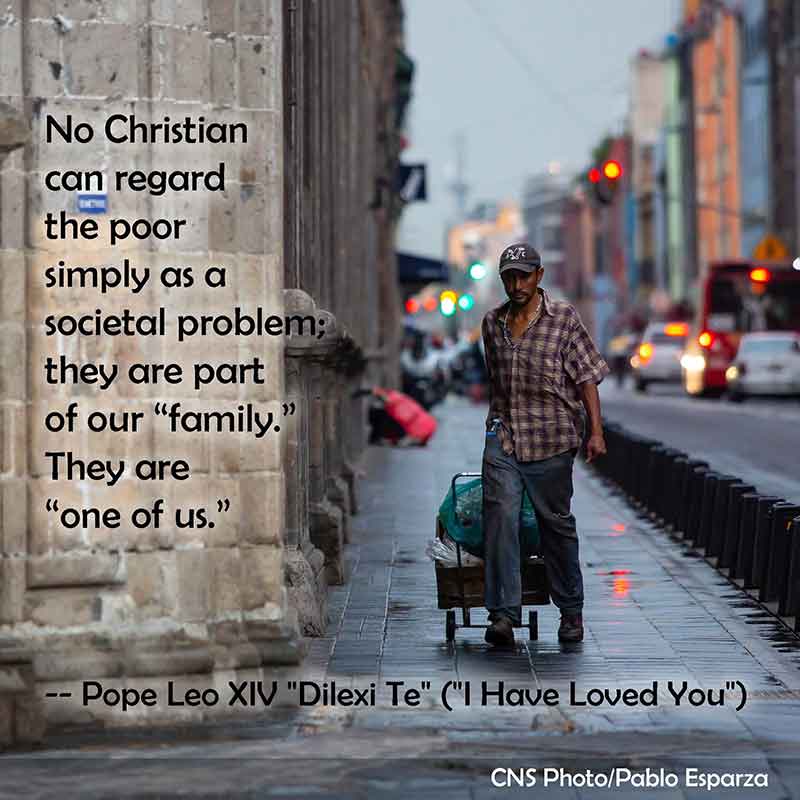
“The poorest are not only objects of our compassion, but teachers of the Gospel … Lives can actually be turned around by the realisation that the poor have much to teach us about the Gospel and its demands.”
These lines invite humility. The Church, in Leo’s vision, does not merely serve — she listens, learns, allows herself to be evangelised by those she serves. The poor teach us about patience, trust, brokenness, and the demands of justice.
Whispers of a Predecessor
While Pope Leo is clearly building upon the legacy and work of Pope Francis, many readers will notice another influence in Dilexi Te: Rerum Novarum. The encyclical, promulgated in 1891 by Leo XIII, remains foundational to Catholic social teaching on labour, capital, and just social order.
Leo XIV does not merely nod to it in passing; he brings it into his centre:
“By way of example, in his Encyclical Letter Rerum Novarum, Leo XIII addressed the labour question, pointing to the intolerable living conditions of many industrial workers and arguing for the establishment of a just social order.”
The critique of economic systems unmoored from moral accountability mirrors Rerum Novarum’s warnings against laissez-faire capitalism.
Conclusion:
Dilexi Te is not an easy text to summarise or reduce. It demands engagement: reading, reflection, response. Pope Leo XIV issues a call not only to feel compassion, but to reconfigure structures, to reform systems, to look steadily at how we live, invest, govern, and choose.
I encourage all readers to read the full document for themselves. It is only in the richness of its arguments, warnings, and moral clarity that one will grasp its full weight.
And let us remember: Dilexi Te is only the beginning. Pope Leo’s first encyclical is yet to come.

- Why I Chose Catholicism: 7 Reasons - October 7, 2026
- Why I Am Not an Atheist: The Three M’s - September 28, 2026
- “Help, the Pope said something I disagree with” - July 20, 2026