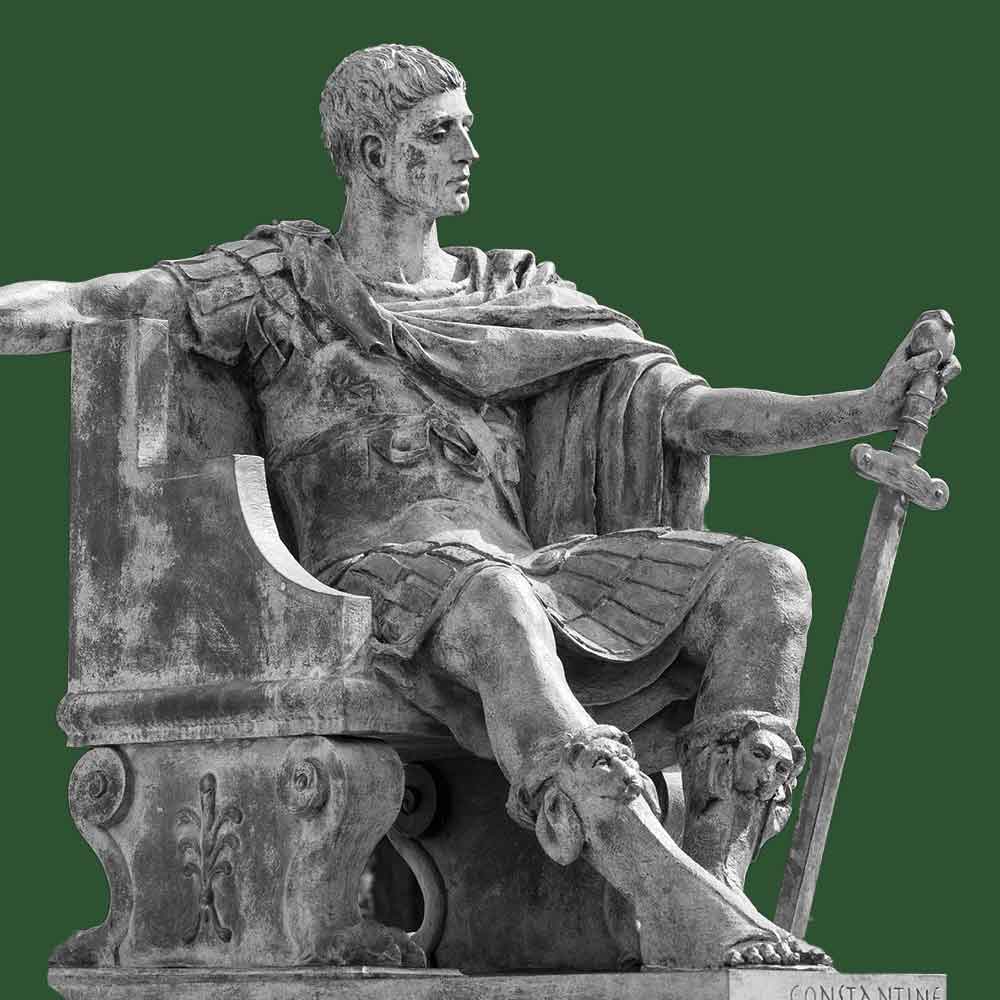
By Jason Scott – One of the strangest and most common attacks on the Catholic Church is the claim that the emperor Constantine “invented” it.
According to the myth, a pagan emperor in the fourth century created a syncretic religion, made himself its head and forced the bishops to adopt pagan rituals. Yet by the time Constantine was even born, there had already been at least twenty‑five popes guiding the flock of Christ. In other words, the Church had already endured three centuries of persecution, produced martyrs and saints and defended orthodoxy before the man usually credited with its “foundation” entered the world. At the end of this article, I will list those popes for those who are curious or in denial.
A Church that pre‑existed Constantine
Early Christian sources refer to the Church as catholic long before Constantine. Around A.D. 110, St Ignatius of Antioch urged the Smyrnaeans to avoid schism and “follow the bishop, as Jesus Christ doth the Father,” reminding them that wherever Christ Jesus is, “there is the Catholic Church”. That letter predates Constantine by more than a century and reflects a hierarchical Church with bishops, presbyters and deacons. By the second century, local churches were already gathering in councils to settle disputes, and Roman bishops were exercising real authority.

Pope Clement I wrote to Corinth around A.D. 96 to restore order when presbyters had been deposed; his intervention was accepted as binding because the Corinthians recognised Rome’s primacy.
Church fathers such as Irenaeus could already trace the succession of bishops of Rome from Peter through the second century. These lists preserve the memory of popes like St Linus and St Anacletus and show that the Church’s hierarchical structure did not develop at the whim of a fourth‑century emperor but was understood as a divine institution from the apostolic age.
By 200 AD, the Roman Church was so respected that its letters were read in liturgy, and by A.D. 300 bishops in Spain were issuing canons calling themselves Catholics. The “Constantine founded the Church” narrative requires us to ignore these centuries of history.
Persecution also reveals an organised Church before Constantine. In the “great persecution” under Diocletian, Christians around the empire had property confiscated, sacred books burned and clergy arrested. Constantine’s victory at the Milvian Bridge (312) and his subsequent policies are significant only because there were already Christian communities to liberate and bishops to consult. Without a pre‑existing Church, there would have been no one to persecute or to free.
What Constantine actually did
Constantine, born around A.D. 272, was not a Christian when he became emperor. On the eve of battle, he reportedly saw the chi‑rho symbol in the sky, yet his conversion was gradual and politic. In 313, he and his co‑emperor Licinius issued the so‑called Edict of Milan. The rescript guaranteed religious freedom to Christians and “all others”, abolishing prior edicts against them and restoring confiscated property. It did not make Christianity the state religion; that status came later with Theodosius’s edict in 380.
Constantine also returned church buildings and funds, exempted clergy from taxes and appointed Christians to high office. His support allowed bishops to build public basilicas, such as the Lateran palace, which he handed over to Pope Miltiades after demolishing the imperial guard’s fort. Under his patronage, massive churches rose over the tombs of St Peter and the Holy Sepulchre.
As emperor, Constantine believed it his duty to promote unity in the Church. He intervened in the Donatist schism in North Africa and later convened the First Council of Nicaea in 325 to resolve the Arian controversy. The council, attended by more than 300 bishops, produced the Nicene Creed and set a common date for Easter. Constantine presided as imperial host but did not define doctrine; the bishops debated and voted, and the creed reflects their faith rather than imperial decree. His involvement in ecclesial affairs was consistent with Roman notions of the emperor as guarantor of public order, not a usurper of apostolic authority. Ironically, he was baptised only on his deathbed in 337, and not by the pope but by Eusebius of Nicomedia, a bishop with Arian sympathies.
It is true that Constantine’s policies altered the Church’s circumstances. The end of persecution allowed for public worship, legal status and the accumulation of wealth. Imperial patronage sometimes tempted bishops to seek worldly advantage. Yet these changes did not create a new religion; they simply shifted the Church from the margins to the centre of public life. This “Constantinian shift” can be debated as a blessing or a curse, but it does not prove that the Church sprang from his will.
Exposing the myth and its sources
So where did the notion come from that Constantine founded the Catholic Church? Part of the confusion stems from later forgeries and legends. An eighth‑century text known as the Donation of Constantine claimed that the emperor gave Pope Sylvester I dominion over Rome and the western empire, supposedly rewarding him for curing Constantine’s leprosy and baptising him. For centuries, this document buttressed papal claims to temporal power until Renaissance scholars like Nicholas of Cusa proved it a forgery.
The Catholic Encyclopedia notes that the legends preserved in the Vita beati Sylvestri and the Donation about Constantine’s healing and baptism “are entirely legendary”. In reality, Pope Sylvester sent legates to Nicaea and oversaw the dedication of basilicas, but he never baptised the emperor.
Anti‑Catholic polemics in later centuries exploited these legends to argue that the Church’s power rested on fraud. Fundamentalist tracts and sectarian videos still allege that Constantine blended Christianity with paganism and invented Catholicism at Nicaea. Yet such claims collapse under historical scrutiny. For instance, the Edict of Milan granted freedom to all religions and did not establish a state church. The Nicene Creed says nothing about emperors, councils or state power; it simply professes faith in the Trinity.
The Church already possessed a clear structure and sacramental life, as seen in Ignatius’s description of the Eucharist as the flesh of Christ and Justin Martyr’s account of the Mass written in the 150s. Irenaeus, writing around 180, insisted that all churches must agree with the Church of Rome because of its apostolic origin. These sources obliterate the idea that Constantine invented Catholic doctrine.
Further, the myth misunderstands the relationship between Church and empire. Had an emperor created a religion, we would expect to find contemporary legal records describing the act. Roman bureaucrats were meticulous about legislation, yet no such document exists. Instead we find property records returning confiscated churches, not founding them, and letters from emperors appealing to bishops to settle disputes. The numerous councils held before Nicaea, from Carthage to Elvira, show that bishops were already meeting to resolve doctrinal and disciplinary issues. Constantine’s invitation to Nicaea simply expanded this practice to address a crisis that threatened imperial unity.
When 320 bishops assembled, they represented an existing communion of churches, not a new organisation.
Finally, the myth ignores the continuity of the papacy. If the Church were invented in 325, one would expect no bishops of Rome before that date. Yet early Christian writers enumerate them. Irenaeus lists the succession from Peter through Eleutherius (c. 174–189), and the fourth‑century historian Eusebius catalogues all the popes up to his own day. Such records would be impossible if Constantine were the Church’s founder.
Continuity through the popes
By the time Constantine was born (circa A.D. 272), the Church had already been shepherded by more than 25 popes.
For the sake of clarity, here are the bishops of Rome from St Peter to St Dionysius (the twenty‑fifth pope):
1 St Peter 32–67
2 St Linus 67–76
3 St Anacletus (Cletus) 76–88
4 St Clement I 88–97
5 St Evaristus 97–105
6 St Alexander I 105–115
7 St Sixtus I 115–125
8 St Telesphorus 125–136
9 St Hyginus 136–140
10 St Pius I 140–155
11 St Anicetus 155–166
12 St Soter 166–175
13 St Eleutherius 175–189
14 St Victor I 189–199
15 St Zephyrinus 199–217
16 St Callistus I 217–222
17 St Urban I 222–230
18 St Pontian 230–235
19 St Anterus 235–236
20 St Fabian 236–250
21 St Cornelius 251–253
22 St Lucius I 253–254
23 St Stephen I 254–257
24 St Sixtus II 257–258
25 St Dionysius 260–268
(26) St Felix I 269–274 (Pope when Constantine was born)
The names alone tell a story: an unbroken line of authority, many were martyrs, long before the empire offered them palaces. They presided over liturgies in catacombs, resolved disputes, corresponded with distant churches and sometimes shed their blood for Christ. When Constantine issued an edict allowing Christians to worship freely, he was addressing their Church; he did not create it.
The lessons of history
The myth that Constantine founded the Catholic Church persists because it appeals to modern sensibilities. It reduces a complex history of faith, martyrdom and theological development to a political conspiracy. It serves the rhetorical needs of those who wish to portray Catholicism as a man‑made institution rather than a divine community. But history is more stubborn. Primary sources show a Church that called itself “Catholic” more than a century before Constantine. Early popes exercised authority and were recognised by other churches. Imperial policies in the fourth century were responses to an already vibrant Church. Forged documents like the Donation of Constantine and legends about Sylvester’s baptism can mislead only those who ignore the abundant evidence to the contrary.
Constantine’s story is fascinating and instructive. His conversion, whether motivated by piety or politics, altered the Church’s relationship with the state. His patronage made possible the building of great basilicas and the convocation of ecumenical councils. Yet the Catholic Church is not a product of his imagination. Its foundation lies deeper, in the proclamation of the apostles, the blood of martyrs and the promise of Christ that the gates of hell would not prevail against his Church.
To understand Constantine properly is to appreciate both his significant role in history and the more ancient, enduring life of the Church he entered just before his death.

- Why I Chose Catholicism: 7 Reasons - October 7, 2026
- Why I Am Not an Atheist: The Three M’s - September 28, 2026
- “Help, the Pope said something I disagree with” - July 20, 2026