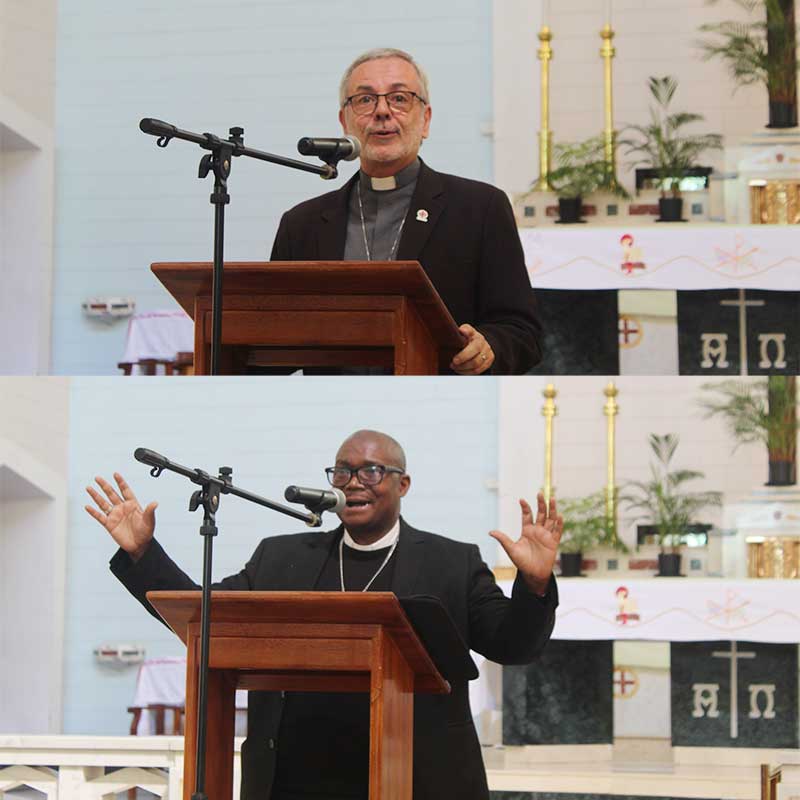
The faithful gathered at the Our Lady of the Assumption Cathedral on Saturday, 25 April 2026, for the annual Bishop Mandlenkhosi Zwane Memorial Lecture, an event that continues to honour the life, legacy and enduring vision of the first local bishop of the Diocese of Manzini.
Now in its eighth edition, the memorial lecture has become a significant moment in the Church’s calendar in Eswatini, bringing together clergy, religious leaders and lay faithful to reflect on pressing issues at the intersection of faith and society. This year’s theme, “The relationship between Church and State,” echoed the life and ministry of Bishop Mandlenkhosi Zwane, a man remembered for his deep commitment to human dignity, social justice and the development of his people.
Among the attendees was Mrs Ida Zwane, the late bishop’s 77-year-old sister-in-law, who has faithfully attended the memorial lectures since their inception.
Honouring a pioneer of faith and justice
Bishop Mandlenkhosi Zwane holds a special place in the history of the Catholic Church in Eswatini and Southern Africa. Ordained in 1964 as the second Swazi priest, he later became the first local bishop of Manzini in 1976. His episcopal ministry was marked by a strong focus on lay formation, social development, communication and support for refugees, particularly during the turbulent years following the Soweto Uprising.

His leadership extended beyond the Church into the broader society. Troubled by the lack of representation and responsiveness to the needs of black communities, he played a key role in founding the Council of Swaziland Churches. Through this platform, he championed initiatives that brought tangible change, including access to clean water, education for adult learners and support systems for displaced people.
Zwane’s life was tragically cut short in 1980 when he was 48 years old, but his legacy continues to inspire. His writings and actions reflected a deep concern for human development, freedom and human rights, values that remain central to the Church’s mission today.
Why this day and place matter
In his remarks, the Bishop of Manzini, José Luis Gerardo Ponce de León IMC, explained the significance of both the timing and location of the memorial lecture. He noted that the event is deliberately held on the Saturday preceding Good Shepherd Sunday.
This timing, he said, is not accidental. Good Shepherd Sunday celebrates Christ as the model of all shepherds, making it a fitting moment to remember Bishop Zwane, the diocese’s first shepherd. Equally significant is the venue. The Our Lady of the Assumption Cathedral is not only the mother church of the diocese but also the burial place of Bishop Zwane.
This deliberate connection of time and place ensures that the memorial lecture remains grounded in its original purpose: to honour a shepherd who gave his life in service and to inspire others to continue his mission.
Setting the tone: Prayer, reflection and remembrance
The programme began with an opening prayer led by Reverend Celiwe Mkhabela of the Anglican Church, reflecting the ecumenical spirit that Bishop Zwane himself championed.
This was followed by contributions that situated the lecture within the broader life of the diocese. Father Thabo Mkhonta reflected on the 75th anniversary of the Diocese of Manzini, highlighting milestones and challenges that have shaped its journey. Father Dumisani Mazibuko then offered a moving reflection on the life and legacy of Bishop Zwane, reminding those present of his humility, courage and unwavering commitment to justice.
A timely theme: Church and state in dialogue
The highlight of the event was the keynote address delivered by His Excellency, Bishop Masilo John Selemela, the Auxiliary Bishop of the Archdiocese of Pretoria in South Africa.
In a thoughtful and wide-ranging lecture, Bishop Selemela explored the complex and often delicate relationship between the Church and the state. He began by referencing the Gospel principle of “rendering to Caesar what belongs to Caesar and to God what belongs to God,” noting that while this suggests a clear distinction, the reality is far more nuanced.
Both the Church and the state, he explained, serve the same people, individuals who are simultaneously citizens and believers. As such, their relationship cannot be one of complete separation, nor should it be one of domination by either side. Instead, it must be characterised by balance, mutual respect and a shared commitment to the common good.
Drawing on Catholic social teaching, Bishop Selemela described the Church and the state as “distinct yet complementary societies.” The state is concerned with the temporal well-being of its citizens, while the Church is oriented towards spiritual salvation. However, both are ultimately ordered towards the flourishing of the human person.
Navigating tension and collaboration
A central theme of the lecture was the tension that can arise when the boundaries between Church and state are either blurred or rigidly enforced.
Bishop Selemela warned that excessive closeness between the two can lead to the Church losing its prophetic voice, opting for silence in the face of injustice. On the other hand, too much distance can result in a lack of moral guidance in public life or an imbalance where one undermines the other.
“The relationship,” he suggested, “must be a distinction without separation and a union without confusion.”
He emphasised three guiding principles for maintaining this balance: recognising moral values that precede politics, respecting the distinct missions of religion and governance, and fostering collaboration where their roles intersect.
Such collaboration is particularly important in what he described as “mixed matters” : areas like education, marriage, social welfare and communication, where both the Church and the state have legitimate roles to play.
The role of religious freedom
A significant portion of the lecture focused on religious freedom, particularly in light of the teachings of the Second Vatican Council. Bishop Selemela reaffirmed that every person has the right to practise their faith freely, without coercion from individuals or institutions.
This freedom, he noted, is not only a religious concern but a cornerstone of a just and democratic society. Protecting religious freedom means safeguarding the dignity of the human person and ensuring the proper functioning of the social order.
He also drew on the teachings of recent popes, highlighting the idea that while the state should never impose religion, it must create conditions in which faith can flourish. At the same time, the Church must avoid seeking political power, remaining faithful to its spiritual mission while contributing to the moral fabric of society.
A call to responsible engagement
Bishop Selemela’s lecture ultimately called for a mature and responsible engagement between the Church and the state, one that prioritises the common good above all else.
He reminded the faithful that the Church’s mission extends beyond the sanctuary. Evangelisation, he said, must include engagement with social realities, addressing issues such as justice, inequality and human development. At the same time, this engagement must respect the autonomy of political structures, avoiding any attempt to dominate or control.
The state, for its part, must recognise the value of religion in forming citizens who are committed to justice, peace and the common good. In this way, both institutions can work together without losing their distinct identities to build a more just and compassionate society.
Continuing the legacy
In remembering Bishop Zwane on the eve of Good Shepherd Sunday, the Church in Eswatini, and by extension in Southern Africa, is reminded that true leadership is rooted in service. Like the Good Shepherd, those called to lead must do so with humility, love and a willingness to lay down their lives for others. In this way, the legacy of Bishop Zwane lives on, not only in memory, but in action.
Additional information:
https://consolatasa.blogspot.com

- Father Chaka Motanyane: Support Matrics 2026! - October 13, 2026
- SECAM Seeks African Participation in World Youth Day 2027 - September 24, 2026
- ‘Carlo is an instrument of God’: His mother reflects on the first year of her son’s sainthood - September 11, 2026