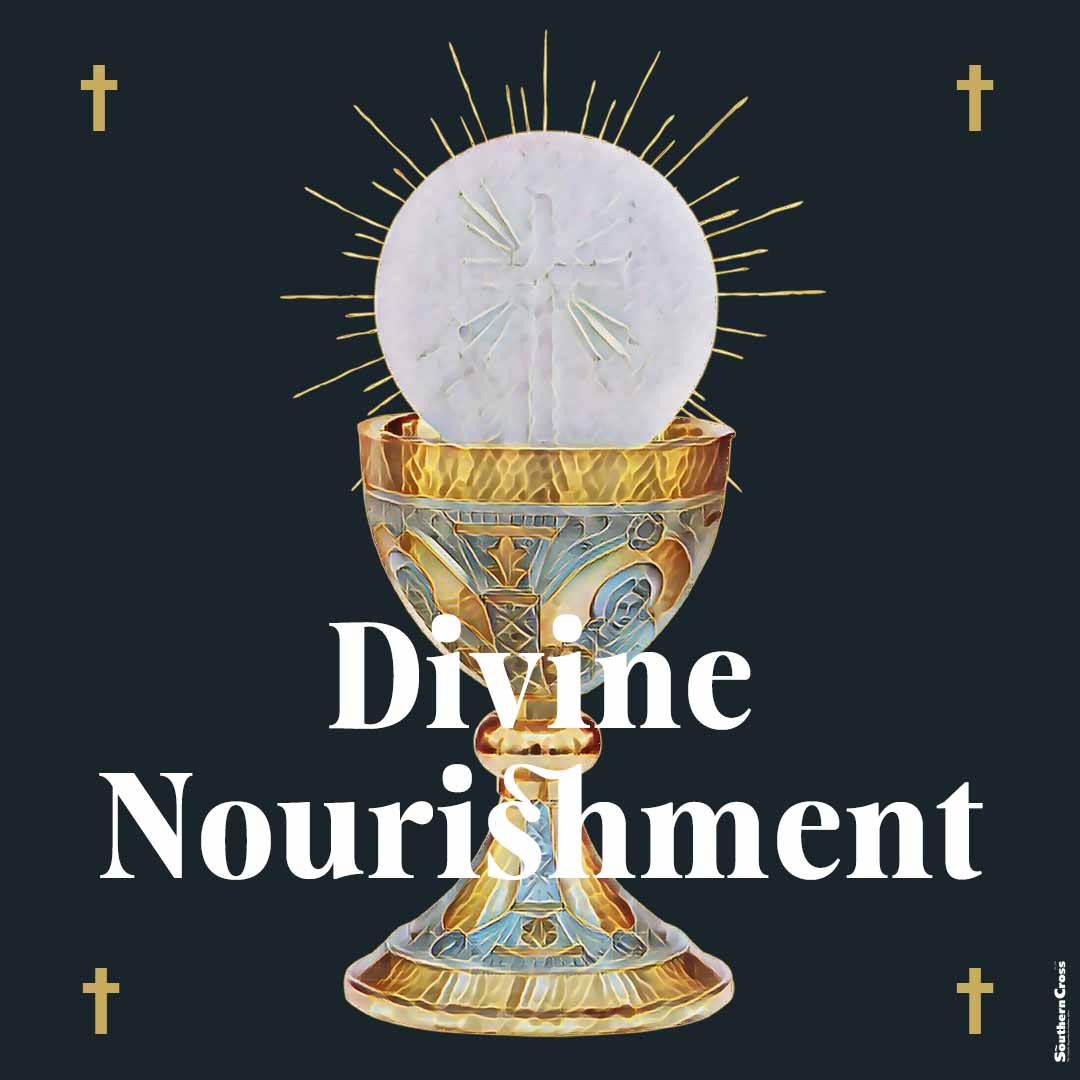
Sermon by Emmanuel Suntheni OSB, Seventeenth Sunday In Ordinary Time, Year A
Sermon And Christian Act In The Word
Theme: God’s nourishment to humanity! Nourishment for the Soul!
Point of reflection: In the Gospel reading of today, we encounter the story of Jesus Christ feeding the people! That is divine nourishment! Is my soul desiring to be nourished? Or am I a deserted person? Do I feel as if I am in a deserted place – a place of lack and emptiness? Do I long for some form of divine intervention in my present situation? How can I provide nourishment for someone whom I know to hunger for a more meaningful and fulfilling life? The Lord nourishes us and sends us to nourish others. We choose to look out for people who are physically hungry and thirsty and see how best we can help them. We also look out for those who are spiritually hungry and thirsty and share the word of God with them.

First Reading: Isaiah 55:1–3
Psalm: Psalm 145:8–9, 15–18
Second Reading: Romans 8:35, 37–39
Gospel: Matthew 14:13–21
Sermon (Reflection): In today’s scriptural readings, we encounter many ways in which God sustains his faithful People. For Isaiah, the nourishment for souls comes in the form of God’s word. For Paul, the divine love of God and Jesus upholds believers in their journey through life. For Matthew, Jesus sustains his followers by his presence, teaching and grace. Those thus nourished will never hunger for a full life, and can only exclaim with the Psalmist, “the eyes of all look to you, and you give them their food in due season.”
The oracle in the first reading of today comes from a prophet known as the “second Isaiah” whose prophecies, delivered at the very end of the Babylonian exile, convey an ardent anticipation and exuberant joy at the approach of freedom. The grounds for his joy and confidence lie in God’s decision to make “an everlasting covenant” with the people, a covenant rooted in God’s steadfast and sure love for David. The tragedy of Jerusalem’s fall in 586 BC and the ensuing exile was interpreted by many as a sign that God had withdrawn from the covenant and disowned Israel. Second Isaiah challenges such demoralising views. The prophet’s certainty of the end of the exile stems from a deep understanding of God’s relationship with Israel, a relationship which includes justice, but is governed by God’s unchangeable and everlasting love.
Prophet Isaiah evokes an image of God’s calling on people to partake in freely offered food and drink: water, wine, milk, bread and “rich food”. However, this is no ordinary meal, but is a double invitation to listen and to come to God with an “open ear” in order to live; this replaces the food imagery; the real invitation is to listen and absorb God’s word. As Christians, sometimes we are in exile of anger and exile of hunger; we all need divine nourishment!
God is inviting us today to open our hearts and ears to listen to His life-giving words, which are vital nourishments that can sustain us and can be found in hearing and adhering to God’s commands.
Paul in the second reading of today has concluded the second major part of his letter to the Romans with an exuberant and joyful hymn. The apostle did not employ explicit images of food, but wrote about the sustenance and the protection that come from love. Separation from the source of life, from nourishment, amounts to death. Paul declared that love nourishes and sustains believers, and that they will never be separated from it.
Paul in the second reading focuses on the love of Christ, declaring believers inseparable from it. He lists a number of threatening human factors and forces that could cause separation from Christ. He identifies psychological factors such as fear and distress, hostility and violence; such as persecution and sword, social misfortunes such as famine, nakedness and peril, only to declare them impotent to break believers’ union with Christ. In fact, he states that these perils drive believers closer to Christ, and make them victorious! As Christians, are we living in the love of God? Are we sharing the love of God as our tool for divine nourishment?
In the Gospel reading of today, Jesus Christ shared his love with us through the feeding of the hungry people and the miraculous multiplication of the bread. The Gospel story of the miraculous feeding of a multitude is set in the desert, a place of want, danger and deprivation. The crowds, drawn to Jesus, venture into this hostile environment, leaving the safety of their towns behind. Seeing their devotion, Jesus, moved with compassion, heals those afflicted with illnesses and then provides the crowd with food. A superficial interpretation of Jesus’ action would suggest that he was primarily concerned with the people’s bodily needs. However, this story hides a far deeper meaning and message.
Looking at the hungry people at dusk, the disciples suggest that Jesus send them away to buy food in the villages. This suggestion, reasonable as it was, would mean separation from Jesus for the sake of satisfying bodily hunger. Jesus disagrees and commands the disciples to feed the people, which, naturally, they are unable to do with the five loaves and two fish they have. Jesus then takes this ordinary and utterly insufficient food and performs actions with a profound theological and spiritual significance. First, Jesus raised his eyes to heaven, a sign that his actions will originate with God. Next, he blessed the food, transforming it into an expression of God’s nourishing blessing. He then breaks the bread, which signifies his diffusion of God-given nourishment to the multitudes. Finally, he gives the food to the disciples to distribute to all, making them intermediaries in God’s provision of nourishment to the people. This deeply symbolic event discloses that Jesus brings God’s life-sustaining blessing, true nourishment for life, into the midst of humanity. In the Eucharistic interpretation of the story, Jesus himself is this nourishment; those seeking life must come to him.
In the context of today, the story reveals its full meaning in two ways: First, despite the size of the crowd, “all ate and were filled”, which means that Jesus’ provision for life is unlimited and complete. He can boundlessly and fully satisfy people’s deepest hunger for life. Second, the leftovers gathered amount to twelve baskets. The number twelve stands as a symbol for a complete community. Consequently, Jesus’ presence and provision of sustenance established a new community, one that is gathered and sustained by him.
Christian Act in Word of God “Divine Punishment”
The miracle of the feeding of the five thousand teaches us one big lesson, namely, the Lord is capable of nourishing us wherever and in whichever situation we find ourselves. My inability to solve a seemingly impossible equation does not mean it cannot be solved. There is always a solution to a problem. Yes, there is always a way out of every problematic situation. We sometimes focus too much on the problems of life at the expense of finding a solution to them.
Today, Jesus turns to each one of us and says, “Bring them here to me”, meaning all those riddles and vicissitudes of life that appear to us as insurmountable as the feeding of thousands of hungry people in a desert place.
What we consider to be impossible would turn out to be doable if only we would trust in the Lord and respond to his invitation. As we place all that we have and are in his hands, we would experience nourishment for our souls.
Action: I will ask the Lord to fill my heart with living water that nourishes. I will renew my faith in the Eucharistic meal that the Lord offers me at every Eucharistic table.
Prayer: Eternal Father, you are capable of providing humanity with all their needs. Sometimes we find ourselves in a spiritual desert, with no food and no love. And so today, we turn to you with faith and trust to place our human daily needs before You. As we have heard in the book of Isaiah, water is life. We need Your word to nourish our life! As You fed the needy people in the Gospel of Matthew, we ask You to divinely nourish us with love and peace in our hearts. We ask this through Christ our Lord, Amen.

- One in Christ: Mission Sunday - October 16, 2026
- God is Inviting Us: 28th Sunday in Ordinary Time - October 9, 2026
- Good or Bad Fruit? 27th Sunday in Ordinary Time - October 2, 2026