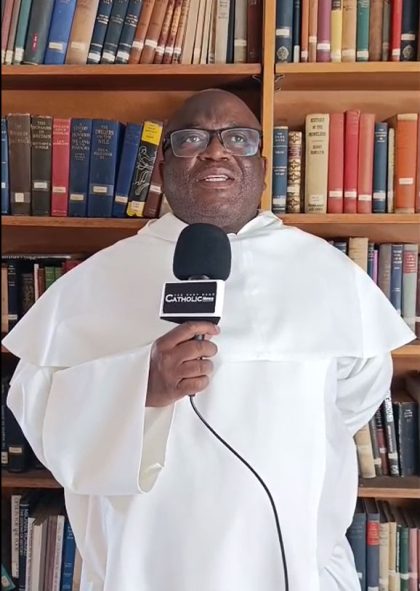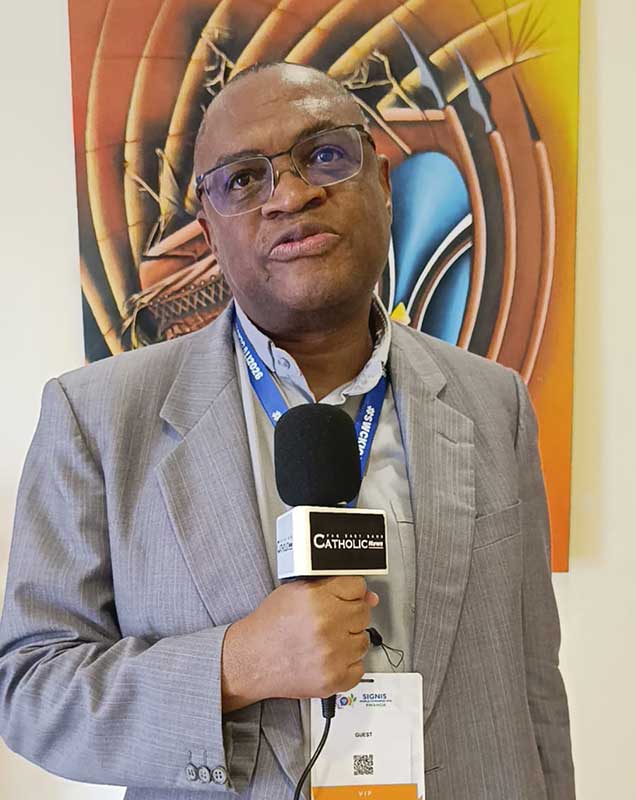
For Fr Paul Samasumo, the conclusion of the 2026 SIGNIS World Congress in Kigali, Rwanda, was not just the end of a week-long gathering. It was the culmination of years of conversations, uncertainty, perseverance and prayer. “This is just the beginning for Africa,” he said during an interview.
Fr Samasumo, a Zambian priest who heads Vatican Radio’s English Africa and KiSwahili Service, recently completed his two-year term as SIGNIS World vice-president. His tenure ended as the Catholic communications association held its first-ever World Congress on African soil.
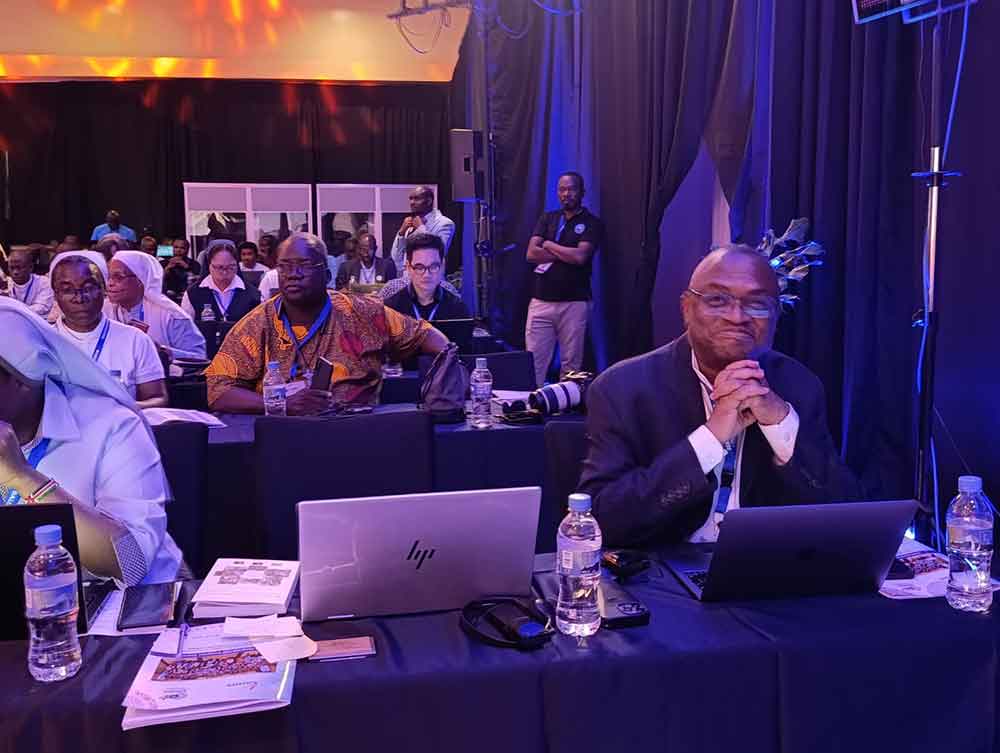
Held in Kigali from August 3-8 under the theme “Digital Communication for Cultural Harmony and Environmental Wellbeing,” the congress brought together Catholic communicators, journalists, media practitioners, filmmakers, digital communicators, researchers and Church leaders from around the world. SIGNIS describes itself as the World Catholic Association for Communication, bringing together professionals working across press, radio, television, cinema and digital media. For Fr Samasumo, seeing the congress finally happen in Africa was one of the greatest achievements of his time in SIGNIS’ leadership.
A dream that finally became reality
“We managed to pull this thing off in Africa,” Fr Samasumo said. For years, the possibility of bringing the SIGNIS World Congress to Africa had been discussed. The opportunity eventually emerged after Brazil, which was initially expected to host the gathering, withdrew. Africa then put forward its own proposal. “At first, we thought we would do it in Ivory Coast,” Fr Samasumo recalled. However, challenges led the organisers to look elsewhere, and Rwanda emerged as a suitable host, particularly because of its accessibility and visa arrangements. The decision proved significant. Kigali became the first African city to host the global SIGNIS gathering since the association’s first World Congress in Rome in 2001.

Previous congresses have been held in cities including Rome, Chiang Mai, Quebec and Seoul. The road to Kigali, however, was not without anxiety. As preparations intensified, concerns were raised about whether Africa could successfully host an international gathering of this scale. Towards the end of the preparations, the emergence of Ebola concerns in the neighbouring Democratic Republic of Congo added another layer of uncertainty. “There was a lot of assuring,” Fr Samasumo said. But those concerns ultimately did not define the congress. Instead, more than 300 participants from over 40 countries arrived in Rwanda, turning the long-discussed dream into reality. “It has been a spectacularly surprising, amazing week,” he said.
‘Africa has come of age’
For Fr Samasumo, the significance of hosting the congress went beyond logistics. It was an affirmation of what Africa is capable of contributing to the global Church. “Africa has come of age,” he said. He recalled the words of Archbishop Fortunatus Nwachukwu, who also works in the Vatican and was present at the congress: “Africa is not a small child. We know what we need.” The successful congress, he believes, demonstrates that African Catholic communicators can take their place confidently within the global communications mission of the Church.
That confidence was strengthened by another historic development during the congress: the election of Fr Walter Chikwendu Ihejirika of Nigeria as the new SIGNIS World president, succeeding Helen Osman. Fr Samasumo says that having an African lead the global association at the same time that the continent hosted its first World Congress made the moment particularly meaningful. “There is so much to be thankful for,” he said, also acknowledging the support of non-African members who believed in what the continent could achieve. The SIGNIS World Congress was not simply brought to Africa; Africa also emerged from it with a stronger voice within the global Catholic communications family.
The power of meeting face to face
For an organisation representing Catholic communicators across the world, Fr Samasumo believes that one of SIGNIS’ greatest strengths is its ability to bring people together. “You come to know so many people,” he said. The encounters expose communicators to realities different from their own. Participants hear about the challenges facing Catholic media in different countries, cultures and regions and discover approaches that can enrich their own work. “You come out of your own smallness,” he explained. For Fr Samasumo, this kind of encounter can be transformative. It reminds communicators that the challenges they face in their own countries are part of a much larger global picture.
At the same time, it can help them appreciate that their own work has value. “You realise that you’re not so bad at what you are doing,” he said. This spirit of networking and mutual encouragement has accompanied Fr Samasumo throughout his own journey in Catholic media, particularly through his work with Vatican Radio and Vatican News. His experience reflects the broader mission of SIGNIS: creating a space where Catholic communicators can learn from one another while strengthening their contribution to the Church’s evangelising mission.
Bringing young people into Catholic communication
But as the communications landscape changes, Fr Samasumo believes SIGNIS must also change with it. One of the most important challenges facing the association is attracting young communicators. Young people increasingly consume news and information through social media, and many are themselves becoming influential content creators. “These are beginning to be very important news sources,” Fr Samasumo said.
The challenge, he believes, is not simply to reach young people as audiences, but to invite them into the Catholic communications community as active participants. Africa has already taken steps in this direction. Father Samasumo acknowledges that young communicators bring both new ideas and energy, and SIGNIS can offer them formation in media ethics and responsible communication. “When you come into the association you come to know also about the ethics and the ethical way of doing things,” he said.
That formation is increasingly important in a digital environment where anyone can create and distribute content instantly. Young people can therefore benefit from SIGNIS’ experience, while SIGNIS itself can benefit from their creativity, digital fluency and understanding of emerging platforms. The Kigali congress provided evidence of what young people can already contribute. Fr Samasumo noted that many members of the local organising committee were young people. “We have seen what they have done and what they can do if there were so many of them on board,” he said.
A changing African SIGNIS
The transformation is also taking place within SIGNIS Africa itself. During Fr Samasumo’s tenure, one of the important developments was the establishment of a constitution for SIGNIS Africa, which previously did not have one. The leadership structure has also become more representative. Fr Samasumo noted that the new SIGNIS Africa executive is majority women, with representation from different linguistic and geographical communities across the continent.
There is representation from Francophone, Anglophone and Lusophone Africa, alongside lay people, priests and a religious sister from Mozambique. Fr Samasumo notes that this is an important sign of a changing Church and a changing communications landscape. “Before, most of SIGNIS Africa’s executive were priests,” he said. “The world has moved on.” The presence of women and lay communicators is therefore not simply a question of numbers. It reflects the reality that Catholic communication is carried out by a diverse community of professionals whose experiences and perspectives can enrich the Church’s mission.
A journey interrupted by COVID-19
Fr Samasumo’s leadership journey with SIGNIS has itself been marked by unexpected challenges. He was first elected in Quebec, Canada, in 2017. But soon afterwards, the COVID-19 pandemic disrupted much of the association’s planned activity. For almost three years, many activities could not take place as originally intended. Yet the crisis also forced SIGNIS to innovate. “We started having more meetings on Zoom,” Fr Samasumo recalled. The experience demonstrated that digital platforms could not replace physical encounters completely, but they could keep a global communications network connected during a period when travel and gatherings were impossible.
When the mandate was renewed in 2022, Fr Samasumo and his colleagues were able to continue strengthening the organisation. Among the achievements was the work with SIGNIS Africa to establish its constitution and develop stronger structures. Now, with the successful Kigali congress behind them and a new African president at the helm of SIGNIS World, Fr Samasumo sees a new chapter beginning.
From Zambia to the global Church
Fr Samasumo’s own journey reflects the increasingly international nature of Catholic communication. A Zambian priest working in Vatican media, he has spent years communicating the life and mission of the Church to audiences across Africa and beyond. Vatican Radio’s English Africa Service has a long history of serving the continent. English-language broadcasts to Africa began in 1950, while the English Africa Service was formally established in 1979. KiSwahili was introduced as a regular programme in 1994, and today the English and KiSwahili services function administratively as one department.
This work has given Fr Samasumo a front-row view of Africa’s changing media landscape. Radio remains important, but the rise of digital platforms means Catholic media must continually find new ways to engage audiences, particularly young people. His experience in SIGNIS has reinforced the importance of collaboration rather than working in isolation. The global Church needs communicators who understand different cultures, languages and media realities and who are prepared to learn from one another.

- Bishop Nyandoro calls on religious leaders to defend human dignity and advocate for peace - October 14, 2026
- Father Chaka Motanyane: Support Matrics 2026! - October 13, 2026
- SECAM Seeks African Participation in World Youth Day 2027 - September 24, 2026