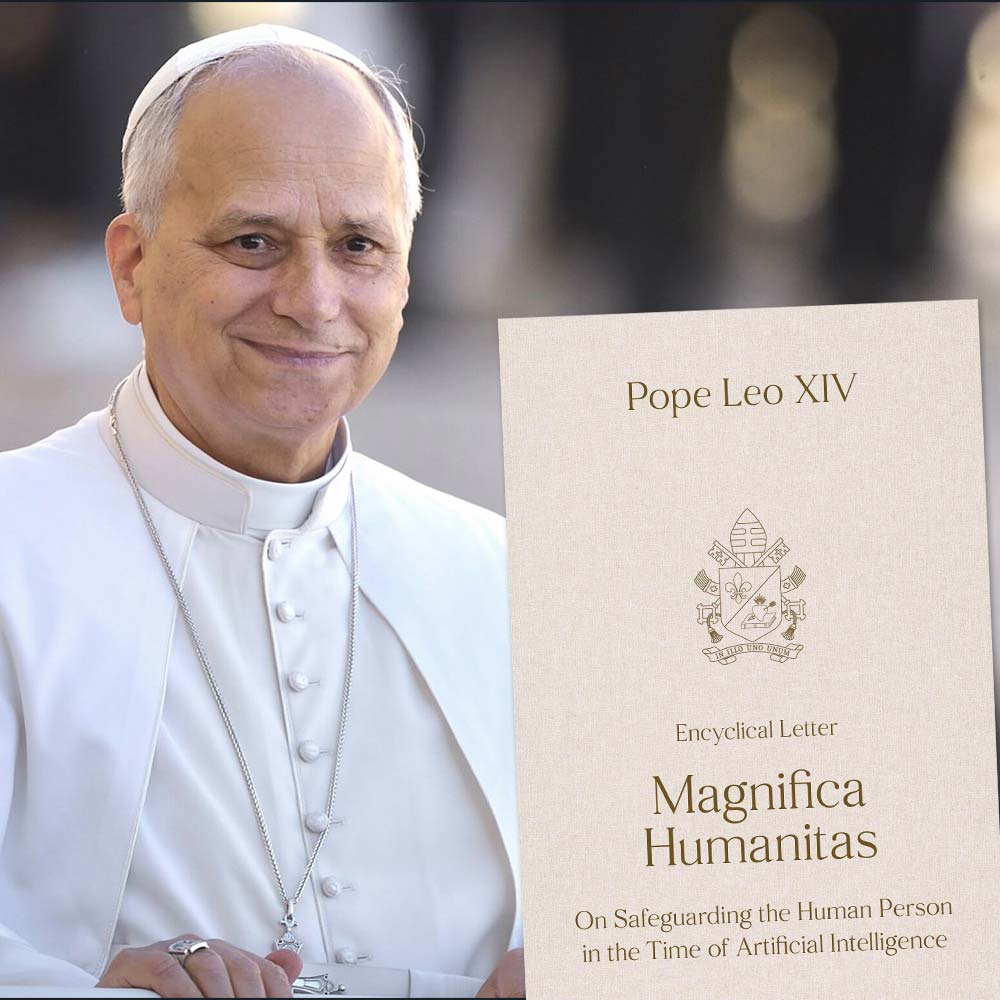
Faced with the 38000 words of Pope Leo XIV’s first encyclical — not to mention the 225 footnotes — I might have been tempted to click on the oh-so-“helpful” AI button which regularly pops up on my screen to ask: “Would you like me to summarise that for you?”
But to do so would be to fall into one of the temptations against which the encyclical warns us. So let me assure my loyal readers that I ploughed through 75 pages of A4 to bring you the reflection that follows.
Or at least part of it. After an initial introduction, my column will present two parallel threads of equal length. One will have been handcrafted by me, after lengthy reading, research of references, reflection on themes and prayerful consideration. And the other will have been generated by an AI bot (in this case, ChatGPT).
Both “authors” will be responding the same challenge: “Thinking of a South African Catholic reader of The Southern Cross, draw out a few of the main themes in the encyclical.” I will leave you to work out which is which. If you prefer the AI author, then please let the editor know and I will cede my column to a large-language model sitting in the Arizona desert.

Since this approach halves the number of words that I may use in this space, I will not attempt to summarise the document. Nor will I encourage you to resort to AI.
Instead, I urge you to turn to the English pages of the Vatican website www.humandevelopment.va, where you will find not only a thoughtful summary but also excellent resources for adults and young people, and fun infographics.
A shift in language
Before that, since this is Women’s Month, I just want to draw attention to one very important shift.
For years after it had stopped being acceptable almost everywhere else, the Vatican persisted in using the term “man” when it meant humankind. It was hardly surprising that the English translations of Benedict XVI were still doing this and, to begin with, Francis also maintained this outdated practice. But by the end of his papacy, humankind was always presented as “man and woman”.
I am relieved to see that Leo — the first pope ever to use English to draft his texts — understands that the old argument of “‘man including men and women” is now widely considered offensive, and he avoids the expression, except when quoting others.
Now, can you spot the difference between Raymond and AI? Here we go:
Version 1
A theme which really captures the challenge of Magnifica Humanitas (“Magnificent Humanity”) is that of “co-creation”. Although Leo does not use this exact expression, he does state: “Created in the image of the Creator, our own work in some way continues his, for thereby we contribute to the progress of society and the common good…” (paragraph 148).
The pope reminds us repeatedly that our human value is derived from being made in the image of God; this requires us not only to protect our own dignity but also, in solidarity, fight for the inherent dignity of every other human being.
Moreover, our value is not based on what we create — or, to use the language of capitalism, how productive we are — but on the very fact that each one of us, throughout our lives, is participating in different ways in God’s creative plan.
Creation is about both process and result. In Genesis, the Creator clearly delights in the act of creating — why else spend six days over it? — as much as in what is created (“It was good”).
Thus, as co-creators, our mission is not just to produce, like cogs in a machine or blinks in a computer, but rather to engage in the act of creation. That is what links this encyclical with the one that inspired it, written 135 years ago.
In the landmark encyclical Rerum Novarum, the previous Pope Leo (XIII) stressed that the value of the worker is not in the sale price of the goods which they produced but rather in the very creative act of manufacturing.
The present Pope Leo shows us how AI can deprive us of this co-creation. Every shortcut we take — whether we read digested news rather than trying to truly understand a situation, or we cheat in our homework by asking Claude AI to do the work for us — we are giving away an opportunity to be creative. It is not that we should never use AI, but we should remain in charge of how often we do.
Moreover, we lose the chance to be wrong. “For an algorithm, an error is a flaw to be corrected; for a person, however, an error can be a catalyst for profound change” (128). Pope Leo reminds us that we will always be better than AI, not because we are perfect but because we are imperfect and yet still loved by God. And our journey towards perfection in Christ is not one that happens with the click of a mouse but through a long and sometimes painful journey of learning about ourselves and those around us. n
Version 2
For South African Catholics, especially readers of The Southern Cross, Pope Leo XIV’s first encyclical, Magnifica Humanitas (“Magnificent Humanity”), is best understood not as a document about technology alone, but as a reflection on what it means to remain fully human in a rapidly changing world. Drawing inspiration from Rerum Novarum, which addressed the social upheavals of the Industrial Revolution, Pope Leo argues that artificial intelligence presents a similarly profound challenge today.
A central theme is the inviolable dignity of every human person. The pope warns that modern societies increasingly measure people by productivity, efficiency or economic value. Against this, he insists that every person possesses a God-given dignity that cannot be earned, bought or justified.
This message resonates strongly in South Africa, where economic inequality, unemployment and social exclusion remain pressing concerns. The encyclical reminds Catholics that people must never be reduced to data, consumers or units of labour.
A second major theme is the common good and solidarity. Pope Leo criticises the concentration of technological power in the hands of a few corporations or elites and argues that new technologies should benefit all people, especially the poor and vulnerable. He calls for international cooperation, economic inclusion and responsible governance so that technological progress narrows rather than widens existing inequalities. This echoes the long tradition of Catholic social teaching and speaks directly to the challenges facing developing nations.
The encyclical also emphasises the importance of truth, education and responsible communication. In an era of misinformation, manipulation and algorithm-driven media, the pope calls for an “ecology of communication” rooted in honesty, transparency and critical thinking. Schools, families and faith communities have a vital role in helping young people seek truth rather than merely consume information.
Finally, Pope Leo repeatedly urges humanity to choose a future shaped by relationship, compassion and peace, rather than domination and control. Technology can be a powerful tool for good, but it must never replace human responsibility, moral judgment or our capacity for love.
The question, he says, is not whether technology advances, but whether that progress serves human flourishing or the interests of power. For Catholics in South Africa, the encyclical is an invitation to place human dignity, justice and fraternity at the centre of public life in the digital age.
Neither version, the editor assures me, is stating anything that is incorrect. But could you spot which version was written by a real person and which by a bot? If so, what was the difference?

- Lessons from the Saints - October 12, 2026
- No Room for Exclusion - September 7, 2026
- Rose Calaca: The Vocation to Educate - August 18, 2026