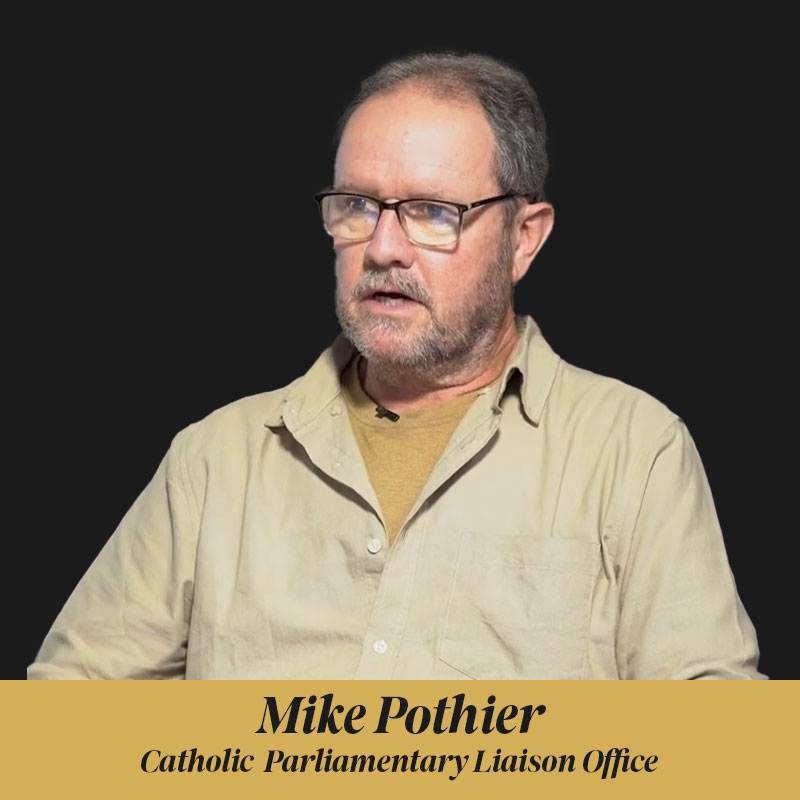
What does the Catholic Parliamentary Liaison Office actually do? As the office nears its thirtieth anniversary, Mike Pothier, its programme manager, talks to Jason Scott about how a submission is made, what the bishops wanted in 1997, and where the Church’s voice fits in a secular democracy.
Mike Pothier is the programme manager of the Catholic Parliamentary Liaison Office (CPLO), an office of the Southern African Catholic Bishops’ Conference, where he also co-ordinates the Democracy and Governance project. After the municipal elections of 4 November, The Southern Cross reported on his commentary on the coalition talks, “Seeking Political Maturity”.
Many of our readers have seen the CPLO’s name under a statement without ever being told what it is. What is the office, who does it answer to, and what does an ordinary week there look like?
The CPLO is an office of the Southern African Catholic Bishops’ Conference, established in January 1997 and reporting to the Secretary General and to a liaison bishop, currently Bishop João Rodrigues of Tzaneen diocese. CPLO’s task is to be a bridge of communication between the Church on the one hand and Parliament and government on the other. We try to ensure that the Church’s positions on important policy and legislative issues are brought to the attention of the relevant Parliamentary committees or government departments, mostly through formal submissions; and also to ensure that Church leadership is kept up to date with developments in the fields of policy, legislation and politics through the various Briefing Papers, Digests and Responses that we publish.
Our work is mostly desk-top research and writing, which we carry out from home – though we have an office at the Chancery of the Archdiocese of Cape Town, just over the road from Parliament. We also have a programme of webinars and occasional in-person panel discussions where we invite speakers to talk about a range of issues – governance, environment, refugee matters, social and economic policy, and concerns affecting women, children and the family.
Take us through one submission from start to finish. A bill is tabled: who decides the Church has something to say, who writes it, and what happens once it reaches a committee?
We focus our attention on the issues just mentioned, so the first step is to identify Bills that deal with those issues. Then, we decide whether it is something that calls for a response from the Church. We stay away from highly technical legislation and from issues on which Catholic teaching has no firm opinion. But when a matter of justice is involved, or when Catholic Social Teaching has insights to offer on the subject matter, we will always try to make a submission. The actual research and drafting is done by one of our staff members and then it is checked by myself or our Director, Fr Peter-John Pearson. If the topic is a controversial one, or one with certain sensitivities, we will refer the submission to our Bishop or to the Secretary General for guidance.
Once the written submission reaches the relevant portfolio committee we wait to hear whether we will be invited to make an oral submission and to be asked questions. That happens in a majority of cases, but not always. And then we wait again, while the Bill is debated and refined through the legislative system, and finally we hope to see at least some of our points reflected in the final product.
Which piece of legislation are you proudest of having helped change or influence, and which did the office lose?

It’s really not possible to select one piece of legislation. We have influenced many over the years, but that influence can range from a word or two here and there in a Bill, to a definition, to a fairly substantive addition to or subtraction from a Bill’s wording that significantly changes it. Readers who would like to see how the influencing process works in more detail can refer to a short piece I wrote on our experience with the controversial Expropriation Act a couple of years ago (https://cplo.org.za/wp-content/uploads/2025/02/Democracy-Digest-15-Influencing-Legislation-by-Mike-Pothier.pdf).
We have never approached our advocacy work as a question of ‘winning’ and ‘losing’, but rather as trying to contribute to better laws and policies. No organisation (or political party) gets everything it wants when it makes a submission; by the same token, we usually get something.
The office turns thirty in January. What did the bishops want it to be then, and has that changed?
The idea of forming such an office developed after the 1994 elections, as we gradually looked for a way in which the Church could respond constructively – but also critically when necessary – to the new dispensation, with its properly democratic Parliament and its rights-based Constitution. Unfortunately, it took a couple of years to develop the idea and to find funding for it, and by that time the abortion legislation had already been passed. But the Bishops made a submission on the Choice on Termination of Pregnancy Act, which was respectfully received, though predictably not followed, and I have no doubt that that experience demonstrated to them the value of having such an office.
We have not deviated from the basic principles that were set out for us when we started. We evaluate laws and policies through the lens of Catholic teaching, most often social teaching but also the Church’s moral theological stances; we remain resolutely non-partisan; we try to find and support the good in a piece of legislation as much as we criticise the bad; and we are respectful of the diversity of views that exist in a democratic society. Often, the Church’s views will coincide with those of the majority, but sometimes they will diverge and be unpopular – either way, our task is to put across those views as clearly as we can.
Fr Pearson once told the Mail & Guardian that the office is not chiefly a chaplaincy, nor a lobby in the strict sense of the word. So what is it? When the Church speaks to Parliament, is it one voice of civil society among many, or something more?
Some Bishops’ Conferences maintain a Catholic chaplaincy to their Parliament, but early on we concluded that the roles of chaplain and advocate are different. Sometimes we may strongly oppose a given party’s position on a Bill – any Catholic members of that party could be embarrassed if the head of our office was also their chaplain. In addition, there is no strong tradition here, unlike in some other African and European countries, for example, of a religious or pastoral presence in Parliament.
When we speak to Parliament we are indeed but one civil society voice; we have no privileged or special position in our very diverse secular democracy. But I would also say that we offer something unique – a moral voice that has no ideological ambitions or partisan aims, and which is informed by the Church’s unparalleled experience of human affairs, across the centuries and around the world. And guided, I hope, by the Holy Spirit.
When the Church makes a submission on a bill, is it asking the state to legislate Catholic teaching, or making an argument any citizen could accept?
We do not ask Parliament to legislate Catholic teaching, and it would be inappropriate to do so. Rather, we try to suggest provisions (or omissions) that we believe would make for a better law or policy, and which we think any reasonable person could accept as enhancing the common good.

- Mike Pothier of CPLO – Building a Bridge between Church and Government - November 24, 2026
- Theologian Corné Gieselbach interviewed - October 31, 2026
- Ten Books for Catholic Apologetics - October 26, 2026