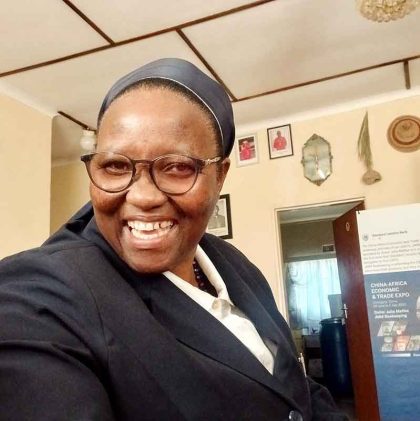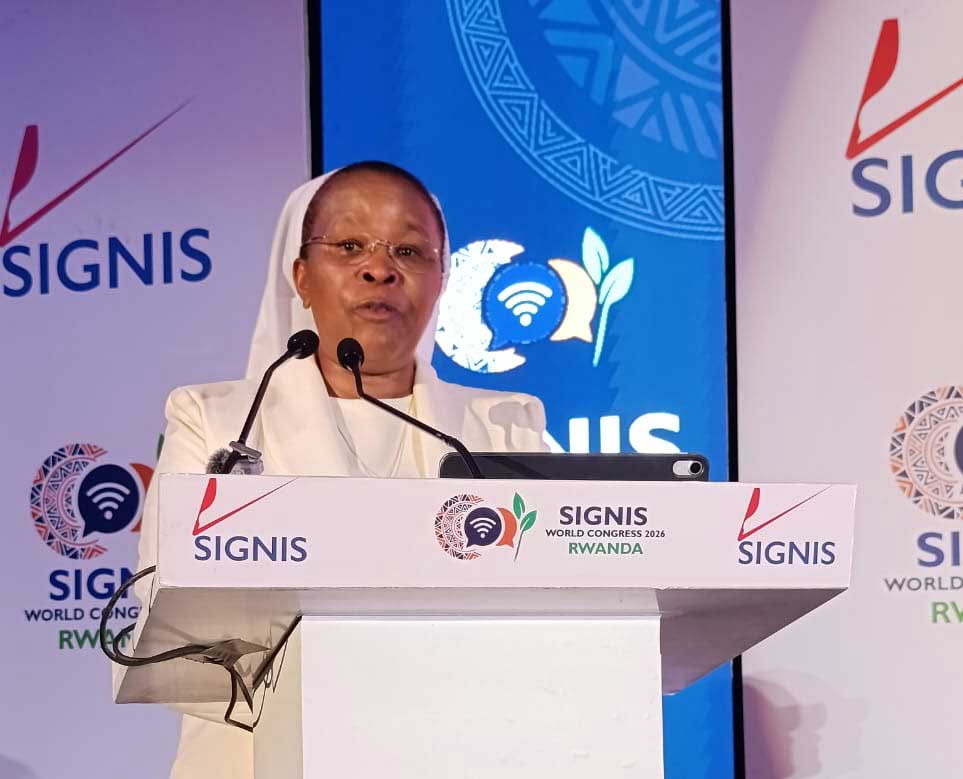
For Catholic communicators, telling stories can become a way of revealing God’s work, giving dignity to people whose voices are rarely heard and offering hope in places often defined only by suffering. This was the central message of Sr Jane Wakahiu LSOSF at the SIGNIS World Congress 2026, which took place in Kigali, Rwanda, where she called for greater efforts to amplify the voices and stories of Catholic sisters in the public square.
Sr Dr Jane, LSOSF, Associate Vice President of Program Operations and Head of Catholic Sisters at the Conrad N. Hilton Foundation, told Catholic communicators gathered for the congress that storytelling can be a “Gospel imperative”.
Her reflection came during the historic SIGNIS World Congress, held in Kigali from August 3-8 under the theme “Digital Communication for Cultural Harmony and Environmental Wellbeing”. The gathering brought together Catholic communicators, journalists, producers, filmmakers, digital communicators, researchers, academics and Church leaders from around the world.
The 2026 congress marked the first time in SIGNIS’ history that its World Congress was held on African soil.

For Sr Jane, the setting was particularly significant. Her reflection connected the global mission of Catholic communication with the often unseen work of women religious who serve communities at the margins.
A historic gathering in Africa
The choice of Kigali was more than a geographical milestone. Since its first World Congress in Rome in 2001, SIGNIS has taken its global gatherings to different parts of the world, including Europe, Asia and North America. The 2026 congress in Rwanda therefore represented an important moment for Africa and for the global Catholic communications community.
SIGNIS World President Fr Walter Chikwendu Ihejirika described the congress as particularly significant for the continent, saying it represented the growing role of Africa in the life and mission of the Church. Kigali was also a fitting location for conversations about communication, peace and reconciliation. Rwanda’s history has demonstrated both the destructive power of communication and its potential to contribute to healing and rebuilding. It was against this backdrop that Sr Jane placed storytelling at the centre of her reflection.
“Communication as God’s relationship with humanity”
During her presentation, Sr Jane began with a theological understanding of communication.
“Communication is not simply the transmission of information,” she said. Rather, it is woven into God’s relationship with humanity because it “creates, reveals, calls and gives life”. She pointed to Scripture, from the creation account in Genesis to the opening of John’s Gospel, to show that God’s relationship with humanity is itself communicated through the Word. Jesus, she said, remains the model for Christian communicators.
The encounters between Mary and the angel Gabriel, and between Mary and Elizabeth, further demonstrate that communication is not only about the words being spoken, but also about the way a message is conveyed and the response it evokes. She adds that this means asking not only, “What are we saying?” but also “How are we saying it and What does our communication make possible in the lives of those who receive it?”
From Pentecost to the digital world
Sr Jane connected this understanding of communication with the experience of Pentecost. The Holy Spirit did not erase the differences between people and languages. Instead, people from different nations were able to hear the Good News in their own languages. “Communication became the bridge that transformed diversity into communion,” she said.
That image of communication as a bridge is particularly relevant in today’s digital environment, where people from different cultures and continents can encounter one another instantly. But greater connectivity does not automatically lead to greater communion. The challenge is to use these platforms in ways that build understanding rather than division, and solidarity rather than suspicion. At the heart of this mission is storytelling. “Storytelling is never merely about publicity,” Sr Jane said. “It is an act of service to the Gospel.”
Telling stories that give hope
One of the strongest themes in Sr Jane’s reflection was the responsibility of communicators to tell stories of hope. She acknowledged that journalism and communication must expose injustice, corruption, conflict and suffering. But she cautioned that if these become the only stories told, audiences are left with an incomplete picture of reality. “Our task is not to deny the darkness,” she said. “Our task is to reveal the light that continues to shine within it.”
She illustrated this through the story of a young woman whose life had been marked by hardship. Married at the age of 13 to settle a debt, she became a mother of three by the age of 18 and was later abandoned without resources or support. When Catholic sisters encountered her, they did not see only her circumstances. They asked her a question she had apparently never been asked before: What is your dream? She wanted to become a beautician so that she could make other people feel beautiful.
With the support of the sisters, she received training, rebuilt her life and eventually established a small business. Her children went to school, she had a home and her future was no longer defined by her past. Sr Jane alluded that this is what hope looks like when it is lived rather than merely spoken about.
The story also illustrates the distinctive ministry of Catholic sisters: accompanying people until they are able to imagine a future again.
Giving a voice to those on the margins
Sr Jane urged communicators to place people at the margins at the centre of their storytelling. Through the Pentecost Project, implemented by the Vatican’s Dicastery for Communications, and the Wisdom Calls pilot project implemented by SIGNIS, Catholic sisters are being equipped and encouraged to share their stories and experiences.
Around the world, sisters teach children who might otherwise have no access to education. They care for the sick in places where healthcare systems are weak or have collapsed. They accompany migrants and refugees, support survivors of trafficking and violence and remain with communities affected by poverty, conflict and natural disasters. Yet Sr Jane cautioned against reducing their work to social services alone. Their ministries, she said, are ultimately expressions of the Gospel. “Every classroom, every clinic, every counselling session, every visit to a refugee camp, every act of accompaniment is ultimately an expression of the Gospel,” she said.
“Humility should never become invisibility”
One of the most striking lines in Sr Jane’s reflection was her observation that “humility should never become invisibility”. Catholic sisters have traditionally not sought the spotlight. Their vocation calls them to humility and service rather than recognition. But their reluctance to seek publicity should not mean that their stories disappear. “When their stories remain untold, the public square becomes poorer,” Sr Jane said.
The issue is therefore not about making religious women celebrities. It is about ensuring that the public conversation reflects the full reality of the Church’s mission. Pope Leo XIV’s reminder that communicators “need faces and voices to speak for people again” resonated with Sr Jane’s message. Catholic sisters can give a human face to the Gospel, particularly among communities that are easily reduced to statistics. The task of the communicator is to ensure that those faces are not forgotten.
Communication as an act of love
Sr Jane ultimately described storytelling as an act of love. Drawing on the words of Conrad N. Hilton, she reflected on the danger of another form of poverty: the poverty of invisibility. People can be materially poor, but communities can also suffer when their experiences, achievements and dignity remain unseen. “Storytelling becomes an act of love when it refuses to leave people in that darkness,” she said. “It becomes an act of justice when it gives voice to those who are rarely heard.” For Catholic media, this carries a profound responsibility. The Church’s communicators are called to do more than report events. They are called to discern where the Holy Spirit is already at work and to recognise wisdom where the world may see only obscurity. This, she states, requires a willingness to move beyond the stories that are easiest to tell towards the stories that most need to be heard.
A Pentecost mission for Catholic communicators
Concluding her message, Sr Jane mentioned that the digital age gives the Church unprecedented opportunities to reach people across languages, cultures and geographical boundaries.
But technology alone cannot create communion. When practised with faith, truth and love, communication itself becomes a ministry. And when the stories of those who serve quietly are heard, the Church becomes more visible, not because communicators put the spotlight on themselves, but because those stories reveal Christ already present among his people.

- Bishop Nyandoro calls on religious leaders to defend human dignity and advocate for peace - October 14, 2026
- Father Chaka Motanyane: Support Matrics 2026! - October 13, 2026
- SECAM Seeks African Participation in World Youth Day 2027 - September 24, 2026