An Indian Catholic journalist said his new documentary film about Mother Teresa is an attempt to show the “prophetic path of compassion” she laid out for the world through the Missionaries of Charity, while also challenging what he describes as “canards” about her work and motives.
Anto Akkara, a senior journalist who has in the past also written for The Southern Cross, produced Mother Teresa – Prophet of Compassion, a 66-minute international documentary tracing the saint’s work from her early years in India through the global expansion of the congregation she founded in 1950. The film includes accounts from India and abroad, as well as testimonies about Mother Teresa’s work among the destitute, people with disabilities and mental illness, leprosy patients and orphans.
The film is available on YouTube (see video at the end of the article).
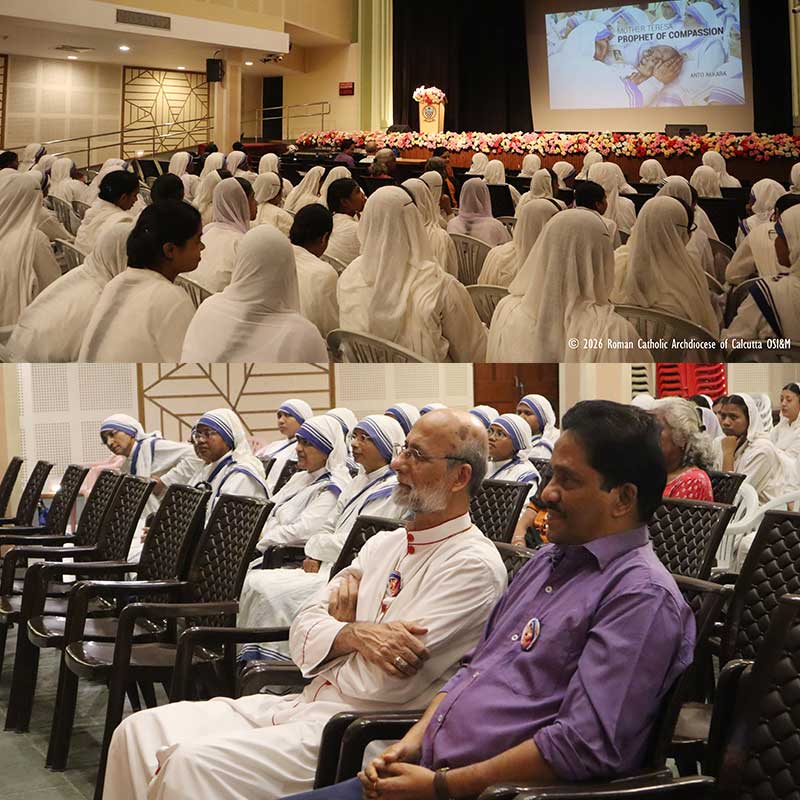
The documentary’s premier in Kolkata was presided over by Archbishop Elias Frank of Kolkata before an audience of more than 200 people, including dozens of Missionaries of Charity nuns and novices.

Archbishop Frank praised Akkara’s “passion” for making Mother Teresa better known. “There are things that we may not even know yet,” he said, noting that Akkara had highlighted events through what he described as “journalistic eyes”.
He also praised the journalist’s determination to complete the project after a computer hard drive crashed, wiping out vital work at a critical stage.
Akkara said his association with Mother Teresa began when he was 33 in 1995, and she gave him a comprehensive interview.
75th Anniversary of the Missionaries of Charity
When the Missionaries of Charity marked the 75th anniversary of their foundation, Akkara proposed making the documentary. The congregation agreed to his initiative.
The documentary expands on an earlier Indian version. Akkara said he had overhauled the film with new material, including accounts tracing Mother Teresa’s footsteps in Patna in 1948, Jharkhand in 1959 and New Delhi in 1961.
Among the international stories incorporated into the new version are the killings of Missionaries of Charity nuns in Yemen in 1998 and 2016, the expulsion of the congregation from Nicaragua, and the decision by the Sisters to remain in Gaza and Ukraine amid bombardment by Israel and Russia respectively.
The documentary also includes testimony from the photographer Raghu Rai and an account of former Indian prime minister Jawaharlal Nehru’s appreciation of Mother Teresa when he inaugurated a new Shishu Bhavan building in New Delhi.
Akkara said the film also addresses allegations that Mother Teresa used her charitable work as a means of conversion. He argued that such claims have been used to tarnish her reputation, and emphasised the breadth of support she received during her lifetime.
Details of Mother Teresa’s Life
Mother Teresa, born Anjezë Gonxhe Bojaxhiu in present-day North Macedonia in 1910, came to India as a Loreto Sister in 1929 and founded the Missionaries of Charity in 1950. According to Akkara, the congregation now operates in 138 countries, with 5,076 nuns serving through 754 homes.
The film highlights lesser-known episodes from Mother Teresa’s life, including the weaving of the blue-striped white saris worn by Missionaries of Charity Sisters by people affected by leprosy at the Titagarh centre dedicated to Mahatma Gandhi.
It recounts how she persuaded the Indian Air Force to plant trees at the congregation’s leprosy home in Delhi and how she declined an invitation from Pope John Paul II to attend the 1993 World Youth Day in Denver in order to travel instead to Borduria in Arunachal Pradesh, where she sought to prevent the killing of infants born with deformities.
Another episode concerns a raffle organised to raise funds for a leprosy hospital at Shanti Nagar after Pope Paul VI gave Mother Teresa his mobile telephone following the 1964 World Eucharistic Congress in Mumbai.
The documentary also records tributes from former Indian president Abdul Kalam and former prime ministers Inder Kumar Gujral and Atal Behari Vajpayee. It recounts how Mother Teresa named her Missionaries of Charity centre in a suburb of Ranchi “Radharani Convent” in honour of a Hindu woman who donated land for a leprosy home in 1973.
Former West Bengal chief minister Jyoti Basu, a Marxist who knew Mother Teresa, is quoted describing her influence on him: “This lady makes me a bad Marxist, making me believe in godliness.”
Akkara said the documentary is intended not simply as a record of Mother Teresa’s life but as an exploration of the “prophetic path of compassion” represented by her work and continued by the Missionaries of Charity.


- Walking in the footsteps of Blessed Joseph Gérard: Missionary Associates renew their missionary call - October 15, 2026
- Congratulations to Navi Pillay on Peace Prize - October 14, 2026
- 170 Years of Serving the Poor in South Africa! - October 14, 2026