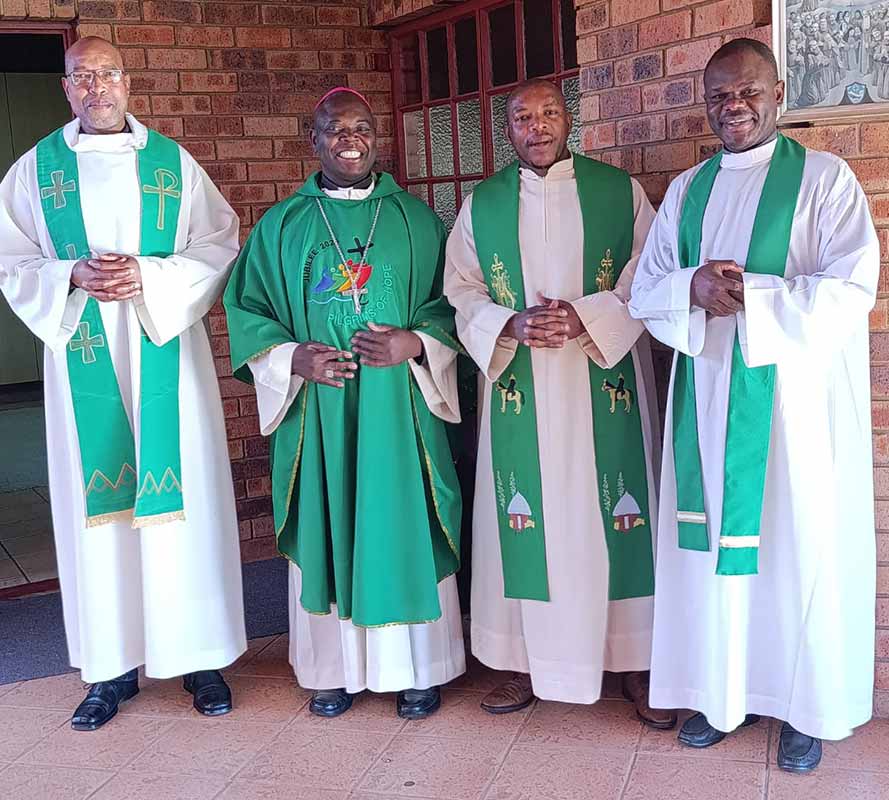
Religious and lay leaders must go beyond prayer and take an active role in advocating for human dignity, peace and justice across the region, Bishop Rudolph Nyandoro said during the opening Mass of the IMBISA Justice and Peace workshop on 13 October 2026.
Presiding over the Mass, Bishop Nyandoro of Gweru Diocese, Zimbabwe, reflected on the theme of the workshop, “Empowering Religious Leaders to Engage in the Advocacy of Socio-Political, Economic and Environmental Issues in the IMBISA Region.” During his homily, he challenged participants to recognise that their Christian mission extends beyond the Church and calls them to respond to the challenges affecting communities across Southern Africa.
Drawing on the words of St Paul in the first reading, “For freedom Christ has set us free,” the bishop said Christian freedom should not be understood only as freedom from sin, but also as freedom from anything that undermines human dignity.
“I think we have come for this workshop to be empowered to advocate for freedom, to respect the dignity of the human person,” he said.

Bishop Nyandoro emphasised that the workshop offered an opportunity for religious leaders to strengthen their ability to speak out against injustices and promote conditions in which people can live with dignity and freedom.
Poverty, inequality and corruption require a response
The bishop highlighted poverty, unemployment, inequality, corruption and political instability as some of the challenges confronting countries across the IMBISA region. He urged participants to pray for those affected while also equipping themselves to advocate for meaningful change.
He stressed that religious leaders have a responsibility to contribute to peacebuilding, particularly in countries experiencing conflict and insecurity.
Reflecting on the situation in Cabo Delgado in Mozambique, Bishop Nyandoro spoke about the suffering of displaced communities and the insecurity experienced by both local residents and those visiting affected areas.
He recalled visiting camps housing people displaced by violence, describing the pain of families who had lost loved ones, children who had become orphans and people who had been forced to leave their homes. The bishop said the suffering of these communities should move religious leaders to deepen their commitment to peace, solidarity and advocacy.
“We need to pray and to live a life of peace,” he said, reminding participants that the pursuit of peace must be reflected in their own lives and their engagement with others. His homily highlighted the importance of the Church’s presence in communities affected by violence, where religious leaders can offer spiritual support while also drawing attention to the needs and rights of vulnerable people.
Environmental destruction demands attention
Bishop Nyandoro also raised concerns about environmental degradation, drawing from his experience in Zimbabwe, where he said extensive mining activities were damaging mountains and affecting roads and surrounding infrastructure. He described how landscapes that were once mountains had been flattened by mining, raising questions about the environmental and social consequences of resource extraction. His observations reinforced the need for religious leaders to include environmental protection in their advocacy, particularly where economic activities affect communities and the natural environment.
Advocacy must begin with personal conversion
Reflecting on the Gospel reading, in which Jesus challenges a Pharisee who is concerned about external cleanliness while neglecting what lies within, Bishop Nyandoro urged participants to examine their own hearts before seeking to correct the world around them. He cautioned that workshops and training would have limited impact if religious leaders failed to practise the values they were promoting.
“We may have workshops like this, but if we are not clean inside, it may not be impressive for others,” he said.
The bishop added that effective advocacy begins with integrity, humility and a genuine commitment to peace and love. Religious leaders must ensure that their words and actions reflect the values they encourage in others. He encouraged participants to use the workshop as an opportunity for spiritual renewal, building relationships grounded in mutual respect and strengthening their commitment to serving their communities.
During the first session after the opening Mass, Bishop Tonito José Francisco Xavier Muananoua, the auxiliary bishop of the Archdiocese of Maputo in Mozambique and regional representative, officially welcomed delegates to the workshop. In his welcome address, the bishop stated that the themes guiding the workshop, including economic justice, social inclusion, democratic consolidation, and integral ecology, are not merely academic topics, but vital challenges for the future of our communities and of the region itself. “We live in a region rich in resources and diversity, yet also scarred by inequalities, xenophobia, conflicts, fragile democracies, and the severe impacts of climate change. These challenges demand from us not only careful analysis, but above all, profound reflection, prophetic courage, and a spirit of solidarity expressed in joint action,” he said, adding, “may this workshop be lived as a true laboratory of communion and transformation, where faith is translated into action and action becomes testimony.” Concluding his address, he appealed to the delegates not to be afraid to dream of a Southern Africa where justice flourishes, peace endures, and creation is respected. “May this workshop be yet another catalyst of our prophetic courage, so that together, in mutual recognition, we may face the challenges of the region with faith, hope and love.”
In a virtual address, Sister Alessandra Smerilli FMA, who assumed her office as prefect of the Dicastery for Promoting Integral Human Development on 1 September, called on Church leaders present at the workshop to defend human dignity through advocacy, collaboration and courageous dialogue. She emphasised three key actions: see, build and speak to recognise the dignity of people affected by human trafficking, migration and poverty, work together across the nine IMBISA member countries to promote justice and peace and raise their voices against injustice through dialogue rather than division. Addressing the issue of migration and xenophobia, Sister Smerilli referred to Pope Leo XIV’s emphasis on how societies treat migrants and refugees as a test of social justice. She challenged participants to consider whether their responses to vulnerable people are driven by fear or by fraternity.
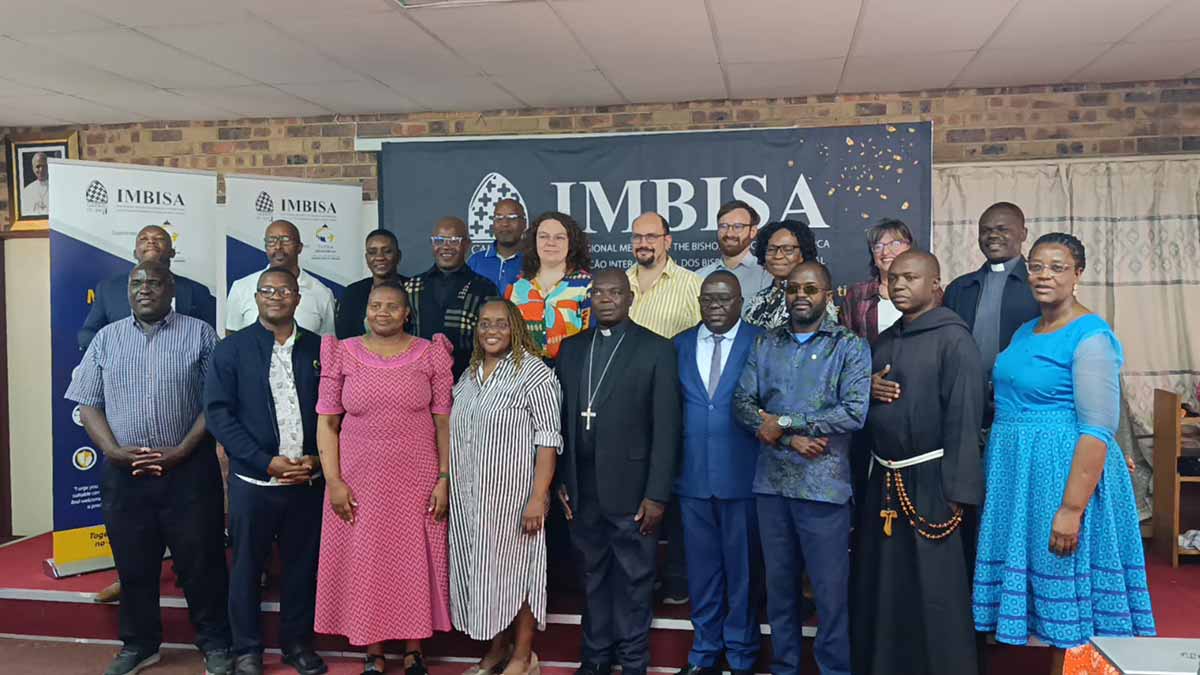
The workshop began on Tuesday, 13 October 2026, at Padre Pio Retreat Centre in Pretoria, and will end on Friday, 16 October 2026. Sixteen religious leaders and lay people actively involved in Justice and Peace in countries, including Zimbabwe, Lesotho, Eswatini, Angola, Mozambique, São Tomé and Príncipe, Botswana and South Africa, have gathered to be workshopped on ways to strengthen their role in addressing the social, political, economic and environmental challenges facing the IMBISA region, ensuring that the Church’s mission of promoting human dignity, justice and peace translates into meaningful action.
Some of the topics that will be discussed throughout the week include economic justice and natural resources; xenophobia, human trafficking, media and human rights; post-election resilence and democratic consolidation; and climate change environmental justice and food insecurity.
Imbisa [The Inter-Regional Meeting of the Bishops of Southern Africa] was officially constituted in 1978 following preparatory meetings in Rome (1974) and Pretoria (1975), with its first general assembly held in April 1975 at Saint John Vianney Seminary in Pretoria. It represents nine countries grouped into six episcopal Conferences, including CEAST (Angola and São Tomé and Príncipe), LCBC (Lesotho), CEM (Mozambique), NCBC (Namibia) and SACBC (Botswana, Eswatini, South Africa) and ZCBC (Zimbabwe).

- Bishop Nyandoro calls on religious leaders to defend human dignity and advocate for peace - October 14, 2026
- Father Chaka Motanyane: Support Matrics 2026! - October 13, 2026
- SECAM Seeks African Participation in World Youth Day 2027 - September 24, 2026