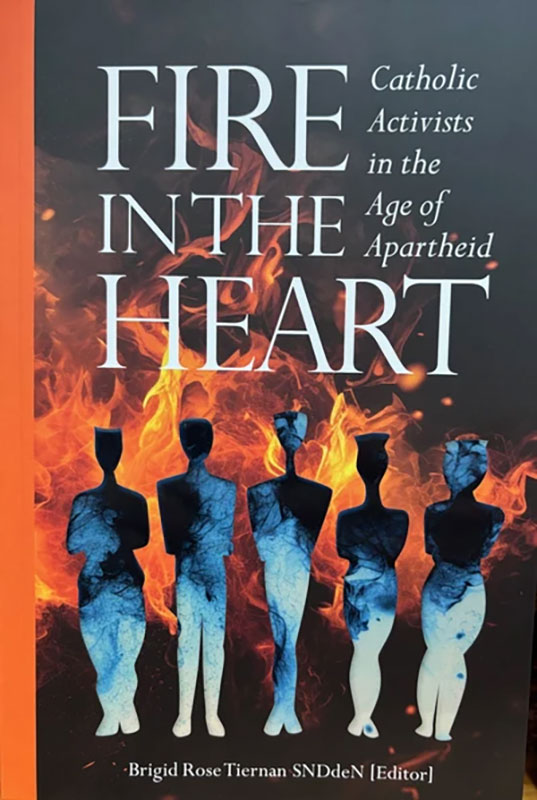
The contribution of Catholic lay men and women to South Africa’s struggle against apartheid has been captured in a new publication, Fire in the Heart: Catholic Activists in the Age of Apartheid, launched at Holy Family College (HFC), also known as Parktown Convent, in Johannesburg on Saturday, 14 November.
Published by the University of Johannesburg Press (UJ Press), the book is edited by Sister Brigid Rose Tiernan (SNDdeN), of the Sisters of Notre Dame de Namur. Cardinal Stephen Brislin, Archbishop of Johannesburg, wrote the foreword.
The book profiles approximately 25 Catholic lay men and women from across the country who participated in the struggle against apartheid in various capacities.
Among those featured are prominent anti-apartheid activists Dr Fabian Ribeiro and his wife, Florence Ribeiro; Tom Manthata and his wife, Barbara Manthata; Drake Koka; and Catholic journalist Sydney Duval.

Unlike many other publications documenting anti-apartheid activists, Fire in the Heart also profiles couples who were involved in the struggle together. These include Frankie and Tony Connell, Wladimir and Barbara Ledochowski, and Eric and Jean Tyacke and a few more. Their inclusion highlights the contribution of couples who shared a commitment to justice and the fight against apartheid, often making sacrifices together in pursuit of a democratic South Africa.
Sister Brigid Rose Tiernan was the first main speaker at the launch. She traced the origins of the project and explained the need to document the experiences of Catholic activists whose contribution to the liberation struggle might otherwise be overlooked.
“We felt there was a need to document the stories of Catholic lay men and women who played an important role in the struggle against apartheid, ensuring that their contribution is not forgotten,” she said.
The launch also heard from family members of some of those profiled, who shared personal accounts of their relatives’ involvement in the anti-apartheid struggle.
Among them was a member of the Manthata family and Theophilus Hlalethwa, son of Deacon Hans Ramaphakeng Hlalethwa, who was actively involved in the struggle against apartheid in Soshanguve, north of Pretoria.
Hlalethwa spoke about his father’s involvement and the role played by the family in the resistance movement during the 1980s.
“My father was not only involved in the anti-apartheid struggle as an individual. We were involved as a family. He took the lead, and alongside the priest present here, Father Smangaliso Mkhatshwa, they waged a just war against apartheid in Soshanguve. They fought in the Church and in the broader community. I thank the Sisters for Justice for documenting this very important history, so that future generations will know what it took for us to be here,” he said.
His account highlighted the personal sacrifices made by families whose lives were shaped by their involvement in the struggle, often alongside priests and other members of their communities.
The keynote address was delivered by Catholic priest and anti-apartheid struggle veteran Fr Smangaliso Mkhatshwa, who reflected on the role of the Church and its members in opposing apartheid.
Father Mkhatshwa was among the prominent Catholic clergy involved in the liberation struggle. He was detained by the apartheid government following the 1976 Soweto uprising and later subjected to banning restrictions. He subsequently served as secretary-general of the Southern African Catholic Bishops’ Conference (SACBC) and became involved in the United Democratic Fron (UDF). In democratic South Africa, he served as Deputy Minister of Education before becoming Executive Mayor of Tshwane.
Addressing the launch, Fr Mkhatshwa highlighted the sacrifices made by Catholic laypeople, clergy and the wider Church in standing alongside those oppressed by apartheid.
“The Catholic Church was among the few churches that stood firmly with the oppressed during apartheid. Its members made enormous sacrifices, both individually and collectively, in the fight against injustice. However, the struggle does not end with the attainment of democracy. Many of the conditions that people fought against during apartheid remain with us today. Poverty, inequality and social injustice continue to affect our people. The Church must therefore continue to play its part, standing alongside the oppressed, defending human dignity and speaking out against injustice,” he said.
He called attention to the continuing relevance of the Church’s social responsibility, arguing that the conditions which prompted resistance to apartheid have not all been resolved and that the Church must remain engaged in addressing contemporary injustices.
With approximately 25 profiles, Fire in the Heart brings together individual stories of courage, faith and commitment from different parts of South Africa. It documents a dimension of the liberation struggle in which ordinary Catholic men and women, alongside religious leaders, used their faith and convictions to challenge an unjust system.
The publication seeks to ensure that their experiences are preserved for future generations and that the contribution of Catholic activists remains part of the country’s historical record.

- New book documents Catholic contribution to anti-apartheid struggle - November 17, 2026
- Catholics bring faith perspectives to SA’s electoral process - November 6, 2026
- Two Catholic leaders join hands in ensuring elections readiness - November 2, 2026