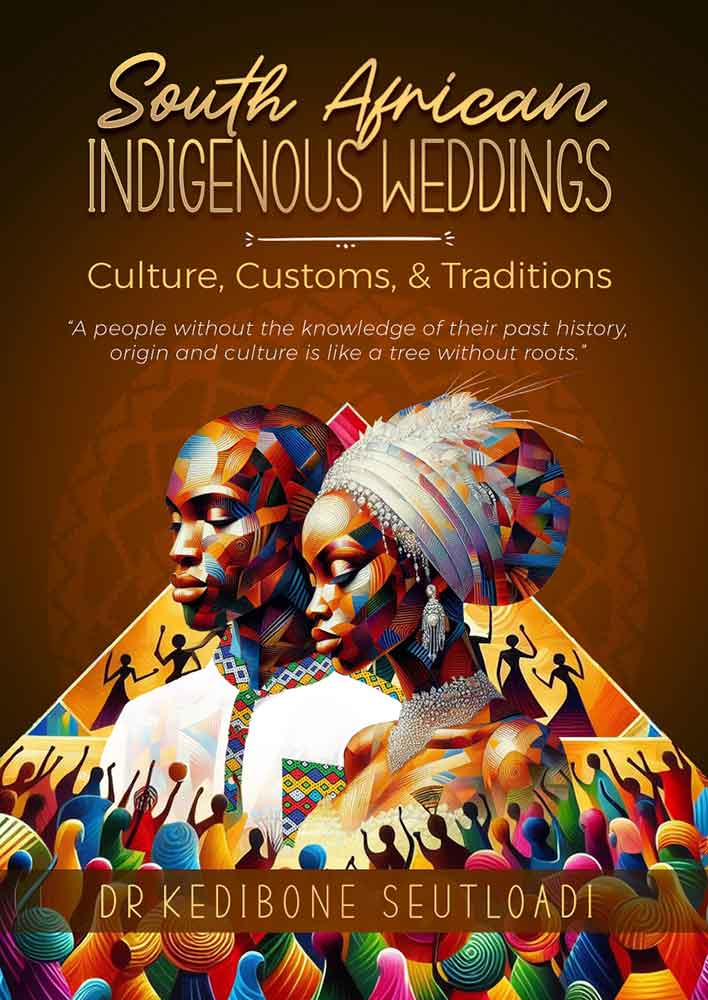
 Book Review: South African Indigenous Weddings — The Culture, Customs and Traditions by Dr Kedibone Seutloadi.
By Daluxolo Moloantoa – In a chapter of the book Masusumetsa – Fr Michele D’Annucci Css: Tributes To A Martyr Of Charity, a biography on the late Catholic missionary Fr Michele D’Annucci written by the author of this review, it is stated that among the Italian priest’s significant pioneering works in the Archdiocese of Pretoria — particularly in the northern Pretoria black areas of Ga-Rankuwa, Mmakau, and Mabopane — was his leadership in the ministry of marriage counselling. The book reads:
“Fr Michele (best known by the English version of Michele as Fr Michael D`Annucci) was a marriage enthusiast. He was very passionate about the importance of marriage, and the consequences thereof from a Catholic standpoint. He set in motion the family apostolate movement, with preparation and marriage enrichment courses for couples wishing to give serious meaning to their vocation. In 1981, together with two Ga-Rankuwa couples — Mr James and Mrs Beauty Seutloadi, and Mr Cleophus and Mrs Eleanora Vilakazi — Fr Michele founded the Marriage Preparation Course, which would later evolve into the Catholic Engaged Encounter. The course was presented over weekends, three times a year, at the Most Holy Redeemer Mission in Mmakau Village, north-west of Pretoria. At the parish level, it was administered by Mr William and Mrs Suzan Motsepe at Maria Mater Ecclesiae (MME) parish in Ga-Rankuwa Zone 4. The course was inspired by St Paul’s exhortation:
“With all humility and gentleness, with patience, bearing with one another in love, eager to maintain the unity of the Spirit in the bond of peace.” — Ephesians 4:2–3

This historical background provides a fitting prelude to South African Indigenous Weddings: The Culture, Customs and Traditions by Dr Kedibone Seutloadi — the daughter of that same Seutloadi couple. Indeed, the apple has not fallen far from the tree. Raised by parents who were among the pioneers of Catholic marriage preparation in South Africa, Dr Seutloadi has built on her family’s legacy by documenting, with both scholarly depth and heartfelt reverence, the sacred institution of marriage as it unfolds in African traditional life.
The book is an expansive and meticulously researched study of wedding traditions among ten South African cultural groups — the Khoisan, Pedi, Sotho, Tswana, Ndebele, Swati, Tsonga, Venda, Xhosa, and Zulu. Dr Seutloadi explores these ceremonies not merely as social events but as profound cultural texts — repositories of history, identity, and communal spirituality. While each culture has its unique customs, one of the book’s great strengths lies in its demonstration of shared values that run through all. Across these traditions, marriage is never just a private affair; it is a covenant that binds families, ancestors, and the living community together. Lobola or magadi, in its various forms, emerges as a unifying element — not as a “purchase” but as a gesture of respect and gratitude to the bride’s family, affirming the sanctity of union and mutual recognition.

Dr Seutloadi vividly portrays how the Khoisan’s simplicity, expressed through open-air ceremonies and ancestral dances, contrasts with the structured negotiations and rites of passage observed by the Pedi, Sotho, and Tswana. Among the Khoisan, the union of two people is celebrated under the vast sky — symbolising openness, equality, and the presence of the ancestors. Storytelling, music, and shared meals connect generations in a circle of joy and remembrance. Their weddings are not about grandeur but about reaffirming the community’s bond with the earth and the spirit world, reflecting the Khoisan worldview that life itself is a sacred dance of interconnection.
In contrast, the Pedi, Sotho, and Tswana traditions unfold with careful formality and deep symbolic gesture. Negotiations between families — the presentation of magadi or bogadi — are carried out with diplomacy and mutual respect, marking the moment when two families become bound in kinship. The bride’s journey from her home to her husband’s village is filled with ritual: washing of the hands, the sharing of traditional beer, the exchange of blessings, and songs that counsel patience, endurance, and harmony. Dr Seutloadi captures these moments with both admiration and scholarly precision, showing how every stage of the marriage process — from proposal to post-wedding ceremonies — reinforces the community’s moral and social fabric.
The Ndebele weddings, she notes, are a feast for the eyes — a marriage of art and identity. The bride’s attire, crafted from intricate beadwork and adorned with brass rings, symbolises continuity, beauty, and strength. The painted murals on homestead walls are not mere decorations but sacred expressions of womanhood and family lineage. The Ndebele wedding is a living gallery of symbolism: the colours, patterns, and movements all narrate a story of unity, respect, and transformation.
Among the Swati, the pageantry reaches royal proportions. Weddings such as the umtsimba extend over several days and involve entire villages. The bride’s arrival, escorted by dancers and singing maidens, is a celebration of womanhood and ancestral blessing. Each step of the ritual — from the presentation of gifts to the sharing of meals — is choreographed with spiritual significance. The Swati see marriage as both a personal joy and a communal affirmation of cultural identity, ensuring that even the humblest of unions reflects the dignity of a nation’s heritage.
The Venda and Tsonga customs bring music and storytelling to the forefront. Dr Seutloadi writes with warmth about how traditional songs, performed in rhythmic unison, narrate the couple’s journey and convey moral wisdom to the younger generation. Drums, ululations, and call-and-response songs serve not only to celebrate but also to teach — reminding all present that marriage is a sacred trust that demands respect, compassion, and perseverance.
Xhosa and Zulu traditions, with their majestic umembeso and ukuthwala ceremonies, stand out for their balance between pride, discipline, and ancestral reverence. The umembeso involves the offering of gifts by the groom’s family to the bride’s family, symbolising gratitude and goodwill. The rituals are filled with music, traditional dress, and the fragrance of burning herbs to invite ancestral blessing. The Zulu’s ukuthwala, often misunderstood outside its cultural context, represents a symbolic gesture of uniting two families under the guidance of elders. Both cultures hold steadfast to the belief that marriage honours the lineage of those who came before — that the ancestors must be invoked and pleased for the union to be fruitful.
Through these detailed portrayals, Dr Seutloadi affirms that beauty in marriage lies not only in outward ceremony but in the meaning embedded within. Across all these cultures, the wedding is a covenant that bridges the visible and the invisible worlds — a spiritual dialogue between the living, the ancestors, and God. Whether simple or elaborate, each ritual act becomes a thread in the tapestry of communal memory, ensuring that love, respect, and continuity remain the pillars of African life. Her narrative resonates particularly with those aware of the transformative work of pioneers like Fr D’Annucci and the Seutloadi couple — whose marriage apostolate sowed seeds of understanding between cultural heritage and Catholic Teaching. Indeed, one senses that Dr Seutloadi’s insight into the heart of marriage comes not from theory alone but from the lived example of her parents’ enduring union — a marriage built on faith, mutual respect, and service.
While South African Indigenous Weddings is both comprehensive and heartfelt, one area that could have further enriched the book would be a deeper comparative discussion of how these traditional marriage practices have evolved within modern South Africa — particularly in urban and diasporic contexts. The text masterfully documents traditional rituals in their authentic forms, yet it leaves readers curious about how younger generations are blending ancestral customs with contemporary lifestyles and faith practices. For instance, exploring how inter-ethnic marriages are negotiated today, or how couples reconcile traditional lobola customs with civil and church ceremonies, would have provided valuable insight into the living, adaptive nature of these traditions. Similarly, testimonies or reflections from modern couples who strive to honour their roots while navigating modern realities — career mobility, gender equality, and global influences — could have added a dynamic sociological layer to the book’s cultural richness.
It is no exaggeration to say that the author’s foundation as a child of a strong Catholic couple profoundly shaped her perspective. Her parents’ marriage — blessed by faith and strengthened by service — becomes a living model of the Holy Sacrament of Matrimony, which has upheld families through generations and remains a testament to love’s endurance. In South African Indigenous Weddings: The Culture, Customs and Traditions, Dr Kedibone Seutloadi has written more than an ethnographic study; she has written a love letter — to her people, her faith, and her parents’ example. She reminds readers that the future of African marriage depends not on choosing between tradition and religion, but on harmonising them — so that, as in the marriages of old, love remains both sacred and communal, eternal and blessed.
For further details about the book, please contact the author Dr Kedibone Seutloadi at:
Cell/WhatsApp: 082 878 8375
Facebook: Kedibone Seutloadi
Instagram: DrKediBones

- A Final Appeal: Help Take Sister Julia’s Bees to Rome - October 19, 2026
- Take Sister Julia’s bees to Rome - October 12, 2026
- A Catholic Journey to the Sacrament of Marriage - October 3, 2026