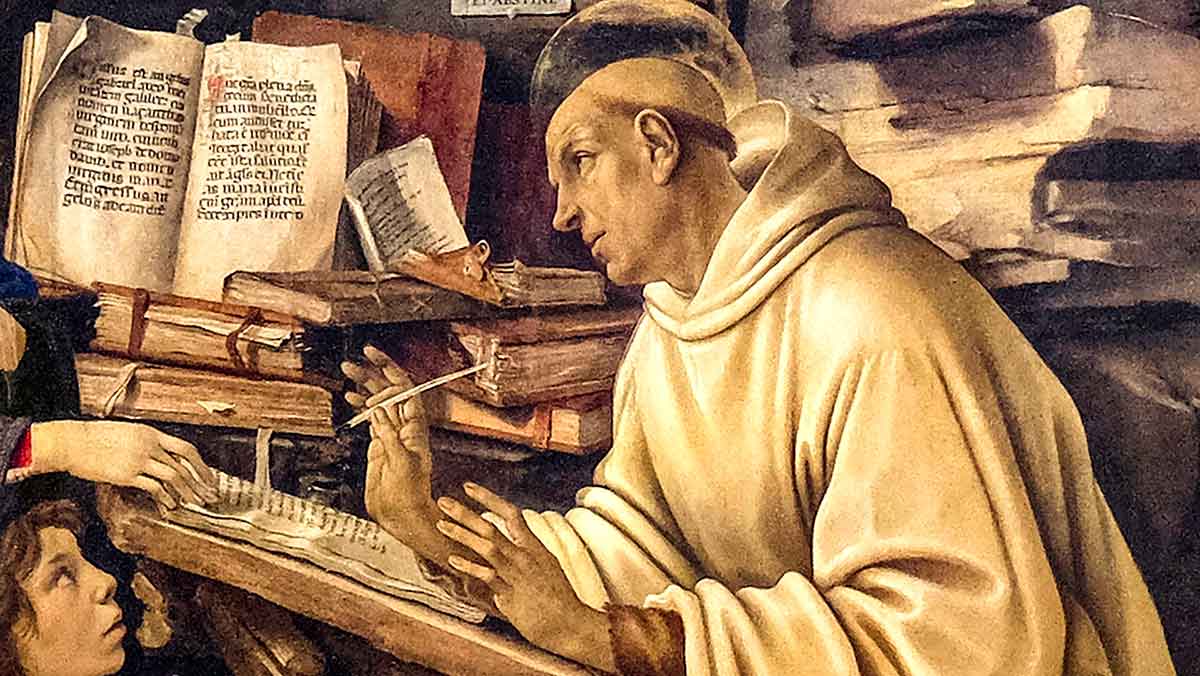
More than 800 years after his death, St Bernard of Clairvaux remains a hugely influential figure in our faith. This is his life.
Saint Bernard of Clairvaux was a 12th-century monk who helped to build up the Cistercian order — some of whose members are today known as the Trappists, the order to which Abbot Franz Pfanner belonged when he and his companions first came to South Africa, before he founded the Congregation of Mariannhill Missionaries.
St Bernard was born in 1090 near the French town of Dijon. His father, the knight Tescelin, and his mother, Aletha, belonged to the highest class of nobility in the region.

Bernard, their third of six children, received an especially good education, in response to a local man’s prophecy that he was destined for great things. After his mother’s death, the boy, who had already thought of becoming a priest, began to consider a life of solitude and prayer.
In 1098, a group of monks had gathered at Cîteaux, near Dijon, with the intention of returning to St Benedict’s original 6th-century rule of monasticism. Around 1113, Bernard, together with 30 other noblemen of Dijon, joined this monastery.
Three years into his life as a monk at Cîteaux, Bernard was asked by his abbot to establish a new monastery which would practise the same rule of life. He dubbed the location of his first monastery Clairvaux, or Clear Valley.
In his zeal to set an example for the Cistercian monastic reform, Bernard lived a life of such severe penance that his health suffered, and his superiors had to persuade him to be more moderate. Meanwhile, the monastery thrived and attracted a large number of men, including Bernard’s five brothers and his widowed father.
In 1119, Bernard played an important role in the first general chapter of the Cistercian order, which drafted its constitutions and rules. The following year, he composed a treatise on the vice of pride and the virtue of humility, as well as a series of homilies in praise of the Blessed Virgin Mary.
He also defended the Cistercians against charges from other monks who claimed their rule was too severe. He would have to navigate a long-running conflict with the powerful Benedictine monks of Cluny.
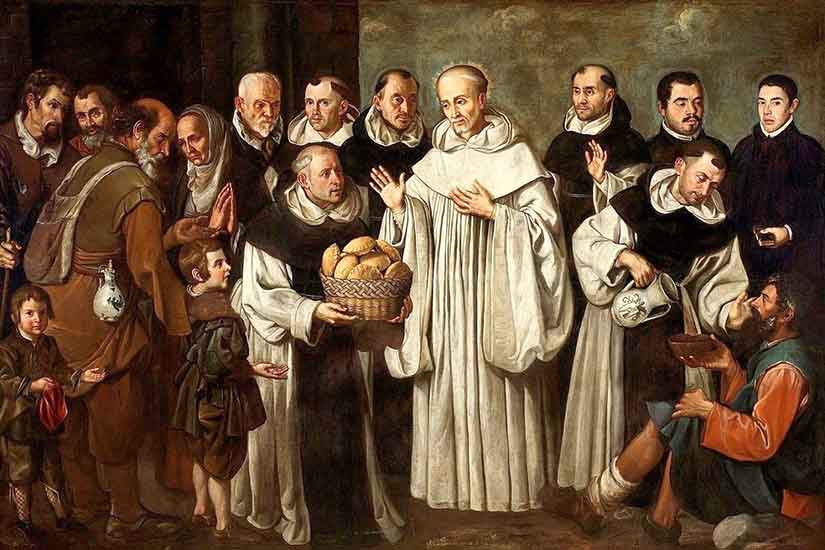
Preacher and diplomat
Bernard spent much time outside the abbey, serving as both a preacher and a diplomat in the service of bishops and the pope.
At the local Council of Troyes in 1128, Bernard assisted the cardinal bishop of Albano in resolving internal disputes within the Church of Paris. At this same council, he outlined the rule of life for the newly-recognised Knights Templar, the Catholic military order charged with the defence of the Holy Land. Bernard developed the ideals of Christian knighthood in his writings addressed to the Templars.
Bernard defended the Church’s freedom against the intrusions of temporal rulers and admonished bishops who had abandoned their sees.
In 1130, Pope Honorius II died and a schism broke out in the Church due to the election of two popes, Innocent II and Anacletus II. Bernard was appointed to determine which of the two rivals would legitimately occupy the chair of Peter. He chose Innocent II.
Bernard became a close adviser to Pope Innocent II, spending the next eight years in diplomatic endeavours to ward off political challenges caused by the supporters of Anacletus. These challenges ended when the anti-pope died in 1138.
All the while, Bernard continued to produce important writings, including his groundbreaking commentary on the biblical Song of Songs.
In 1145, one of his own Cistercian monks, Bernard of Pisa, became Pope Eugene III, prompting Bernard to write him a letter of instructions, which subsequent popes found valuable.
‘There are those who seek knowledge for the sake of knowledge – that is Curiosity. There are those who seek knowledge to be known by others – that is Vanity. There are those who seek knowledge in order to serve – that is Love.’
Preaching a Crusade
When Eugene III declared a Crusade in 1146 for the protection of Christians (and Christian political interests) in Antioch and Jerusalem — much of the Holy Land had fallen into the hands of the Seljuk Turks — he appointed Bernard to gain support for the military campaign.
Initially there was little enthusiasm for a new Crusade, but Bernard’s persuasive preaching attracted huge numbers of volunteers, even from the nobility. A broad coalition of European leaders was assembled to back the military venture.
Sadly, the fervour also had appalling side-effects, with pogroms being launched against Jews in the Rhineland by a fanatical Cistercian monk named Radulf. Bernard denounced these attacks, having been informed of them by the horrified archbishops of Cologne and Mainz. When Radulf continued his hateful campaign, Bernard travelled to Mainz to silence him personally.
The Second Crusade, despite great support, failed in its attempt to take Damascus. This was a heavy blow to Bernard, and he was blamed for a defeat that was more likely due to political intrigue and military misconduct. Bernard defended himself in a letter to the pope, saying that the Crusade had failed because of the moral deficits of its participants.
40 years a monk
Bernard died at the age of 63 on August 20, 1153, six weeks after his confrere and friend Eugene III. In his 40 years as a monk, Bernard had personally founded 163 Cistercian monasteries.
He was buried at Clairvaux Abbey. After its confiscation in 1792 by the French Revolutionary government, his remains were transferred to Troyes cathedral.
Pope Alexander III canonised St Bernard of Clairvaux in 1174.
In 1830, Pope Pius VIII declared him a Doctor of the Church, recognising St Bernard as one of the foremost and timeless thinkers in the history of the Catholic Church.
In contrast to the scholastics’ rational approach to understanding God, St Bernard adopted a more poetic style of preaching. A master of Christian rhetoric, he appealed to emotion and personal conversion to cultivate a direct and practical faith.
As a Mariologist, Bernard strongly emphasised Mary’s central role in Christian theology and was a powerful advocate for Marian devotions.
In 1953, on the 800th anniversary of St Bernard’s death, Pope Pius XII wrote the encyclical Doctor Mellifluus in his honour, calling him “the last of the Church Fathers”.

- Sydney Duval: We Call him Friend - October 8, 2026
- St Francis and Mission - October 6, 2026
- St Francis of Assisi: Creation and Brotherhood - September 28, 2026