In 1985 the bishops founded the Catholic Institute of Education. We look at 40 years of the role the CIE has played in Southern Africa’s Catholic life.
In 1985, Catholic mission schools, serving mostly black learners, faced existential threats from state policy, under-resourcing and political violence.
In this turbulent era, the Catholic Institute of Education (CIE) was born as a coordinating and support agency to maintain the values of Catholic education, support teachers, protect learners, and provide a network for the Church’s schools.
Its mandate was clear: service, research, policy-shaping, training and advocacy, all guided by Gospel values and respect for human dignity. Initially, the Department of Schools of the Southern African Catholic Bishops’ Conference (SACBC) had carried out this work, but by January 1990, all functions were subsumed into the CIE.

Today, there are 335 Catholic schools in South Africa, with about 7600 teachers and more than 170000 learners, of whom 92% are black. Of all Catholic schools, 70% are public schools on Church-owned land, while the other 30% are independent.
The CIE is structured to support the Catholic schools through various initiatives, such as:
– Staff development, curriculum support, and Religious Education training;
– Leadership formation, literacy and numeracy training, and provision of workshops, also in areas such as HIV/Aids;
– Child safeguarding policy implementation and psycho-social support;
– Liaison with provincial education departments and policy advocacy;
-Support for school governing bodies, Catholic ethos preservation, and skills training centres.
With offices in Johannesburg, Kokstad, Mthatha, Polokwane, Bloemfontein, Rustenburg and Keimoes, the institute covers the range of the Catholic schools network in the Southern African pastoral region, and even Lesotho.
In its first decade, the CIE faced apartheid’s education crisis and, after 1990, the uncertainties about the post-apartheid dispensation. After its founding in 1985, the CIE provided critical support as Catholic schools navigated political strife and underfunded operations.
The first CIE logo was a reaching hand, symbolising Catholic education’s role in offering hope amid violence.
A new South Africa
As South Africa transitioned to democracy, the CIE helped negotiate the 1996 Schools Act, ensuring public schools on Church property could retain their distinctive Catholic character.
As Catholic schools grappled with the HIV/Aids crisis, curriculum reforms, and inequality, the CIE developed staff training, supported orphaned pupils, maintained ethos-driven schooling, and sustained pastoral care.
New challenges have presented themselves with a rise in school violence and mental health challenges, and a cohort of pupils growing up in an environment of systemic corruption, institutional racism, xenophobia and rising unemployment.
In response, the CIE developed the “Building Peaceful Schools” programme in 2013. The initiative remains central: training schools in restorative justice practices, surveying school climates, reducing conflict, and promoting mental health support.
Child safeguarding became a defining initiative, with national policies adopted in 2012 and revised in 2018.
New Challenges
A new circular logo was introduced in 2015, inspired by the Camino pilgrim’s shell, to signify an ethos of inclusion and journeying together.
In the past decade, the CIE’s advocacy intensified on issues such as rising violence against teachers. The Covid-19 pandemic also resulted in high rates of school dropouts. The CIE worked hard to urge parents to keep to their obligations and send children back to school. Another area of concern has been literacy deficits, with the CIE calling on Catholic communities to mobilise to help learners.
The CIE continues to develop Religious Education curriculum resources, literacy and numeracy training, leadership workshops, gender and HIV education, and support for vulnerable learners. It works together with the Catholic Schools Offices, the Catholic Schools Proprietors Association, and the SACBC.
Through its Thabiso Skills programme, the CIE supports 26 registered, independent skills centres on Church properties across eight provinces, offering practical training to marginalised communities. Each year, around 5000 unemployed youth and adults complete three-month courses in a range of occupations, equipping them for work in both the formal and informal economies.
The CIE also raises funds for under-resourced Catholic schools. This year it repeated its “Leave Your Print Campaign”, in which, on one day in spring, learners make a monetary donation to be able to attend school barefoot. In 2024, over 70 schools raised R164173, funding vital projects such as sanitation upgrades, safe fencing and improved facilities across the Catholic network.
An annual highlight on the CIE’s calendar is the Johannes Brenninkmeijer Memorial Lecture, dedicated to the late Dominican who was the bishop of Kroonstad from 1977 until his death at the age of 72 in 2003. He chaired the board for many years, quietly inspiring, leading and supporting many initiatives.
Cardinal over a Wall
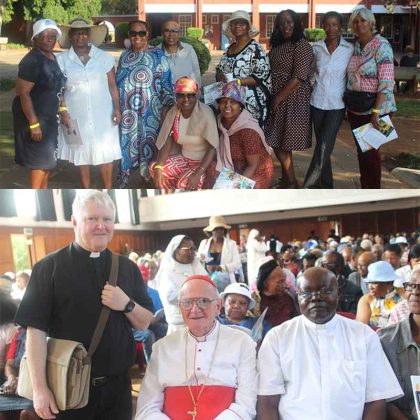
One oft-told anecdote involved Bishop Hans, as he was widely known. In 1995, Cardinal Thomas Williams of Wellington, New Zealand, visited South Africa at the invitation of the CIE.
Sr Biddy-Rose Tiernan, a former CIE director, recalls one memorable evening in Yeoville when she and Bishop Brenninkmeijer were escorting the jetlagged cardinal to his domicile at Bishop Reginald Orsmond’s residence. “The lock to the gate had some trick, but the cardinal broke the key in the lock as he was trying to open it,” Sr Biddy-Rose recounts. With no answer to the bell and no way in, they dashed across the road to Nazareth House, only to find that equally barricaded.
On their return, they discovered the cardinal had vanished — until they heard a muffled noise on the other side of the gate. “There we were, almost lying on the pavement, heads down as low as possible to see what was going on. It was the cardinal himself. He had managed to scale the wall and, fortunately, landed clear of the rose bushes. From the other side of the wall he assured us he was safe.
“Somewhat embarrassed, we said goodnight to our visitor and drove away, wondering what kind of story the cardinal would have to tell on his return to New Zealand.”
The CIE is currently led by Janice Seland, who has been involved with the institute for over 30 years and became its executive director in 2013. Her predecessors were Br Jude Pieterse, Sr Biddy-Rose Tiernan, Nathan Johnstone, Thantshi Masitara and Dr Mark Potterton.
Anne Baker is the long-standing deputy director, who has frequently represented the CIE in media and written widely on literacy, safe schools and educational policy, including many articles in The Southern Cross.
Though the future is uncertain, as it has always been with funding concerns, the CIE remains committed to shaping schools as communities of care, justice and transformation.
For more information, see cie.org.za
Published in the November 2025 issue of The Southern Cross magazine

- Pope: Marriage in the light of Christ’s love - October 22, 2026
- Queen of the Most Holy Rosary Parish Celebrates 70 Years of Grace - October 21, 2026
- Mass Readings: 25 October – 1 November, 2026 - October 20, 2026