Jason Scott’s weekly review of Pope Leo XIV’s audiences –
22 November — Jubilee Audience: Dorothy Day and “taking a stand” for peace
At the Saturday Jubilee Audience in St Peter’s Square, Pope Leo XIV turned to Servant of God Dorothy Day as a guide for Christians in a violent and unequal world. He sketched her as a woman who allowed grace to convert her restlessness into compassion, and her compassion into concrete, often costly, decisions for justice.
“Dorothy Day teaches us that Christian hope is never neutral. It does not sit comfortably on the fence while others suffer, but takes a stand beside the poor, the migrants, the workers whose dignity is denied.”

The Pope warned against the illusions of a “false peace” built on consumerism and indifference, insisting that peace is always measured by how the weakest are treated. Returning to his Jubilee theme of hope, he said that to hope in Christ is to let him set our hearts on fire where others’ lives are being extinguished.
“When the dignity of even one child of God is trampled upon, the Christian cannot say: ‘It is not my concern.’ Hope in Christ makes us stand up, take sides with the crucified of history, and build peace not with slogans but with our own hands.”
For Leo, Dorothy Day is not a romantic figure from a distant past but a very contemporary reminder that sanctity today passes through social friendship, non-violence and a radical closeness to those whom the world finds inconvenient.
23 November — Angelus, Christ the King: hostages, young people and Nicaea
On the Solemnity of Christ the King, Pope Leo appeared at the Angelus with a visibly heavy heart as he spoke of priests, lay people and students kidnapped in Nigeria and Cameroon. He invited the whole Church to intercede for them and their families, and appealed for decisive action so that churches and schools remain places of safety.
“I carry in my heart the pain of so many kidnapped brothers and sisters, especially the young, deprived of freedom and often subjected to violence. I implore those responsible: release them without delay, and may every place of worship and education be a sanctuary of peace and hope.”
The Angelus also shone a spotlight on diocesan World Youth Day, celebrated that same Sunday. Addressing young people in every local Church, Leo encouraged them not to be spectators but protagonists in the Kingdom of Christ, discovering in him a demanding yet joyful path.
“Dear young people, do not be afraid to let Christ the King reign in your hearts. His crown is of thorns, his throne is the Cross, but whoever follows him finds a joy that the world cannot give and a courage that no trial can steal.”
Looking ahead to his journey to Türkiye and Lebanon, the Pope announced the publication of his Apostolic Letter In Unitate Fidei, marking 1700 years since the Council of Nicaea and inviting Christians to rediscover the Creed as a bond of unity and a wellspring of hope in troubled times.
26 November — General Audience: hoping in life in order to beget life
Resuming his catechesis series “Jesus Christ, Our Hope”, Leo devoted Wednesday’s General Audience to the theme “Hoping in life in order to beget life”. He began with a simple but demanding reminder: none of us gives ourselves life; we receive it as a gift entrusted to our care, even when it feels fragile or burdensome.
“Today many people look at life with fear, as if it were a threat rather than a gift. There is a widespread resignation that whispers: ‘Better not to risk, better not to welcome new life, better not to get involved.’ This is not Christian hope.”
The Pope described this resignation as a subtle sickness of our time, affecting families tempted to close themselves to children and societies that tolerate throw-away cultures. Against this, he proposed hope in the risen Christ as an inner engine that allows us to walk forward even when the path is steep or unclear.
“Hope lets us glimpse the destination and so it gives us the courage to take the next step. For spouses, this often means daring the adventure of motherhood and fatherhood; for all of us, it means choosing to ‘generate’ life wherever despair has taken root.”
Broadening his reflection, Leo said that to “beget life” is not only about physical birth but also about creating spaces of work, welcome and care where the weakest can breathe. In this sense, he linked the openness of families to children with the Church’s wider mission to defend life at every stage and in every circumstance.
27 November — Ankara: Türkiye as a bridge of encounter
Arriving in Ankara for his first Apostolic Journey, Pope Leo spoke to the authorities, civil society and diplomatic corps about Türkiye’s unique vocation as a bridge. Reading its geography almost like a parable, he said that the country stands at a crossroads of continents, cultures and religions at a time when many are tempted to build walls.
“The great bridges that span your seas and straits are an eloquent image of what this land can be: not a trench that separates, but a bridge that unites; not a border to be defended with fear, but a meeting place where peoples walk together.”
Leo warned that the temptation to uniformity or exclusion would be a loss for everyone, since true social life is woven from dialogue between different identities and convictions. He called instead for a “culture of encounter” in which compassion and solidarity, rather than economic or military might, are the true measures of development.
“The dignity and freedom of every child of this land—men and women, believers and non‑believers, citizens and migrants, poor and rich—are the solid foundation of a peaceful future. Let us not waste our energies in a new arms race, but invest them in peace, in the fight against poverty, and in the care of our common home.”
In this vision, Türkiye is encouraged to be not only a strategic player but a moral and spiritual reference point, helping to calm tensions in the region and to show that coexistence among different peoples is possible.
28 November — Istanbul: a “little flock” with a wide horizon
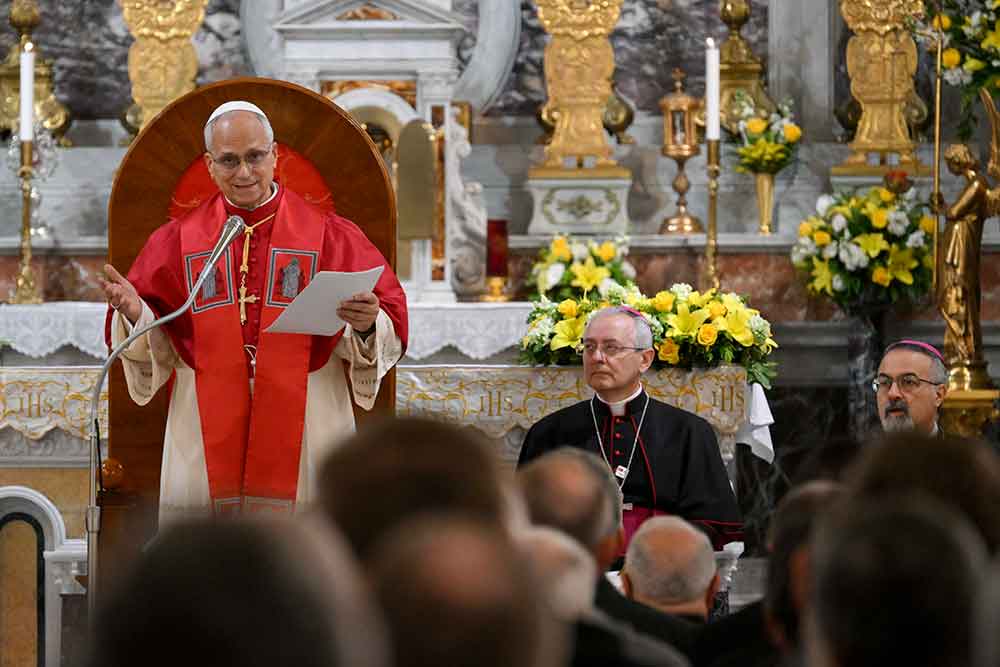
On Friday morning, in Istanbul’s Cathedral of the Holy Spirit, Pope Leo met bishops, priests, religious and pastoral workers who serve Türkiye’s tiny but vibrant Catholic community. He reminded them that the land where they minister is steeped in biblical and Christian memory, from Abraham’s journey to Paul’s preaching and the great Councils of the early Church.
“Here, on this ‘holy land’ where Asia and Europe touch, the Lord has planted a small Catholic flock, diverse in rites and languages yet united in the one faith. Do not be discouraged by your small numbers: God loves to work with the ‘little flock’.”
The Pope underlined that the Church’s strength is never in statistics or influence but in humble fidelity to the Gospel. A minority community, he said, is called to be leaven: serving refugees and migrants, engaging in ecumenical and interreligious dialogue, and translating the Gospel into the language and culture of the people.
“The logic of the Kingdom is that of the mustard seed and the yeast. Hidden and seemingly insignificant, they nonetheless transform everything from within. This is your mission in Türkiye: to be a discreet but real sign of God’s closeness, especially to those who feel forgotten.”
Leo encouraged them to persevere in daily service, often unseen, confident that the Lord writes the history of salvation starting from small, faithful communities such as theirs.
28 November — İznik: remembering Nicaea to resist “new Arianisms”
Later that day in İznik, the ancient Nicaea, Pope Leo joined Ecumenical Patriarch Bartholomew and other Christian leaders for an ecumenical prayer service near the ruins of the basilica where the Nicene Creed was first articulated. Standing where bishops once gathered to answer the question “Who is Jesus?”, he proposed the same question for today.
“We risk a kind of new Arianism whenever we reduce Jesus to a wise teacher, a prophet, or a spiritual influencer, but no longer confess him as ‘true God from true God’. A Christianity without the living Son of God soon becomes a harmless ideology.”
The Pope stressed that Nicaea is not about nostalgia for a glorious past, but about drawing strength from the Creed to face present trials. In a world where religion can be misused to justify violence, he said, Christians must rediscover together the humble and disarming power of the Crucified and Risen Lord.
“The Creed we profess is not a museum piece but a compass for the journey. If we walk together beneath its words, Catholics and Orthodox will find not only the courage to forgive the wounds of history, but also the strength to resist every instrumentalisation of faith.”
For Leo, this shared return to Nicaea is both theological and profoundly pastoral: it can help divided Christians to stand side by side in serving peace, migrants, the poor and a wounded creation.
29 November — Istanbul: Advent begins on the bridges of the Bosporus
On Saturday, at Holy Mass for the First Sunday of Advent in Istanbul’s “Volkswagen Arena”, Pope Leo invited the small Turkish Catholic community and pilgrims to see their city through the lens of Isaiah’s prophecy of all peoples streaming to the mountain of the Lord. He linked the opening of Advent with the anniversary of Nicaea and with the local Church’s mission.
“Istanbul, with its bridges over the Bosporus, reminds us that the Church is called to be a living bridge: between heaven and earth, between peoples at war, between those who believe and those who are searching.”
Reflecting on the three great bridges that unite the city’s shores, he spoke of three essential “bridges” that Christians are called to maintain: unity within the Catholic Church’s different rites and communities; fraternity with other Christians, especially the Orthodox; and respectful, patient dialogue with believers of other religions.
“Bridges do not remain standing by themselves; they need constant care. Unity is like this: a gift from God that asks for our daily maintenance—patience, forgiveness, the courage to take the first step.”
Advent, he concluded, is not a soft, sentimental countdown to Christmas but a time to “put on the armour of light” and to examine whether we are building bridges or digging trenches—in our families, our communities and our societies.
29 November — Joint Declaration with Patriarch Bartholomew: one Creed, toward one Easter
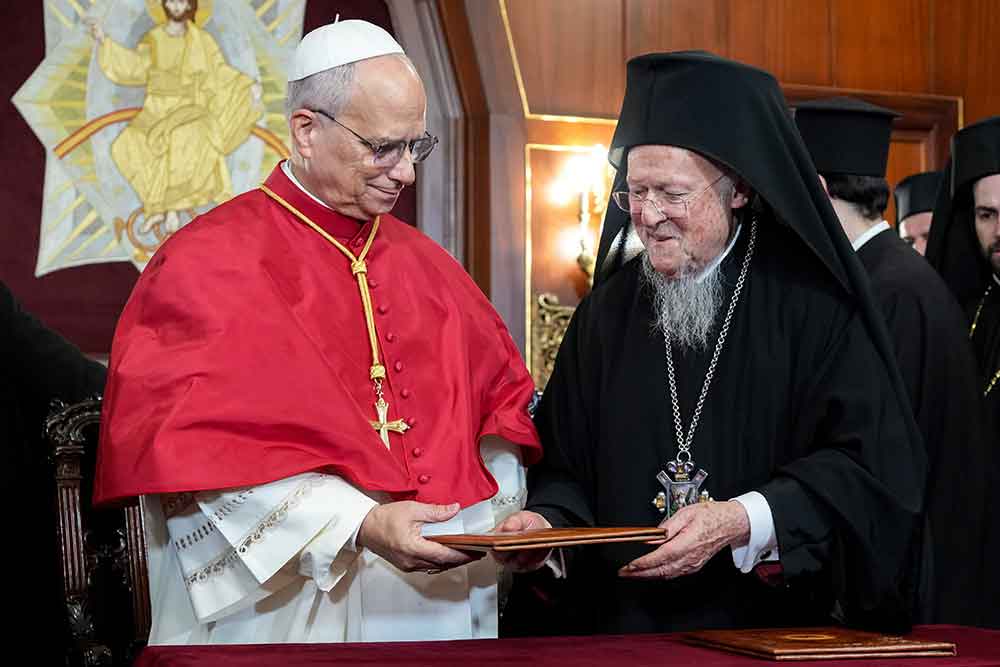
That same day, in the Patriarchal Palace, Pope Leo and Ecumenical Patriarch Bartholomew I signed a Joint Declaration that may become one of the spiritual landmarks of this pontificate. Beginning with the words of the psalm—“O give thanks to the Lord, for he is good, for his steadfast love endures forever”—the text looks with gratitude on the path already travelled towards Catholic-Orthodox reconciliation.
“We give thanks to the God of mercy, who has allowed us to meet as brothers and to walk together, despite our wounds, on the path that leads from estrangement to communion, from suspicion to trust.”
The Declaration stresses that, despite remaining obstacles, Catholics and Orthodox are already united by the faith of Nicaea and by a shared desire to bear credible witness in a fractured world. Strikingly, the two leaders highlight that this year all Christians celebrated Easter on the same date, and they express their wish to keep moving towards a common date every year.
“The fact that this year we celebrated the one Pasch of the Lord on the same day is not a coincidence but a sign. We desire to continue, with patience and determination, to seek a common date, so that the world may see us celebrate together the heart of our faith.”
Recalling the 1965 lifting of the mutual excommunications of 1054, Leo and Bartholomew invite clergy and faithful not to listen to voices that sow fear of dialogue, but to welcome the fruits already given and to work so that the Nicene Creed may shine as a shared confession of hope and peace.
Take-Away Points:
Hope refuses neutrality: Dorothy Day is offered as a Jubilee icon of Christians who take a stand for peace where human dignity is trampled.
Christ the King gathers the vulnerable and the young: from kidnapped students to diocesan World Youth Day, Leo places hostages and teenagers under the same merciful kingship of Christ.
Life is a gift to be generated, not feared: the General Audience confronts a culture of resignation and invites families and societies alike to “beget life” in all its forms.
Türkiye as a parable of bridges: in Ankara and Istanbul, the Pope reads geography theologically, calling Church and society to resist polarisation and become places of encounter.
Nicaea as a living compass: from İznik to the Joint Declaration, the week’s thread is clear—returning together to the Creed deepens our faith in Jesus as Lord and moves Catholics and Orthodox closer, perhaps even towards a shared Easter.
Sources:
22 November – Jubilee Audience:
https://www.vatican.va/content/leo-xiv/en/audiences/2025/documents/20251122-udienza-giubilare.html
23 November – Angelus, Solemnity of Christ the King:
https://www.vatican.va/content/leo-xiv/en/angelus/2025/documents/20251123-angelus.html
26 November – General Audience:
https://www.vatican.va/content/leo-xiv/en/audiences/2025/documents/20251126-udienza-generale.html
27 November – Address in Ankara to the Authorities, Civil Society and the Diplomatic Corps:
28 November – Meeting with bishops, priests, deacons, consecrated persons and pastoral workers in Istanbul:
28 November – Ecumenical Prayer Service at İznik:
29 November – Holy Mass for the First Sunday of Advent in Istanbul:
https://www.vatican.va/content/leo-xiv/en/homilies/2025/documents/20251129-messa-istanbul.html
29 November – Joint Declaration with Ecumenical Patriarch Bartholomew I:
- Ten Books for Catholic Apologetics - October 26, 2026
- Why I Chose Catholicism: 7 Reasons - October 7, 2026
- Why I Am Not an Atheist: The Three M’s - September 28, 2026