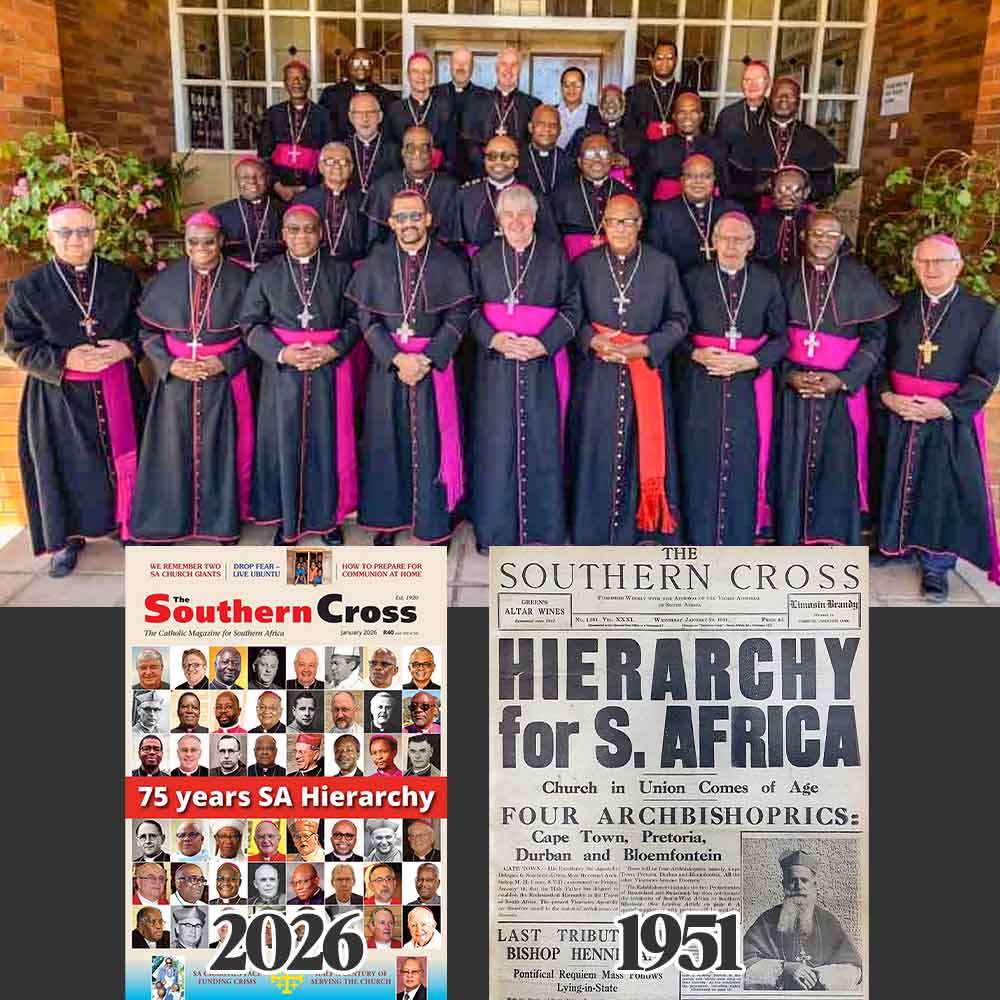
This month it is 75 years ago since Pope Pius XII established the Southern African Hierarchy, a momentous event which altered the way our local Church would operate. In this abridged version of a full article by Günther Simmermacher in our January 2026 issue, we look at how that moment changed things, and what the 75th anniversary must mean to us today.
On January 11, 1951, Pope Pius XII issued the papal act that formally established the ecclesiastical hierarchy in the pastoral region covered by the Southern African Catholic Bishops’ Conference (SACBC), founded in 1947 and including Basutoland and Swaziland (now Lesotho and Eswatini; Botswana joined in 1959). That administrative moment marked a turning point — a papal recognition that the local Church had grown up. No longer a missionary dependency administered indirectly from Rome, it was now a matured body governed by its own bishops.
The establishment of the hierarchy meant that apostolic vicariates and prefectures became dioceses. Bloemfontein, Cape Town, Durban and Pretoria were elevated to metropolitan archdioceses, with their bishops becoming archbishops. Formerly supervised by the apostolic delegate, these dioceses were now answerable directly to the Holy See. The SACBC naturally became the forum for regional collaboration, coordinating pastoral policy and issuing public statements.
The hierarchy’s establishment was celebrated in April 1951 in Cape Town, coinciding with the centenary of St Mary’s cathedral. Three years later, the bishops mounted a phenomenal fundraising campaign to save Catholic mission schools, raising around R600 million in today’s value. Two decades on, the SACBC backed Sisters who opened their schools to all races, breaking school apartheid.

The bishops acted in union — often contested behind the scenes — in confronting apartheid. Their statements challenged injustice and guided the faithful. The SACBC showed real muscle by appointing outspoken anti-apartheid priest Fr Smangaliso Mkhatshwa as secretary-general. Pioneering appointments followed: Sr Brigid Flanagan as associate secretary-general, Sr Hermenegild Makoro as secretary-general in 2010, and Br Jude Pieterse, likely the first religious Brother to hold such a post.
Post-apartheid, the major challenge has been the shift from overseas-funded dependence to self-reliance. The 75th anniversary marks institutional maturation and invites reflection on evangelisation, education, healthcare and the Church’s prophetic voice. It also calls for honest acknowledgment of imperfect witness and ongoing tasks of racial integration, lay participation and synodality.
A decisive development has been indigenised leadership: from all-white bishops in 1951 to a largely local hierarchy today. The Church must now balance humanitarian need with formation — and seek spiritual renewal, asking how maturity bears fruit in holiness, justice and charity.
Read the full story in the January issue of The Southern Cross.

- Sydney Duval: We Call him Friend - October 8, 2026
- St Francis and Mission - October 6, 2026
- St Francis of Assisi: Creation and Brotherhood - September 28, 2026