By Sr Margaret Mary SU for the Diocese of Mthatha – April 27, 2026, was an emotional day for the Diocese of Mthatha. Ever since the announcement of Archbishop Sipuka’s transfer to Cape Town on January 9, 2026, it has been a season of mixed emotions, joy and anxiety, gratitude and grief, all at once.
Archbishop Sithembele Sipuka had served the Diocese of Mthatha for eighteen years. In that time, he became part of the community, just as any human being does when they give themselves fully to a place and its people. The priests, religious and faithful became part of him, and he of them. And yet, it is often at the point of greatest comfort and familiarity that the Lord makes his next move, calling us beyond what we know into something we have not yet imagined. Nobody, including the Archbishop himself, had anticipated that 2026 would be a year of great transitions for Mthatha.
Looking back at the work done by Archbishop Sipuka in the Diocese of Mthatha, it is clear that he was shaped for service in a diverse environment. The Diocese of Mthatha is home to varied nationalities, and it was here that Archbishop Sipuka worked to draw these differences together, so that in them the Kingdom of God could be realised and grow.
He conducted pastoral visits throughout the diocese. He served two parishes, St Peter’s Parish in Elliotdale and Uganda Martyrs Parish in Tsolo, as a parish priest himself in addition to his role as a bishop of Mthatha. He structured the administration of the diocese, developed the Diocesan Pastoral Plan, and the Synodal Booklet. He emphasised doing things right when it came to Catholic doctrine, always reminding the faithful of the real essence of worship, that it goes beyond the outward acts but touches something, a grace that is deeper. He was a reflective leader, and that quality of reflection helped him make decisions that kept the diocese steady and moving forward.

To mention but a few things: Archbishop Sipuka gave himself generously to the Catholic Diocese of Mthatha, and through all of that, the Lord was preparing him to shepherd the Archdiocese of Cape Town.
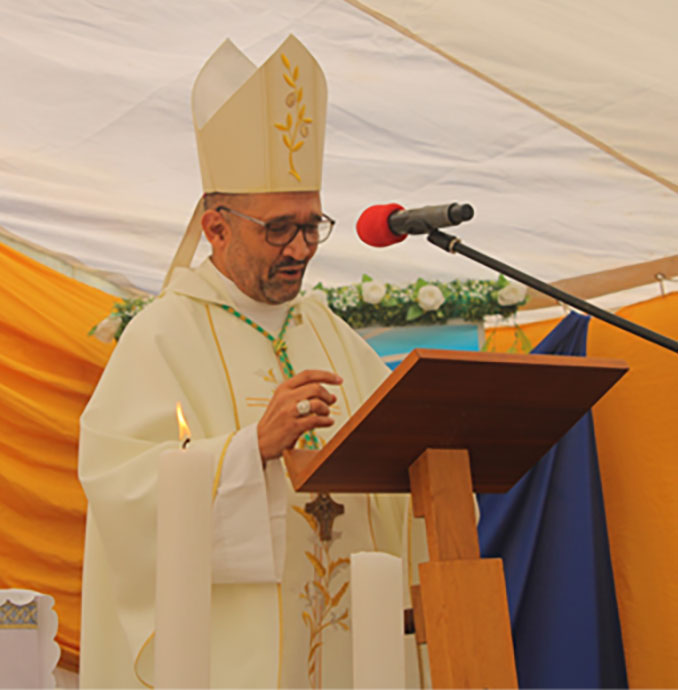
It is with this appreciation that the diocese could only say thank you to Archbishop Sipuka, and did so in the most fitting way possible, in the Holy Mass, the highest form of prayer the Church has.
The farewell took place on April 27, 2026, at St Francis Xavier Parish, Maclear. The faithful from all four deaneries of the diocese gathered, along with school principals, the Catholic Institute of Education Regional Manager, priests and religious, and representatives of the South African Council of Churches, all present to witness and be part of this significant day. Within the farewell celebration, the diocese celebrated the Archbishop’s birthday and the launch of the Diocesan Synodality booklet.
The Homily
“I leave this Diocese with gratitude. I carry you in my heart and in my prayers. Go and help each other to live, fully and joyfully, the life that God intended. United and Sent.”–Archbishop Sithembele Sipuka
In his homily, the Archbishop expressed his joy at coming back to Mthatha for the farewell. He had initially thought the diocese had set the date quite soon after his departure, but looking at it more broadly, it served him well, as it would help him settle properly in Cape Town and conclude his ministry in Mthatha with a sense of completeness.
Basing his homily on his Coat of Arms, Archbishop Sipuka spoke about unity, not unity for its own sake, but unity in the service of the mission of Christ. He acknowledged the gifts of culture, language and identity, but pressed the faithful with a deeper reflection; “Someone says and says it proudly, I am Xhosa. I am Zulu. I come from this country. And there is nothing wrong with knowing who you are. Culture is a gift. Language is a gift. Your roots are a gift. But the question I want to put to you is this: how does that identity contribute to the bigger vision of why you are here as a member of this Church, as part of this presbyterate, as a religious, as a faithful Catholic? Because if the answer is that it does not, if it becomes instead a reason to withhold cooperation, to stand apart, to serve your own group rather than the mission, then what was a gift has become an obstacle. The resurrection of Christ calls us beyond our tribes. Not to abandon who we are, but to bring who we are into the service of something larger than ourselves.”- Archbishop Sithembele Sipuka
He explained that unity, inclusion and mission belong together. The kind of unity that is built only on culture, language or nationality tends to blind the followers of Christ to the truth, certain wrongs go uncorrected, certain people go unserved, and the overall mission of the Church suffers. On this, he was direct: “This is precisely why my motto is not merely United but United and Sent. Unity without mission is not Christian unity. It is a club. And a club that closes ranks to protect its members at the expense of the work is not a community of disciples.” – Archbishop Sithembele Sipuka
He testified that the unity in Mthatha today is greater than what it was when he arrived, and it was this that gave him the conviction behind his motto. The Archdiocese of Cape Town, like Mthatha, is a multi-cultural society, but to a far greater extent. It is clear that the Archbishop goes there with purpose and experience.
Reflecting on the Gospel of the Good Shepherd, he also raised the concern of competing voices, voices that are becoming more attractive than the voice of Christ, leading to fewer people in the pews and declining commitment in ministry. He called the faithful to be attentive; “To say yes to Christ is precisely to say that his voice has a different weight, a different claim on us, than the voice of the world, the voice of fashion, the voice of our own appetites and fears. The sheep of the Good Shepherd are not sheep who listen to every voice impartially. They are sheep who know the difference.” – Archbishop Sithembele Sipuka
He reminded the people that listening to Christ does not take away freedom, as the scriptures say, “He came that our joy may be full” – John 15:11. It is in listening to Christ that true freedom is found. He closed his homily with a vision of what that looks like in practice: “That too has been my intention in these years with you, not merely to warn, but to call you to joy. You were not created for mediocrity or for mere survival. You were created for the abundance of life that Christ came to bring. And that abundance is not found by turning inward by nursing grievances, protecting comfort, circling around ourselves. It is found by turning outward. By giving. By belonging to one another and to Christ in a way that draws out the best of what God placed in each person. This is what a good shepherd does, and it is what every one of you is called to do in your own sphere. Not only the priests, but every faithful person in this Diocese: to be the voice that others recognise as trustworthy, to stand in the gateway when the thieves come, and to point one another always not toward danger and diminishment, but toward the life that is full and overflowing and worth living.” – Archbishop Sithembele Sipuka
The Launch of the Synodality Booklet
One of the great gifts Archbishop Sipuka brings to any community is his ability to write. Over the years, the Diocese of Mthatha benefited greatly from his clear and informative writing. This gift led, in 2024, to the development of the Diocesan Pastoral Plan, and later to the Synodality Booklet launched on this farewell day.
The synodal journey in Mthatha had, in fact, begun even before the Universal Church declared a synodal process. The Diocese had already started at the local level. It was this diocesan synodality that gave rise to the Pastoral Plan. Then, in 2025, a Synodal Commission was established to facilitate the implementation phase of synodality. The Commission, together with Archbishop Sipuka and Monsignor Phomane Motlatsi, the bishop-elect of the Diocese of Bethlehem, worked to synthesise the input gathered from the faithful. Archbishop Sipuka then consolidated it all into the booklet. The booklets are comprised of three parts: What is Synodality(explanation of synodality with biblical references), Listening to the Voice of the People (a synthesis of the responses on what the faithful understood, contributed and questioned)and Synodality in Action(connecting pastoral concerns to the Diocesan Pastoral Plan).
It was fitting, then, to launch the booklet on the day of his farewell Mass. Great appreciation goes to Archbishop Sipuka and Monsignor Motlatsi for their dedication throughout this process. The work now belongs to the diocese to carry it forward, so that synodality is not merely understood in principle but truly lived.
Farewell
All who spoke at the farewell noted the giftedness of Archbishop Sipuka and expressed confidence that these same gifts would bear fruit in the Archdiocese of Cape Town. His pastoral presence during the COVID-19 pandemic was one of the unique pastoral acts he did. How he buried one of his priests and five religious sisters who lost their lives during that time, when everyone was afraid or uncomfortable to be around crowds, especially at funerals. It was a sign of a father who understands his role of standing unconditionally by his children, in the difficult moments as well as in the good ones.
As a remembrance, the Archbishop left his crozier in the diocese to be kept for the next Shepherd of the Diocese of Mthatha.
The Diocese of Mthatha celebrated Archbishop Sipuka’s farewell in a way that was worthy of his years of service, with prayer, with gratitude, and with a send-off that came from the heart.
- Msgr Phomane: Son of Mthatha becomes Shepherd of Bethlehem - June 30, 2026
- Eastern Deanery Celebrates Youth Day with Joy - June 19, 2026
- Diocese of Mthatha Bids Farewell to Archbishop Sipuka - April 29, 2026