A recurrent experience of being in central Durban is gridlock in the centre of town whenever there is a march on City Hall. My frustration at this is tempered when I recall photos of Archbishop Denis Hurley protesting in front of this iconic building, and am reminded of the importance of civil protest.
Government needs to hear what ordinary people are saying, and this is one of the ways of achieving that. The irony is that the ruling party in eThekwini has actually made most of City Hall unusable, so they are not actually in the building to hear the cries of the poor.
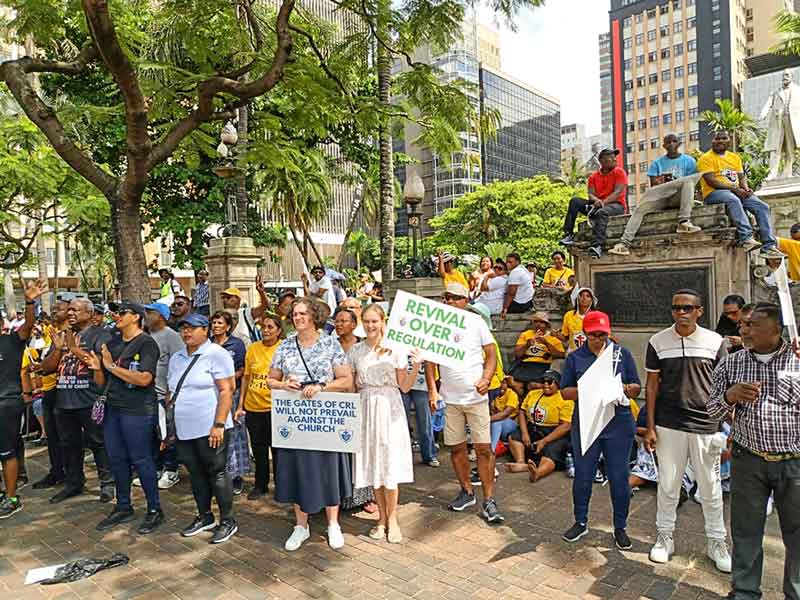
A recent protest took me by surprise because, very unusually, the crowd included Zulus and Afrikaners marching side by side. What, I wondered, could bring about this surprising alliance? Especially when the placards said things like “Keep your hands off God!”
It turned out that this was one of a number of protests around the country, organised by the self-styled “SA Church Defenders Group”. They are enraged about regulations of churches that have been proposed by the Commission for the Promotion and Protection of the Rights of Cultural, Religious and Linguistic Communities (known as the CRL Rights Commission). The group comprises mainly independent, charismatic and Pentecostal-type churches. Neither the Catholic Church nor other mainline churches are part of it, though Cardinal Stephen Brislin has strongly criticised the proposals.

The motivation for these proposed regulations is a spate of scandals involving churches and church leaders that range from tax evasion to sexual abuse to fraud and embezzlement. The CRL proposes a system that requires churches and pastors to be registered so that their actions can be better regulated.
There are interesting arguments on both sides of this debate. Framing it as “the biggest threat to the great commission of the Lord Jesus Christ” or scaremongering about a Chinese-style “state-sponsored religion” does not, however, contribute to the debate.
Our estimable Catholic Parliamentary Liaison Office (CPLO) produced a thoughtful response to this issue as long ago as 2016, which can be found at www.cplo.org.za/publications/briefing-papers-2016/ (look for BP 418).
What struck me amid all the noise created by the protesters was the lack of credibility of key players on both sides of this debate. Those objecting pointed out the irony of a government that is mired in corruption wanting to address corruption in the religious sector.
I am not sure the placard that said “How can Corruption regulate Holiness?” is an entirely fair analysis of the situation. But, given the difference in scale, I was disappointed that no protester had gone for the obvious verse from Matthew 7:5 “First, take the log out of your own eye; then you will see clearly, so that you can remove the splinter from your brother’s eye!”
An offending comment
The anti-brigade has also been greatly assisted in their campaign by the clumsiness of CRL chair Thoko Mkhwanazi-Xaluva. A comment of hers, “If someone says God was talking to me, tell them to go to the psychiatric ward”, can easily be held up as evidence of prejudice on her part and a lack of respect for the sector of society she is mandated to oversee. It is hard to imagine that she would think it acceptable to say such things about linguistic or cultural groups.
Having said that, the response by some members of the crowd to aim highly personal insults directly at her did not bear witness to the very Christianity they were claiming to defend.
There indeed is a lack of credibility on both sides. That is because religious organisations and religious leaders do not have a good track record in regulating their own behaviour — which is generally true of any sector which is entirely self-regulating.
There were many placards at the protest with proclamations like “Leave the Church alone”, “Hands off our Church” and “God gives us Direction”. Seen in a vacuum, these might be plausible rallying cries. But after decades of cover-up by churches — sometimes at the very highest levels — of grotesque sexual abuse, especially of children and vulnerable adults, these placards are, at the very least, tone deaf.
Churches left to themselves have made very little effort to investigate or prosecute perpetrators of evil, choosing instead to ignore it, deny it or even to discredit the victims. So when any part of the Church claims that it should be left to regulate its own affairs, we need to be honest about areas in which that has gone so disastrously wrong.
No accountability
Religious organisations are also still far from transparent when it comes to their finances. They enjoy many of the same tax advantages as NGOs but need to provide almost no accountability.
This is a little different in the Catholic Church. Church law does at the very least require a finance committee in every parish (Canon 537) — so don’t be slow to point this out if your priest is not complying. If you live in a parish with a fully-functioning finance committee, where detailed accounts of income and expenses are freely shared with parishioners, or where the diocese undergoes and publishes an annual audit, count yourself blessed.
But even if secular law does not (yet) set financial rules for churches, Christian virtue is rarely defined by doing “what we can get away with”. Surely it is about acting in a manner which is worthy of the Gospel (Philippians 1:27)! A church (or a parish or diocese) could use existing regulations to voluntarily register, to put in place systems for good financial governance, and to produce and publish their audits.
NGOs are strictly regulated. Some malfeasance still takes place, but the regulations at least set a standard against which they can be judged. I would not be able to raise funds for the Denis Hurley Centre if I did not have an independent board, a history of audited accounts, clear systems of governance (critically in terms of splitting financial powers) and regulations on how money is spent by the key managers in the organisation.
Perhaps you think that churches do not need these things because we can trust the priest/pastor/vicar/bishop. If so, your spectacles might be a little too rose-tinted.
As I watched this protest in Durban, I found myself pondering the issue of accountability in our own Church. And I am saddened to think that we might not always be holding ourselves up to the standards of transparency that we demand from other sectors of society.
Where were the Christian protests?
What made me even sadder was that this was the issue that had brought thousands of Christians out on the streets — as I said an unlikely alliance of Zulus and Afrikaners and others besides. Where were the Christian protestors when our government supported the Russian invasion of Ukraine? Or allowed vigilantes to block foreign nationals from accessing healthcare? Or permitted someone to spend millions of rands of state money on his private home under the guise of security upgrades?
Do Christians only care about justice when it affects their own institutions?
The protesters claimed that they were defending God. They were not; rather they were defending their religious bodies and their religious leaders. But let me quote US Episcopal priest and theologian Barbara Brown Taylor: “If I had to choose between loving my religion and loving my neighbour, I hope I would choose to love my neighbour. Jesus never commanded me to love my religion.”

- No Room for Exclusion - September 7, 2026
- Rose Calaca: The Vocation to Educate - August 18, 2026
- Who Am I, and Who’s AI? - August 16, 2026