St Cecilia is one of the Church’s most popular saints, with a much-loved basilica in Rome built on the site of the martyr’s 3rd-century home. This is the story of the patron saint of music.
In the early centuries of the Church, when persecution threatened Christians at every turn, martyrdom was the ultimate witness to the Gospel. Among the many martyrs, St Cecilia became one of the most popular — even though some question whether she ever existed.
Later, she became the patron saint of music, though she probably never composed or played a single note.

St Cecilia’s hagiography records that she was born into a wealthy patrician family in Rome around 200 AD. Despite her Christian faith, Cecilia was married off by her family to a noble Roman named Valerian, who was not a Christian at the time.
On her wedding day, amid the festivities and music, the young bride is said to have silently prayed to God, dedicating her virginity to Christ. According to tradition, she told Valerian that an angel of the Lord watched over her and would punish him if he tried to consummate the marriage.
This bold declaration could have ended in violence or divorce. Instead, it opened the door to grace. Valerian, intrigued and moved, asked to see this angel. Cecilia told him that he must first be baptised. He agreed, and under her guidance sought out the bishop, Pope Urban, who catechised and baptised him. Soon after, Valerian’s brother Tiburtius also converted.
The two brothers quickly became known for their works of mercy, especially for burying the bodies of Christians who had been executed — an act considered illegal and punishable by death.
Their commitment drew the attention of the Roman authorities, and both Valerian and Tiburtius were arrested and ordered to renounce their faith. They refused and were executed, alongside a Roman soldier named Maximus, dying as martyrs.
Young widow’s martyrdom
Cecilia, now a young widow, gave away all her possessions to the poor and turned her house into a place of worship. For this, she was arrested and condemned to death under the Emperor Alexander Severus around the year 230.
But her execution did not go smoothly. Cecilia was sentenced to die by suffocation in the baths of her own house, which had been sealed and heated to unbearable temperatures. Miraculously, she survived the ordeal unharmed.
The authorities then sent an executioner to behead her. He struck her three times but failed to sever her head completely. Gravely wounded, Cecilia remained alive for three days.
During this time, legend tells us, she continued to speak, encouraging the Christians around her and giving instructions that her house be preserved as a house church.
Pope Urban, who had baptised her husband, arranged for Cecilia’s burial in the Catacombs of St Calixtus, and later dedicated her house as a place of Christian worship.
Pope Paschal I rebuilt the church — already dedicated to St Cecilia — in 822, and moved the saint’s remains there to be entombed. Today, the basilica of Santa Cecilia in Trastevere is one of Rome’s most popular churches.
Body found incorrupt
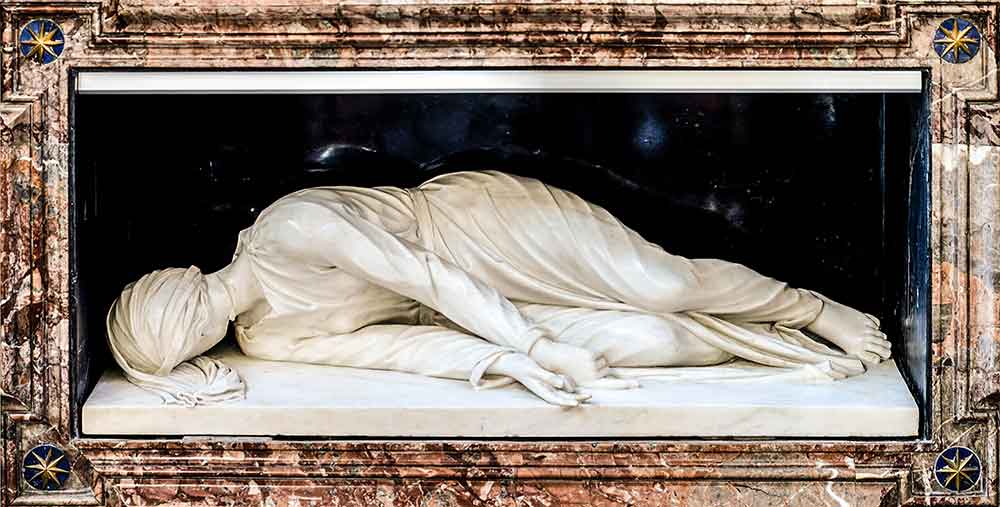
When her body was exhumed in 1599, it was reportedly found to be incorrupt, her head turned slightly as if in peaceful repose. The sculptor Stefano Maderno created a striking statue of Cecilia as she was found, now enshrined in the basilica. It is one of the most moving depictions of early Christian martyrdom.
A marble slab in front of the statue quotes Maderno’s sworn testimony that he portrayed St Cecilia exactly as he saw her. The statue reflects the hapless executioner’s axe blows and highlights the incorruptibility of her body, which still bore congealed blood more than 13 centuries after her death.
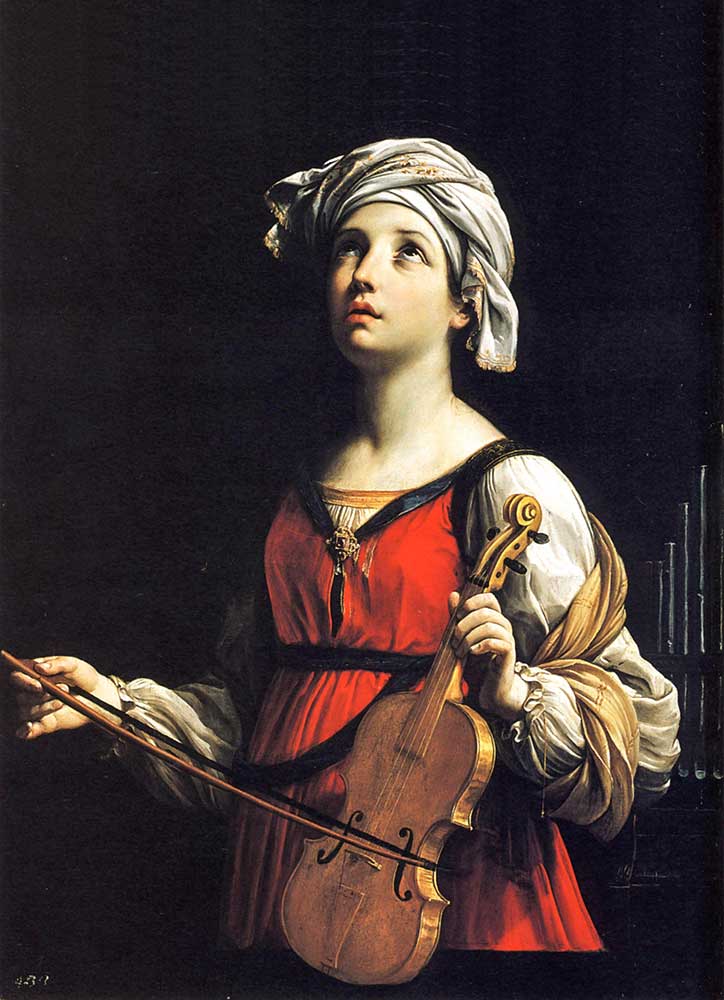
St Cecilia’s designation as the patron saint of music seems to come from a line in the ancient accounts of her life which noted that “as the musicians played at her wedding, Cecilia sang in her heart to the Lord”. This single sentence, combined with the poetic image of her sanctity, gradually led to her association with music, musicians and composers.
By the Middle Ages, Cecilia was firmly established as the patron of sacred music. Her feast day was celebrated with musical festivals and compositions in her honour, as it is today (it is not by chance that the Jubilee of Choirs this month coincides with her feast).
One of the oldest musical institutions in the world, the Accademia Nazionale di Santa Cecilia in Rome, was founded in 1585 by Pope Sixtus V and dedicated to her.
Over the centuries, St Cecilia has inspired some of the greatest composers in the Western canon. Joseph Haydn, Henry Purcell, George Frideric Handel, Marc-Antoine Charpentier, Charles Gounod and Benjamin Britten are among those who wrote music for the feast of St Cecilia — celebrating not just the saint but also the idea that music itself is a divine gift and an expression of the soul’s longing for God.
Was St Cecilia real?
So, did St Cecilia exist? There is no mention of a Cecilia in the 4th-century Depositio Martyrum — but absence of proof is not proof of absence. There is, however, a record of an early Roman church founded by a woman named Cecilia in Trastevere.
Moreover, the stories of Cecilia and Valerian, and of their fellow martyrs Tiburtius and Maximus, are mentioned in the Acts of the Martyrs of the 4th century, as having some historical foundation.
On balance, therefore, one may observe that there likely was a woman named Cecilia who was a Christian and used her home as a house church, and who was remembered by generations of Christians as a martyr. The case for the existence of a Roman martyr named Cecilia is more plausible than the arguments against.
Cecilia’s biography may be thin on authenticated facts but her reputed witness has resonated with the faithful through the centuries. She is representative of many women like her, who dedicated themselves to Christ and accepted martyrdom for their faith in him.
St Cecilia is honoured in the Roman Canon (Eucharistic Prayer I), one of the virgin martyrs in that ancient prayer of the Mass.
Her feast day is on November 22.

- Sydney Duval: We Call him Friend - October 8, 2026
- St Francis and Mission - October 6, 2026
- St Francis of Assisi: Creation and Brotherhood - September 28, 2026