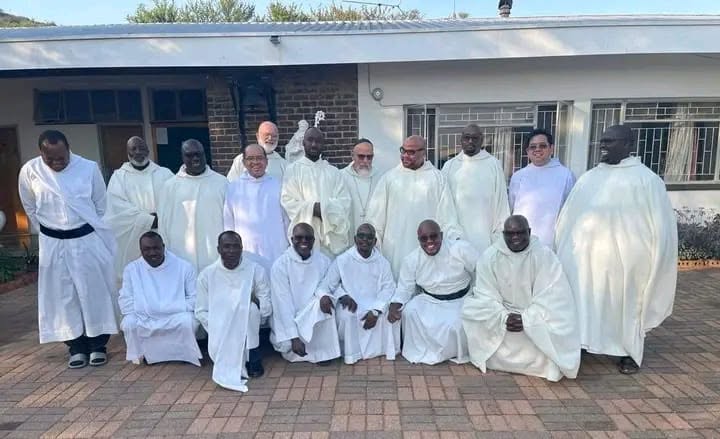
Bokang Tsoanamatsie caught up with Br Bernard Liteboho Tekateka OSB and spoke about the religious life that made him leave his native country, Lesotho and live in a monastery in Polokwane.
In this special interview, Br Bernard Tekateka, OSB, speaks with Bokang Tsoanamatsie during his current stay in Lesotho, where he is attending to visa arrangements before returning to the Benedictine Monastery in Subiaco, Polokwane. Bokang himself has already professed his First Vows as a Benedictine monk and continues his formation within the monastic community.
Br Bernard Tekateka, a native Mosotho, was raised in Maseru at Maria Mabasotho Oblate Pastoral Centre, where he served faithfully as an altar server from a young age. His own journey of faith and monastic life gives him a unique appreciation for the richness of Benedictine spirituality and its relevance in today’s world.
The Benedictine tradition has shaped the lives of countless men and women for over fifteen centuries. Rooted in the wisdom of St Benedict and his Rule, it continues to inspire those who seek a deeper relationship with God through prayer, community life, humility, and service.

What Is Benedictine Spirituality?
Benedictine spirituality is a way of life inspired by St. Benedict of Nursia, the sixth-century monk whose Rule became one of the most influential guides to Christian monastic living. Although the term “Benedictine” emerged centuries later, it refers to all those who draw inspiration from the Rule of St. Benedict and seek to live according to its values.
At its heart, Benedictine spirituality is monastic. Its primary purpose is not external ministry or apostolic activity, but the lifelong search for God. Monks dedicate themselves to prayer, conversion of life, and a profound commitment to living for God alone.
“Listen with the Ear of Your Heart”
The Rule of St. Benedict begins with a powerful invitation: “Listen.”
This single word captures the essence of Benedictine spirituality. A monk is called to listen attentively to God, not only through Scripture and prayer but also through daily experiences, community life, work, silence, and the people he encounters.
For Benedictines, listening is much more than hearing words. It is an attitude of openness and attentiveness to God’s presence. Through silence and reflection, the monk learns to hear God’s voice speaking in the depths of the heart.
A Life of Prayer and Contemplation
Prayer forms the foundation of Benedictine life.
Monks gather throughout the day to celebrate the Divine Office, also known as the Liturgy of the Hours. Alongside communal prayer, they devote themselves to personal prayer and spiritual reading, especially through the ancient practice of Lectio Divina—a prayerful reading of Sacred Scripture.
The goal is not merely to say prayers but to cultivate an intimate relationship with God. Through contemplation, the monk gradually learns to rest in God’s presence and to allow his life to be transformed by divine grace.
Humility: The Path to Spiritual Growth
One of the most famous chapters of the Rule is Benedict’s teaching on humility.
Humility is not about self-degradation or humiliation. Rather, it is the ability to see oneself truthfully before God. It means recognising both one’s gifts and limitations while acknowledging complete dependence upon God’s mercy.
St. Benedict compares humility to a ladder with many steps. Throughout life, the monk ascends this ladder gradually, growing in self-knowledge, gratitude, and trust in God.
Humility opens the heart to receive others with patience, compassion, and understanding.
Obedience as a Response to God’s Love
In Benedictine spirituality, obedience is rooted in love rather than fear.
The monk seeks to follow God’s will wherever it may be revealed: through Scripture, the Rule, the abbot, the community, prayer, work, and everyday circumstances. Obedience becomes a means of spiritual freedom because it helps the monk move beyond self-centeredness and become more fully conformed to Christ.
Through obedience, the monk learns that God’s will is not a burden but a path toward authentic joy and holiness.
Community: A School of Charity
Unlike hermits who live alone, Benedictines live together in community.
St. Benedict described the monastery as a “school for the Lord’s service,” where members learn patience, forgiveness, mutual respect, and charity. Community life challenges monks to grow beyond themselves and to recognise Christ in one another.
The monastery becomes a place of ongoing formation where each member supports the others on their journey toward God.
Simplicity and Stewardship
Benedictine spirituality encourages a simple and balanced way of life.
Material possessions are viewed not as personal property but as gifts entrusted by God. Monks strive to use resources responsibly and avoid attachment to wealth or status. Simplicity frees the heart from unnecessary distractions and creates space for gratitude and generosity.
This spirit of stewardship extends beyond material goods to include time, talents, relationships, and the environment.
Hospitality: Welcoming Christ in Others
One of the most beloved Benedictine values is hospitality.
St. Benedict taught that every guest should be welcomed as Christ himself. Throughout history, monasteries have become places of prayer, refuge, learning, and spiritual renewal for countless visitors.
Hospitality reflects the Benedictine conviction that God’s presence can be encountered in every person who enters the monastery’s doors.
Good Zeal: Love in Action
In the final chapters of his Rule, St. Benedict speaks about “good zeal.”
Good zeal inspires monks to bear one another’s weaknesses patiently, to seek the good of others before their own interests, and to live in genuine love. It is the opposite of selfish ambition and division.
A monk filled with good zeal learns to love God wholeheartedly and to extend that love generously to all people.
A Spirituality for the Modern World
Although Benedictine spirituality emerged more than fifteen centuries ago, its wisdom remains remarkably relevant today. In a world often marked by noise, hurry, and materialism, the Benedictine values of prayer, listening, humility, simplicity, hospitality, and community offer a path toward deeper meaning and inner peace.
For Benedictine monks such as Br Bernard Tekateka, the journey continues through daily conversion and faithful commitment to the monastic vocation. Their witness reminds us that the search for God is not confined to monasteries alone but is a calling shared by every Christian.
As St. Benedict teaches, the path to God begins with a simple yet profound invitation:
“Listen with the ear of your heart.”
- Fr Lehlohonolo Rantho celebrates first Mass at his Parents’ house in Qoaling - October 8, 2026
- Tragic Loss of Chief Malephane: A Legacy of Faith, Leadership, and Vision in Qacha’s Nek - October 6, 2026
- An Artist Shaped by Faith: The Story of John Femi Akinlabi - October 5, 2026