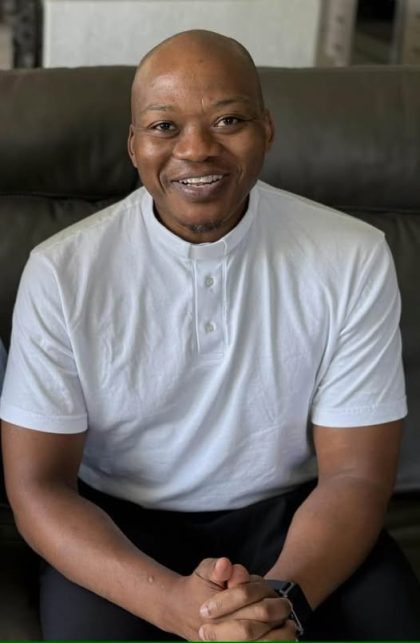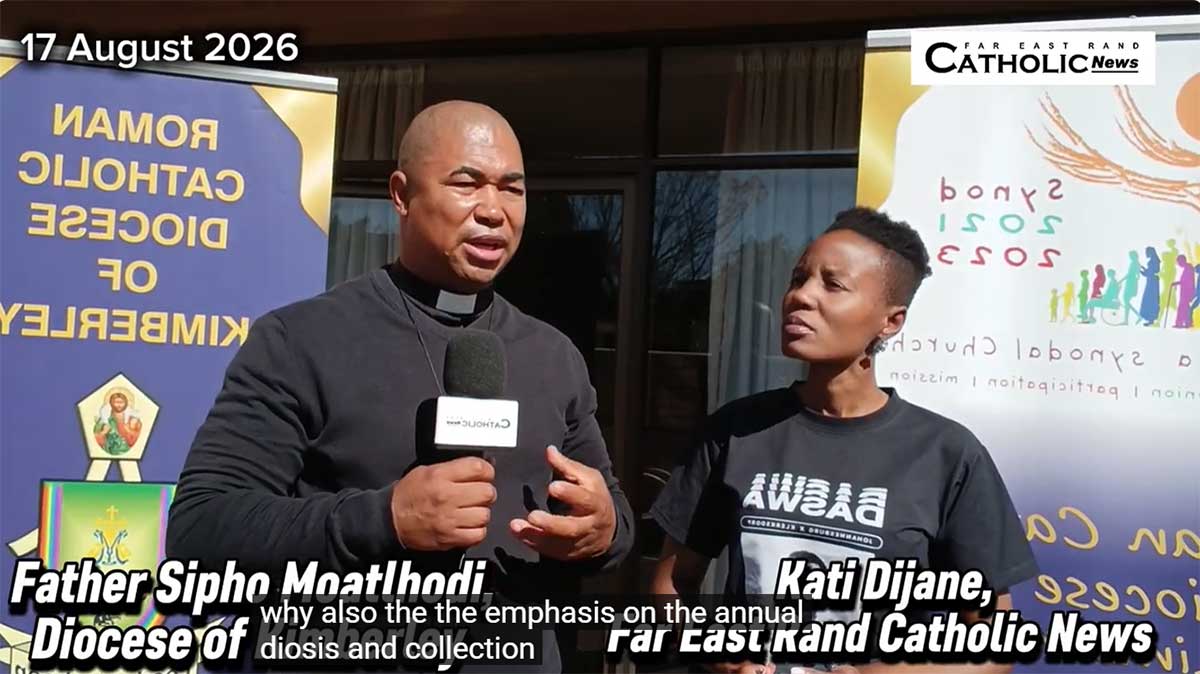
As the Diocese of Kimberley celebrates 75 years of the establishment of its hierarchy, Father Sipho Moatlhodi reflects on a local Church shaped by missionary foundations, growing lay participation and a renewed commitment to young people. During our recent interview after celebrating the Solemnity of the Assumption of Our Lady into Heaven, Father Sipho Moatlhodi shared that the story of the Diocese of Kimberley is also the story of a Church learning to stand on its own feet.
Nineteen years into his priesthood, the diocesan priest has witnessed a significant transition in the life of the local Church: from a diocese largely sustained by missionaries from Europe to one increasingly dependent on its own priests, religious and lay faithful to carry the mission forward.
His reflections come as the Diocese of Kimberley celebrates 75 years since its elevation from a vicariate to a diocese in 1951, marking an important milestone in a history that stretches back to 1886.
At the heart of the celebrations is the local Church’s present leadership under Bishop Duncan Tsoke, who was appointed and installed as bishop in 2021.

Father Moatlhodi also shares that the diocese’s history is not simply something to be remembered, but a foundation upon which a new generation of Catholics must continue building.
From missionary foundations to a local Church
The Diocese of Kimberley began as a vicariate in 1886. For many years, its pastoral life was strongly influenced by missionaries, particularly the Oblates of Mary Immaculate who came from Germany and Belgium. Father Moatlhodi remembers how their presence shaped the Church he encountered as a young person. “They were really working hard,” he recalls, describing how the missionaries built churches and established communities across the diocese. Among those who influenced his own vocation journey was the late Oblate Father Hannes Scheper, who organised vocation workshops and helped young people understand the different forms of priestly and religious life.
For Moatlhodi, these encounters were significant. He had already sensed a call to priesthood at a very young age. Even as a child, while other children imagined themselves taking on different roles, he found himself saying that he wanted to become a priest. His involvement in the Church deepened through serving at the altar. “We loved the Church,” he says, recalling how he and other young altar servers would spend much of their free time caring for the church. Those early experiences eventually led him to the seminary after completing matric in 1998. But his vocation was also part of a much bigger transition taking place in Kimberley.

‘We have to be on our own’
The late Bishop Erwin Hecht OMI, one of the former bishops of Kimberley, recognised the importance of developing a locally rooted diocesan clergy. The missionaries would not remain forever, Father Moatlhodi explains. If the Church was to have a lasting presence, local vocations had to be nurtured. “Missionaries are here, but tomorrow they won’t be here,” he recalls. The answer was the formation of priests who belonged to the local diocese and would commit themselves to serving its people for life. That transition has not always been easy. As the number of European missionaries declined, the responsibility for sustaining parishes and diocesan structures increasingly fell on local Catholics.
The faithful were encouraged to contribute more generously through Sunday collections, parish fundraising and the annual diocesan collection. “It was a realisation that the white missionaries from Europe are no longer here,” Father Moatlhodi says. The Church had to learn to become more self-supporting. The process continues to present challenges, but it has also created a deeper sense of ownership among the faithful. Father Moatlhodi states that this is part of what it means for the Church of Kimberley to mature. The diocese is no longer simply receiving the missionary faith. It is increasingly taking responsibility for carrying it forward.
A diocese learning to walk together
That same spirit of participation can be seen in the diocese’s engagement with the Synod on Synodality. Father Moatlhodi says Catholics in Kimberley participated in the initial consultation, with many responding to the questionnaires and engaging in discussions on synodality. The process has since moved forward with the establishment of a diocesan synodal team. The next step is to establish teams within the diocese’s five deaneries: Kimberley, Taung, Vryburg-Morokweng, Mahikeng and Kuruman.
He rates the diocese’s progress at about six out of 10. There is still work to do, but there is also movement. Father Moatlhodi adds that synodality cannot remain an abstract Church concept, but must become visible in the way priests, religious and lay people participate in the life of their communities. It means listening, sharing responsibility and recognising that the mission of the Church belongs to the whole People of God. This approach also resonates with Bishop Tsoke’s leadership, particularly in the way young people are being encouraged to participate in the life of the diocese.
Young people are not simply the future
One of the strongest themes emerging from Father Moatlhodi’s reflections is the Church’s concern for young people. He acknowledges the difficult circumstances many young people face, including unemployment, substance abuse and other social pressures. Yet he insists that the Church cannot respond to these challenges by giving up on them. “What they need is hope,” he says. That hope, he explains, must come through the Lord, the Church and the leaders who accompany young people. The diocese is therefore seeking to involve young Catholics more deliberately in parish life and Church structures.
Bishop Tsoke, Father Moatlhodi says, is particularly passionate about young people and encourages priests and parish communities to give them meaningful roles. Young people are being encouraged to participate in structures such as Parish Pastoral Councils and Parish Finance Councils, allowing them to see themselves not as outsiders waiting for their turn, but as active members of the Church today. “They are not only the future, but also the now of the Church,” he says. It is a significant shift in the way the Church looks at youth ministry. Rather than simply asking young people to attend programmes organised for them, the challenge is to invite them into the life, decision-making and mission of the Church.
A message of hope ahead of World Youth Day
This pastoral approach comes at an important time as young Catholics around the world prepare for World Youth Day 2027. For some young people in Kimberley, attending the international celebration may be difficult because of the financial cost. But Father Moatlhodi believes that participation in World Youth Day does not begin with boarding a plane. Young people can prepare spiritually, support one another and unite themselves with the global Catholic youth movement even if they cannot physically travel. Most importantly, they can hold on to hope.
Reflecting on the theme, “Take courage, I have overcome the world,” he encourages young people not to allow their circumstances to define their future. “Never give up trusting the Lord, because God is always with you,” he says. The diocese itself has experienced moments of transition, uncertainty and difficulty. It has had to adjust from a missionary-supported Church to one increasingly called to sustain itself. Yet, like the young people Father Moatlhodi speaks about, the diocese continues to move forward.
75 years of hierarchy, a future built locally
The 75th anniversary of the establishment of the hierarchy in Kimberley is therefore more than a commemoration of an event that took place on 11 January 1951. It is an opportunity to recognise how generations of Catholics, missionaries, priests, religious and lay faithful have contributed to the building of the local Church. The presence of the bishops who have served Kimberley forms part of that story, as does the emergence of locally born diocesan priests such as Father Moatlhodi. Now, under Bishop Duncan Tsoke, the diocese is entering another chapter.
Its priorities include strengthening synodal participation, encouraging local responsibility, nurturing vocations and ensuring that young people have a genuine place within the Church. The journey is not without its challenges. Resources remain limited, and the transition away from missionary support continues to test the diocese. But there is also a growing awareness that the Church belongs to its people. While the missionaries helped plant and nurture the faith, today, local Catholics are being called to tend the garden themselves. And among the young people, priests and lay faithful of Kimberley, there is hope that the Church will continue to grow, not simply by preserving its past, but by allowing its people to become active participants in shaping its future.

- Cardinal Brislin: The Church must walk with families beyond the wedding day - October 19, 2026
- JHB leadership conference calls Catholics to shared responsibility for Church’s mission - October 19, 2026
- Justice & Peace call for responsible mining, youth empowerment and accountable leadership - October 16, 2026