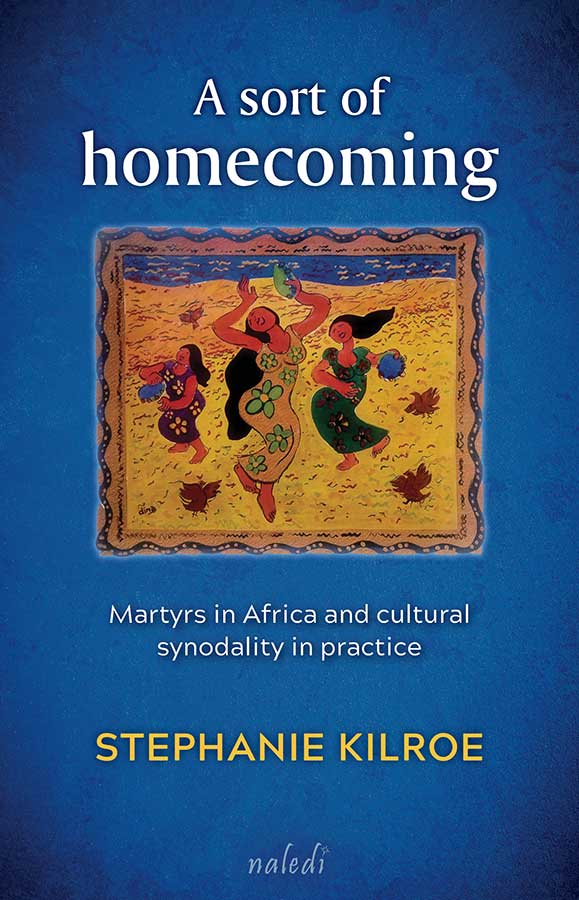
A Sort of Homecoming: Martyrs of Africa and cultural synodality in practice, by Stephanie Kilroe. Naledi, Gansbaai (2026). 160pp
Reviewed by Mike Pothier
In 1930, the German theologian Dietrich Bonhoeffer, having spent some time in New York, observed that “the general picture of the church in the United States is one of racial fragmentation. Blacks and whites come separately to word and sacrament. They have no common worship.”
Years ago, in a suburban Cape Town parish I belonged to, there was a tradition that on the Sunday after Easter the marimba band and choir from a township parish would come and play at all the Masses; and their priest would preside and preach. A collection was taken for them, and it was generously supported. Everyone seemed happy and, for all I know, the tradition continues.

But I was always left with an uncomfortable feeling. Our parish priest did not go and say the Masses in the township parish; neither, as far as I know, did our choir go and sing in the township. Despite the good intentions of all concerned, it all felt a little paternalistic — the wealthy white parish paying to be entertained with something different. Although, for a brief hour once a year, we all shared the same space, we were not really sharing the same worship.
In A Sort of Homecoming: Martyrs of Africa and cultural synodality in practice, Stephanie Kilroe offers us a different picture of common worship — or, at least, of a serious and consistent attempt to overcome some of the racial and cultural divisions that have for so long plagued us as Church.
For over 50 years, Kilroe and members of her family have attended Sunday Mass at various township parishes — St Gabriel’s in Gugulethu, then St Mary’s, Nyanga, both in Cape Town, and latterly in Zwelihle, near Hermanus, at the Martyrs of Africa church that gives her book its sub-title.
It started as an expression of solidarity with oppressed fellow Christians, but it soon became something more than that: “I kept going because I enjoyed it — not as a sort of political statement or spectacle. I just loved being there. It called me to life and strengthened my faith in a good-humoured, incarnate, generous and life-giving God.”
At one level, this is what the book is about. A gradual, ever-deepening immersion in a “different” style of worship; an experience of Christian community quite unlike that which most white and westernised Catholics find in their parishes; a journey towards human wholeness, overcoming — and allowing others to help us overcome — those things that keep us apart.
But this is by no means just a memoir. Along the way, Kilroe introduces us to Iain McGilchrist. He is a neuropsychiatrist whose work on the hemispheres of the brain, and what happens when our left and right hemispheres are out of balance, offers deep insights into Western and non-Western approaches to life; particularly to the pursuit of wealth and power.
We also meet Bonhoeffer and his disciple, Jürgen Moltmann, two giants of 20th century theology, both of whom had their eyes opened to “see from below”, to recognise that the essence of Christian community is expressed “in a joyful, inclusive, bodily gathering of the faithful” — the kind of gathering that one is far more likely to encounter in a township parish than in a suburban one.
There is a compelling chapter on Catholic Social Teaching, which illustrates how its central principles — the common good, the dignity of persons, the option for the poor, solidarity — are lived out and concretised in the Martyrs of Africa community. Not that everything in that community is perfect — there have been misunderstandings between its Xhosa and Malawian components, for example, but these and other problems are gradually worked out in a constructive spirit.
At another level, A Sort of Homecoming is a more political book. It reminds us of one of apartheid’s most pernicious successes: the way the system kept us apart not just physically but culturally and linguistically.
To this day, more than 30 years after the legal defeat of apartheid, only a handful of white South Africans can speak an indigenous language (leaving Afrikaans out of the equation), and the vast majority of us have little knowledge of the music, the customs and the rituals of our African countrymen and women.
Tragically, the schooling system, though physically more and more integrated, seems to have done very little to overcome these more subtle, though deeply harmful, separations.
And neither has the Church. Kilroe writes: “Churches should be ideal meeting places for persons of goodwill to get to know one another across the racial divide.” Few would argue that this has actually been achieved on any scale. Our parishes “are still determined by apartheid’s Group Areas Act, and so many regular churchgoers, apart from philanthropic donations, seem to be oblivious of the call to be one with their Christian neighbour, brother and sister, whatever their ‘tongue or tribe or nation’”.
But there is no need to end on a pessimistic note. This is a life-affirming and faith-affirming story. Kilroe’s journey across the divides — her homecoming — has been a challenging one for her, and reading about it confronts us with our own challenges. But in the end, the sense of community that she describes and the feeling of truly Christian celebration that she shares with us reveal those challenges to be, in reality, blessed opportunities.
A Sort of Homecoming can be ordered at https://naledi.co.za/product/a-sort-of-homecoming/

- Pope Leo’s Prayer for Mission Sunday - October 17, 2026
- A Call to Unity and Love: Pope Leo on the 100th World Mission Day - October 17, 2026
- Walking in the footsteps of Blessed Joseph Gérard: Missionary Associates renew their missionary call - October 15, 2026