The recent harassment of foreign nationals should be a wake-up call for all of us who care. It has shown that, when under pressure, parties who should be defending human rights can give in to forces that seek to “other” those who are different and exclude them. Sometimes they do that by joining in; more often, by remaining silent.
Another area where there is often silence is the exclusion of LGBTQI+ people in many parts of our society. In this article I will use that acronym — although cumbersome — because, importantly, it recognises not just that there are people who are “gender diverse” from the heterosexual norm, but also that they are diverse in a variety of ways. It is also the term that members of the community prefer (as opposed to “homosexual”) and we must not tell people what they should call themselves.
Many people know and may quote the Church’s moral teaching, which reserves the sexual act to a man and a woman within marriage. Fewer are aware of, or promote, the Church’s moral teaching about the treatment of homosexuals: “They must be accepted with respect, compassion, and sensitivity. Every sign of unjust discrimination in their regard should be avoided” (Catechism of the Catholic Church §2358).
For this reason, Catholics should applaud the inclusion of sexual orientation in the South African Constitution 30 years ago, since it is consistent with the demands of the Catechism. However, though our laws are exemplary in defending the rights of LGBTQI+ people, the actual experiences of many people in our families and our communities do not always live up to these ideals.

Groundbreaking research
A recent piece of groundbreaking research which addresses this was produced by the appropriately named “Other Foundation”. Its CEO, Neville Gabriel, is well known to the bishops’ conference for whom he worked for nine years both in the Parliamentary Liaison Office and then as national director of Justice & Peace.
The report is entitled “Admission Reserved”, which expresses the sense in which LGBTQI+ people in South Africa are theoretically admitted to all parts of the community — but in reality, that admission comes with reservations. There is an interesting echo here of the period after apartheid, when public spaces were desegregated. Although people of colour were now legally free to enter beaches, golf clubs and residential areas from which they had previously been excluded, many did and still do not necessarily feel welcome to do so.
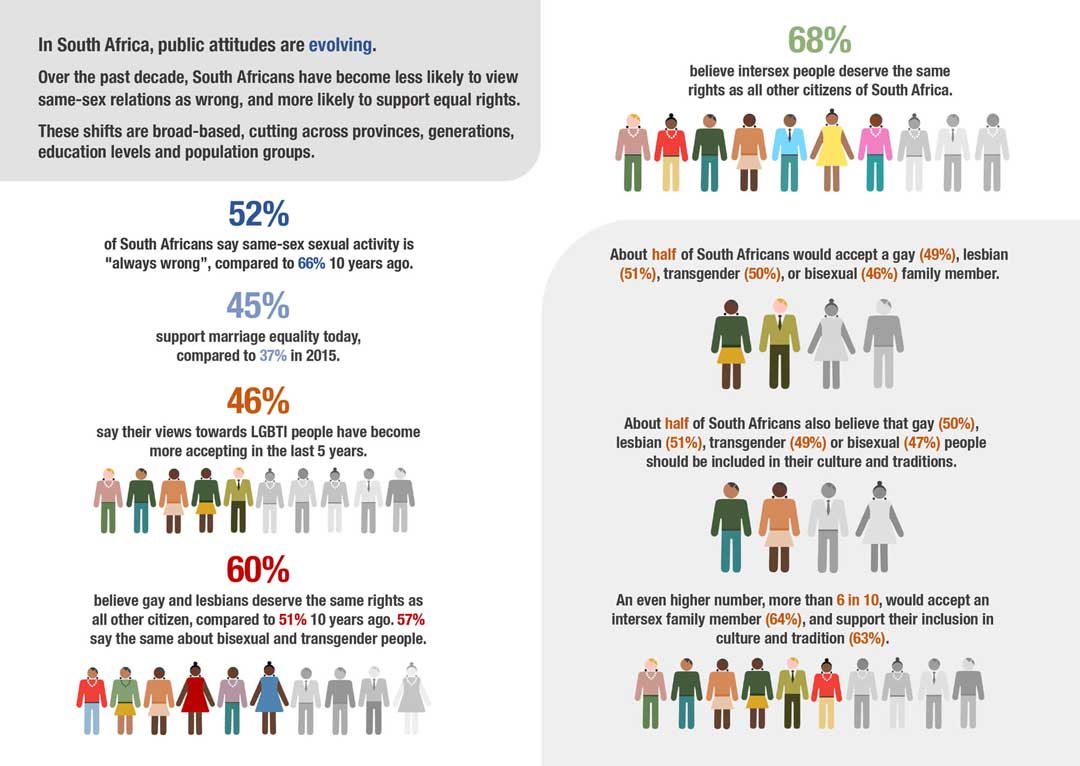
The nationally representative survey was carried out very thoroughly by the Human Sciences Research Council (with whom I have worked closely on research into homelessness). It is a follow-up to a similar survey conducted ten years ago and thus provides a useful insight into how attitudes have changed. It is impressive that, under every measure, South Africans have become more accepting — and in fact 46% of those surveyed said they themselves had become more accepting.
The measures do show changes in attitudes. Where a decade ago, 37% of South Africans supported same-sex marriage, today that figure is 45%. In 2015, 66% said that same-sex sexual activity was “always wrong”; that has declined to 52%. Ten years ago, nearly 8% said they had “never physically harmed a transgender person, but might do so in the future”; this has dropped to 3%. Moreover, these shifts in public attitudes are broad-based, cutting across provinces, generations, education levels and population groups.
Mixed bag of results
But for those who care about human rights, it is concerning that there is still a long way to go. For example, 60% now say that lesbians and gay men deserve the same rights as all other people (an increase from 51% ten years ago). But before we pop the champagne, we should pause to consider how we would react if told that, 32 years after liberation, only 60% of South Africans think that women, or black people, or Catholics deserve the same rights as all other people.
The Constitution is clear that discrimination on sexual orientation is as forbidden as discrimination on gender, race or religion. As a nation, our heads might know that, but our hearts have not all caught up.
Much of this change seems to be rooted in personal experience: 69% say that they know a gay man, 63% a lesbian woman and 30% a bisexual person. This may help explain the relatively high level of willingness to speak out in defence of someone. Seventeen percent of South Africans say they have spoken in support of or defended a lesbian, gay, or bisexual person in public; a further 27% say they have not done so, but may in the future.
It is in the bosom of our families and communities — cultural and religious — that acceptance is most important. It is heartening to read that around half of respondents say that they would accept someone who was LGBTQI+ as a family member, and a similar proportion believe that LGBTQI+ people should be included in their culture and traditions. But this still leaves the other half who are not willing to say that — and that number has not decreased substantially in the last ten years.
On the side of the margins
In presenting the results in July, two events were held, focusing on the importance of faith and families: one at the Methodist Seth Mokitimi Seminary in Pietermaritzburg and one at the Denis Hurley Centre in Durban. Like Archbishop Denis Hurley, Rev Seth Mokitimi was also a senior cleric who realised that the Church should always follow Jesus’ example in placing itself on the side of those who are oppressed and excluded. They would both identify with the notion of religious leaders being “a voice for the voiceless”.
The “Admission Reserved” survey shows that the voices of the LGBTQI+ community are now being heard — but are still unheard or silenced in some parts of society, including in our churches. Its results are a challenge to religious and community leaders to reflect on the limits they might place on their own willingness to include those who are “other”.
The survey estimates that there are at least 2,4 million South Africans who identify as LGBTQI+. Some of them are members of our Catholic families, attend(ed) our Catholic schools, work for our Catholic organisations, and worship in our Catholic churches.
But the survey also tells us that, in South Africa, there are 2,9 million people who admit that they have abused someone who is LGBTQI+, and 1,1 million who admit to having physically harmed someone. Some of them might also be members of our Catholic families and Catholic communities. Does that make us ashamed? Or proud?
What did Jesus do?
When faced with injustice, in whatever form, we can speak out and encourage others to speak out for the oppressed — or we can remain silent.
There is no doubt what example was set by Jesus. He could have joined in with those who wanted to throw stones; he could have remained silent in the face of such injustice and walked by on the other side. Instead, with every excluded person he encountered, he reached out to them with gentleness and love and offered a hand of friendship.
How can we, as followers of Jesus, not do the same?
For more details of the survey, see www.theotherfoundation.org/admission-reserved/
Published in the September 2026 issue of The Southern Cross Magazine

- Lessons from the Saints - October 12, 2026
- No Room for Exclusion - September 7, 2026
- Rose Calaca: The Vocation to Educate - August 18, 2026