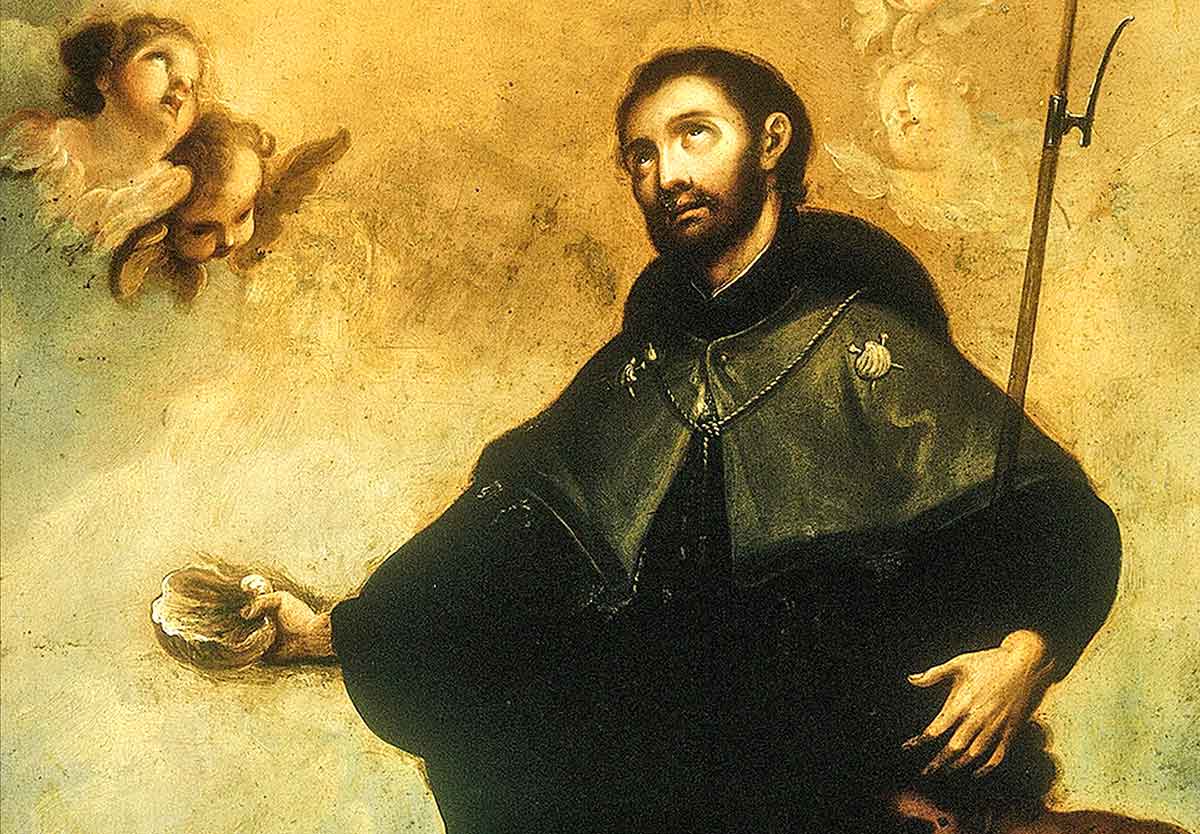
He was supposed to become a soldier, but God had other plans for St Francis of Xavier, who became one of the Church’s great missionaries.
The patron of missions and missionaries led an unlikely life of adventure and heroism, full of unexpected twists and turns, which saw him co-founding the Jesuit order and taking the faith to the ends of the earth.
St Francis Xavier was born on April 7, 1506, as Francisco de Jasso y Azpilicueta to a noble Basque family in Xavier (or Javier), Kingdom of Navarre. Francis grew up in a war-torn land. Wedged between the growing imperial powers of Castile-Aragon (modern-day Spain) and France, Navarre rarely knew peace during Francis’ childhood.

As a member of the nobility, Francis was expected to lead a soldier’s life alongside his father and brothers. But at the age of ten, Francis’ life took its first dramatic and tragic turn. His father died, his homeland of Navarre was defeated by Castile-Aragon, his brothers were imprisoned, and his childhood home — the castle of the House of Xavier — was almost entirely destroyed.
With his family disgraced and nearly wiped out, Francis’ future looked bleak. In 1525, aged 19, he was sent to the University of Paris — then the heart of European learning — in the hope of restoring the family’s lost fortunes.
Meeting Ignatius of Loyola
There, the young Basque noble quickly made a name for himself. Francis was intelligent, athletic and ambitious, and certainly had little interest in a life of piety, never mind self-denial. But that began to change after he met a fellow Basque exile: Ignatius of Loyola.
At first, Francis resisted and even mocked Ignatius’ vision of radical discipleship, but his older compatriot patiently chipped away at his pride, often quoting Christ’s words: “What does it profit a man to gain the whole world and lose his soul?” (Matthew 16:26).
Eventually, Francis yielded. In 1534, in the crypt of the church of St Denis (now St Pierre) on Paris’ Montmartre, he joined Ignatius and five others in taking vows of poverty, chastity and obedience — effectively the beginnings of the Society of Jesus, or Jesuits.
Francis was ordained to the priesthood in 1537, alongside Ignatius. He hoped to travel to the Holy Land to convert the infidels, but war made that impossible.
Going to India
Then came a twist: In 1540, Pope Paul III asked the Jesuits to send missionaries to India, at the request of the Portuguese crown. When one of the appointed priests fell ill, Francis volunteered to go in his place.
On April 7, 1541 — his 35th birthday — Francis set sail for India. The 13-month sea journey was arduous, taking him around the Cape of Good Hope (Cape Town did not yet exist) and stopping in Mozambique, before arriving in Goa in May 1542.
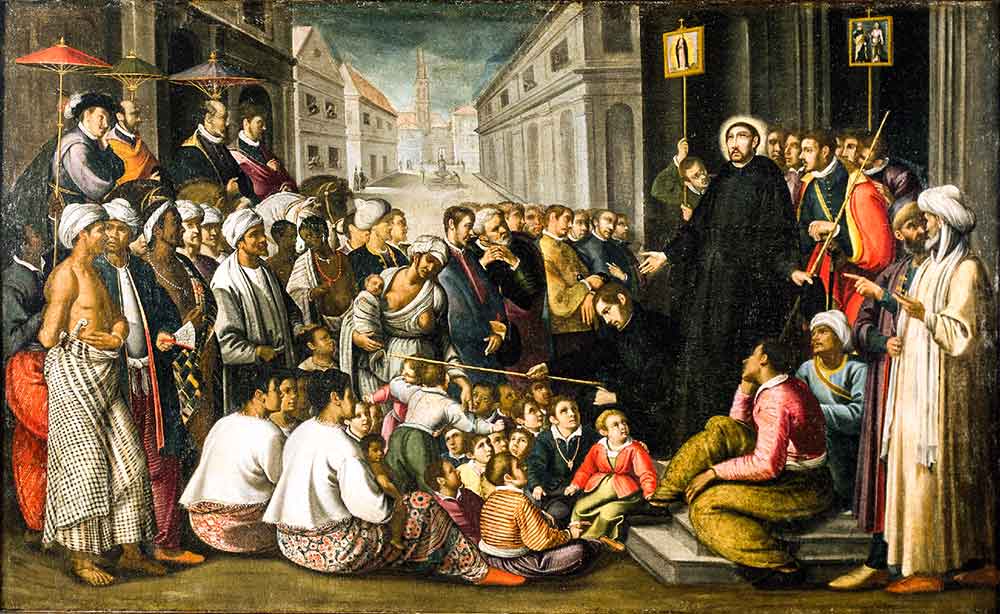
His first mission was to revitalise the faith among Portuguese colonists, but soon he began evangelising the local population. For the next seven years, Francis travelled across India and Sri Lanka, preaching, catechising, and baptising — often in the face of resistance from local rulers, religious leaders, and even the colonial authorities themselves.
But he persevered. By the time he left, he had baptised tens of thousands, built 40 churches, and laid the foundations for a vigorous Indian Church.
He also undertook missions to the Moluccas in today’s Indonesia, but with less success.
Mission to Japan
In Goa, Francis met Anjiro (also rendered as Yajiro), a Japanese fugitive whom he converted to Christianity — the first Japanese Christian. Inspired by what he heard about Japan, Francis decided to take his mission there.
With Anjiro and three fellow Jesuits, he left India in 1549 and landed in Kagoshima. Missionary life in Japan required adjustment and innovation, and Francis realised that public displays of poverty were misunderstood or disrespected there. Adapting quickly, the missionaries dressed as noblemen and were accompanied by attendants, winning the esteem of local lords. He also used Japanese religious vocabulary to explain God and Christian ideas — an early form of inculturation.
After two years, Francis left a small but firm Christian community behind. His heart was now set on China — an even more enigmatic realm. But while waiting for a ship to take him from Shangchuan Island to the mainland, Francis fell ill and died around December 3, 1552, aged 46.
Initially buried on a beach on the island, his body was exhumed by Portuguese merchants and taken to Malacca, and eventually to Goa, where it was received with great reverence by a crowd of 6000.
Today, his body lies in the basilica of Bom Jesus in Goa, while his right arm — the one he used for blessings — is kept at the Jesuits’ mother church, the Gesù in Rome.
He was canonised by Pope Gregory XV on March 12, 1622, alongside his friend St Ignatius, his Spanish contemporary St Teresa of Avila, and St Philip Neri.
Pope Pius XI named St Francis Xavier co-patron of all foreign missions, alongside St Thérèse of Lisieux, in 1927.

- Sydney Duval: We Call him Friend - October 8, 2026
- St Francis and Mission - October 6, 2026
- St Francis of Assisi: Creation and Brotherhood - September 28, 2026