“David danced before the Lord with all his might.” — 2 Samuel 6:14 –
A number of years ago, I was privileged to be part of a group invited to present the Education for Life Programme, a behavioural change initiative, at St Joseph’s Theological College, Cedara, near Pietermaritzburg. It was an experience that left me with many wonderful memories.
It was there that I first encountered the Oblates of Mary Immaculate (OMI), discovered how beautifully the Gospel can be proclaimed through song, marvelled at the splendour of the Howick Falls and stood at World’s View, gazing across the landscape towards Durban in the far distance. I even tasted pork chops for the first time and became an instant believer in their remarkable flavour.
Yet, of all the memories I took home, one has remained with me for more than twenty years.

On our first evening, the president of the college at the time, Fr Daniel Corijn, OMI, took us to Sunday evening Mass at St Mary’s in Pietermaritzburg. Visiting another parish is always a special experience, especially when one is far from home. It allows us to experience the richness and diversity of our Catholic faith.
What struck me most, however, happened at the very end of Mass.
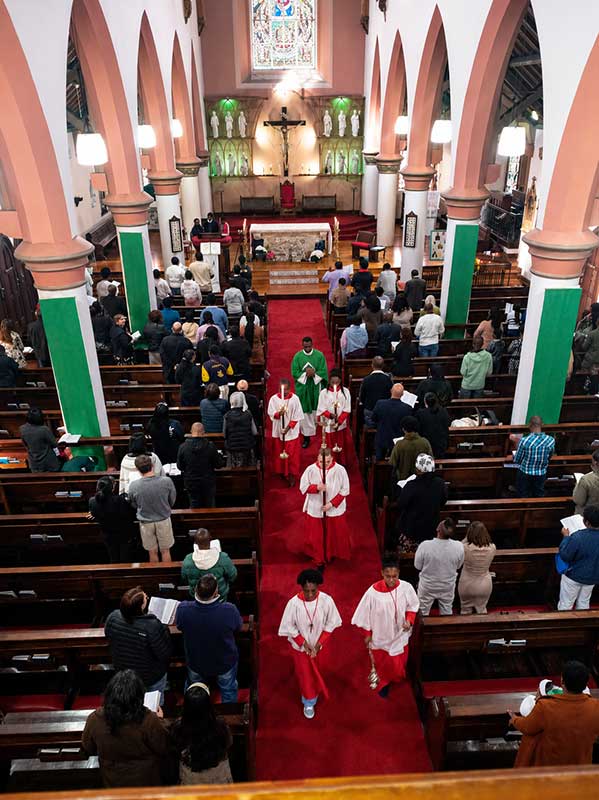
The final blessing was given. The priest and ministers processed out. The congregation remained standing and sang the final hymn with enthusiasm and devotion. No one hurried for the exits. No one glanced impatiently at a watch. Only when the last note had faded into silence did people make their way home.
On the drive back, I mentioned this to Father Daniel. His reply was simple, yet profound. “It’s how you train people.”
Coming from a culture where people often begin making their way to the church doors as soon as the priest proclaims, “Go in peace….,” it was something of a culture shock. Over the years, I have only experienced that same beautiful discipline in a handful of parishes, notably St Vincent’s in Thembisa and my own parish of St Augustine’s in the Diocese of Port Elizabeth. Naturally, there is always the occasional early departure, but more often than not, it is a visitor.
Personally, I have strong feelings about remaining until the final hymn has been sung.
The Church reminds us that sacred music is not simply an addition to the liturgy but an integral part of it. The Second Vatican Council teaches that sacred music is “a necessary and integral part of the solemn liturgy.”
Through our hymns, we pray together, proclaim our faith together and express our unity as the Body of Christ.
The final hymn is therefore not background music for people heading towards the parking lot. It is our last communal prayer before we are sent out into the world to live the Gospel we have just celebrated.
Interestingly, we seem to understand this principle in other settings. University graduation ceremonies, themselves rooted in centuries of Catholic tradition, would seldom see people leaving before the proceedings have formally concluded. Such behaviour would rightly be considered disrespectful to the occasion and to those taking part.
Why should the Holy Mass be any different?
The Eucharist is the source and summit of our Christian life. It is the highest form of worship we can offer God and the greatest gift Christ has entrusted to His Church. Surely it deserves our full attention from beginning to end.
The same principle applies to arriving on time. The Mass is not simply an event we attend. It is a sacred mystery in which we participate. Our punctuality, our attentiveness and our willingness to remain until the conclusion all reveal something of what we believe is taking place at the altar.
Perhaps, then, it is time for us as Catholics to revisit our understanding of the liturgy and our attitude towards worship. More importantly, we should reflect on the example we set for our children and for those who visit our parishes. They are learning from us, whether we realise it or not.
More than twenty years have passed since that Sunday evening at St Mary’s in Pietermaritzburg. I cannot remember the homily. I cannot even remember the hymns that were sung.
But I remember a congregation that stayed. A congregation that understood that the celebration was not over simply because the final blessing had been given. A congregation that sang until the Church had finished her prayer.
I also remember Father Daniel’s words. “It’s how you train people.”
And perhaps that is the challenge for all of us. The dismissal at Mass is not an invitation to leave as quickly as possible. It is a commissioning to take Christ into the world with joy. As mentioned previously and to emphasise it again, the final hymn is not background music for our departure; it is our last communal prayer and our final act of thanksgiving before we go forth to live the Gospel.
Perhaps nowhere is this better captured than in the much-loved recessional hymn, “Go, the Mass Is Ended”. The hymn reminds us that the Eucharist is not simply something that has concluded, but a mission that has just begun. We are sent into our homes, workplaces and communities to share with others what we ourselves have received. It’s a beautiful invitation to“give to all what you have received, the peace and joy of Christ”, which perfectly expresses the spirit of the dismissal.
How can we hurry out before hearing that call? How can we leave before joining our voices in that final act of prayer and commitment?
The saying traditionally attributed to St Augustine tells us that, “He who sings prays twice.” He therefore profoundly emphasises that the final hymn is not an optional extra to the Mass but our last shared prayer before we are commissioned into the world. We sing because we have encountered Christ. We sing because we have received His Body and Blood. We sing because we are being sent to proclaim, by our lives, what we have celebrated at the altar.
We sing because we are being sent out on a joyful mission.
Then comes the stirring refrain of that powerful and memorable hymn:
“Praise the Lord, praise the Lord, let the people rejoice….“
We simply cannot walk out on those words. It is a profound moment of rejoicing and praising the Lord, and we need every voice to proclaim that message and bring the roof down with our singing. The priest and ministers should feel the power of that recessional hymn as they make their way down the aisle, carrying with them the joy and gratitude of the faithful. It should make them dance like David before the Lord, for a Church that truly rejoices in God cannot help but sing His praises with heart, soul and voice.
After all, it’s not over until….the priest leaves dancing and rejoicing.
- When Wooden Spoons Become Instruments Of Grace - October 3, 2026
- All Things Bright and Beautiful — A Beautiful Hymn, An Ugly Reality - September 11, 2026
- Pilgrims of Hope: A Hymn We Must Not Leave Behind - August 14, 2026