This year marks 50 years since the student uprising of June 16, 1976 in Soweto. In this condensed version of a feature in the June 2026 issue of The Southern Cross, Daluxolo Moloantoa looks at the role the Catholic Church played in that time.
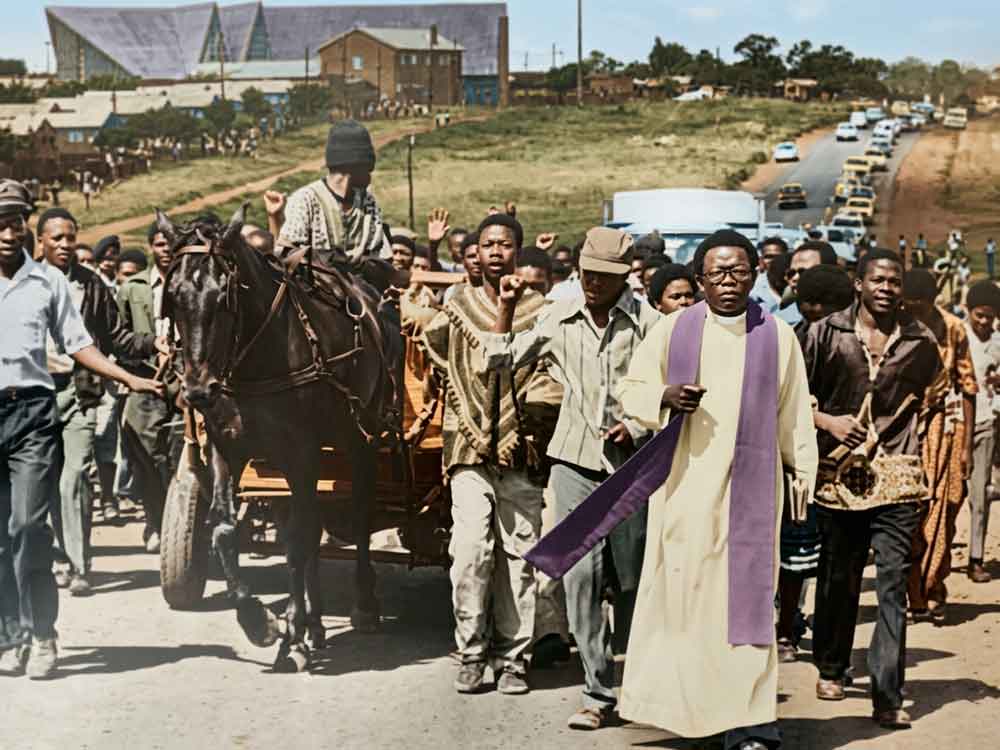
It is one of the most striking images of the aftermath of the Soweto Uprising of 16 June 1976: Fr Buti Tlhagale OMI of Regina Mundi church leading a funeral procession in Soweto as hundreds follow behind him from the church towards Avalon cemetery, the deceased transported on a horse-drawn cart.
As South Africa commemorates the 50th anniversary of that historic day, the memory of the youth who stood unarmed before police Casspirs and bullets remains etched in the nation’s soul. Among them was Hector Pieterson, whose death became a symbol of sacrifice and injustice.
But intertwined with this story of youthful courage is another: the witness of the Church — priests, religious and lay faithful — who refused to remain silent in the face of oppression.

On June 16, 1976, thousands of schoolchildren marched through Soweto to protest against the use of Afrikaans as a language of instruction in their schools. What began as a peaceful protest quickly became a major turning point in South Africa’s history, drawing attention to the realities of apartheid and its impact on young people.
In the 1950s, the Church had already begun to take a clear stand against apartheid. It opposed the Bantu Education Act, refusing to hand over its schools to state control in 1955. The Group Areas Act also disrupted parish communities by separating them along racial lines.
In response, the bishops issued a 1952 pastoral statement rejecting racial discrimination as incompatible with the Church’s social teaching. In 1957, the Southern African Catholic Bishops’ Conference denounced apartheid as a “blasphemy against God” and “intrinsically evil”.
This resistance was not without cost. Many Catholic institutions faced financial strain and political pressure. Yet the Church’s stance affirmed the crucial truth that faith is inseparable from justice.
When the students of Soweto took to the streets in 1976, the Church found itself at the heart of a national crisis. Parishes became sanctuaries, and clergy were drawn into roles as both pastors and defenders of human rights.
One of the most significant spaces was Regina Mundi church in Moroka, known as the “People’s Cathedral”. It became a refuge for protesting students fleeing police violence. Inside its walls, teargas canisters were hurled and bullets scarred the structure — marks that remain visible today. More than a physical shelter, it was a spiritual stronghold where the cries of the oppressed were lifted up to God.
Catholic priests and religious sisters ministered to the wounded, comforted grieving families, and spoke out against injustice, often at great personal risk.
The Black Priests Solidarity Group, formed in the 1970s, became a critical moral and spiritual force. Figures such as Fr (later Bishop) Paul Mogale Nkumishe, its first president, Fr Lebamang John Sebidi and Fr Clement Mokoka helped ensure that the injustices of apartheid were addressed from a faith perspective.
Archbishop Emeritus Tlhagale later reflected: “The Church could not remain neutral in the face of systemic injustice. The events of 1976 compelled us to deepen our commitment to social justice and the dignity of every human being.”
While clergy and religious played visible roles, the contribution of lay Catholics was equally significant. Teachers, catechists, parents and youth leaders formed the backbone of community resistance. Inspired by Catholic Social Teaching, lay organisations became platforms for advocacy and solidarity.
Half a century after June 16, the events of Soweto continue to resonate across South Africa. Honouring the legacy of 1976 requires more than commemoration. It calls on the Church to respond actively to present challenges such as poverty, inequality and violence.
Fifty years on, June 16 still poses the question: In the face of injustice, will we remain silent, or will we allow our faith to speak?
Read the full-length feature in the June issue of The Southern Cross.

- Take Sister Julia’s bees to Rome - October 12, 2026
- A Catholic Journey to the Sacrament of Marriage - October 3, 2026
- Families Celebrate Marriage, Faith and Fun in Pretoria - October 2, 2026