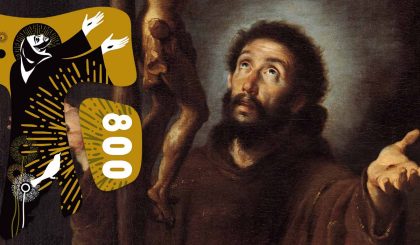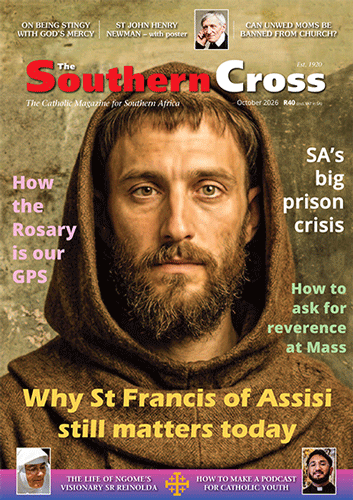
This month’s issue of The Southern Cross features a fascinating likeness of the gentle man of Assisi, in this year of St Francis and in the month when we mark 800 years since his death.
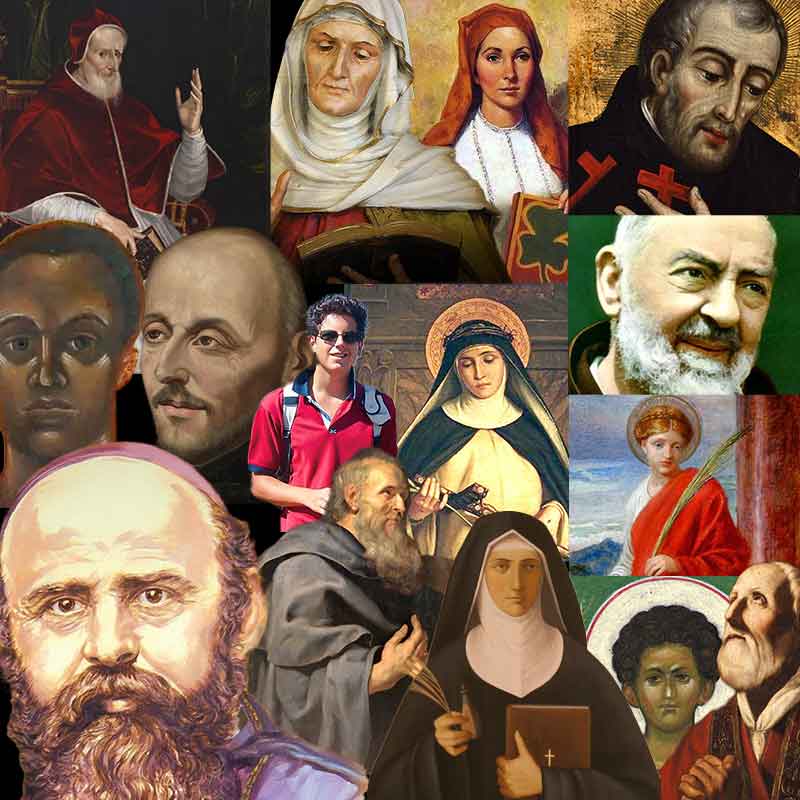
I love the fact that, as Catholics, we can treat the saints as our everyday companions: walking alongside them when we are anxious, turning to them when in need, remembering their feast days and carrying special images in our wallets, like family photos.
For us, they are not long-dead relics of the past but a vibrant part of the life of the Church, and the lives of each of us as Christians. This is what we are affirming each week when we say that we “believe in the Communion of Saints”.
But there are two dangers in this. The first is that we “read back” into their lives assumptions from our age that would have been meaningless to them.

For example, we now recognise that the expansion of European religious orders around the world was not unconnected to a wider project of colonisation and exploitation. But does it make sense to ask whether, for example, St Eugène de Mazenod saw himself as a coloniser when he sent his Oblates of Mary Immaculate to South Africa?
The other is that we “read forward” from the lives of the saints into our own lives without always understanding differences in context.
As St Francis was founding the Friars Minor as an itinerant order of men, he encouraged his dear friend Clare to create an order of women — as enclosed nuns. Can we then conclude that the natural and proper role for women religious is automatically less active than for men religious? Try having that argument with the empowered and liberated religious Sisters who do so much great mission work today.
Meeting the sultan
One incident of St Francis’ life is still relevant today, a time of division: his visit to the Muslim leader Sultan Al-Malik Al-Kamil. What lessons can this teach us about interfaith dialogue today?
The famous meeting took place in September 1219, at the height of the Fifth Crusade in a town called Damietta in Egypt, which the Islamic army was fortifying to help them control access to the Nile.
There is one version of the story which could be a great model of interfaith dialogue today: Francis, wishing to break the deadlock in the fighting, goes to talk to and listen to the Sultan, both of them departing as friends. That is possible.
But there is another version — which traces back to a 1267 sermon by Francis’s biographer St Bonaventure, though most historians regard it as legendary — that he in fact went to convert the “infidel”, and this led to a deathbed baptism of the Sultan. Meanwhile, another version claims that the attempt to convert him was not successful and Francis was sent away disappointed.
Maybe the evidence of the holiness of Francis’ mission lies in the fact that, not long after he left, Damietta was captured by the Crusaders. Perhaps. Except that this victory did not then lead to the seizing of Jerusalem, which was the Crusaders’ ultimate goal. Moreover, two years later, Damietta was recaptured by the Muslims and ultimately the Fifth Crusade — despite the support of the pope, multiple Catholic kings and a military leader who was a cardinal — ended in disaster.
One interesting side story in all of this is that the sultan — whether influenced by Francis’ gentleness or a recognition of his own weak military position — offered peace terms which were rejected by the Crusaders. Had they accepted the sultan’s terms, it would have given them control of Jerusalem, which was what they wanted and which ultimately they failed to gain by force.
Trying to extract lessons for today from across 800 years is either too simplistic (if you think history is black and white) or too confusing (if you recognise that most history is highly contested).
St Ignatius and the ‘Moor’
Might adding in the experience of other saints help us get a fuller picture? One of the best “encounter-with-a-Moor” stories that I know is that of St Ignatius, the founder of the Jesuits.
Ignatius was riding his horse in Spain and came across a Muslim with whom he got into a dispute about the perpetual virginity of Our Lady. After the Muslim had ridden off, Ignatius wondered if he should have stabbed the man to avenge Mary’s honour. Unsure what to do, he decided to let his mule make the decision for him.
When the road came to a fork and the mule took the route not taken by the Moor, Ignatius saw this as divine intervention and the Moor’s life was saved (presumably unaware of how random his safe outcome was).
The lives of the saints include people who killed Muslims, people who were killed by Muslims, people who tried to convert Muslims (successfully or unsuccessfully), and people who engaged in dialogue. It seems that you can find saintly precedent for whichever approach you want to take. And if you are not sure which approach is best, does St Ignatius’ way provide a blueprint?
In the absence of a mule, I for one do not intend to put my GPS on to some random route selection algorithm to decide whether to talk to my Muslim neighbour or stab him.
Although the saints are held to be exemplary, they were far from infallible. We should certainly read about and reflect on their lives. But we should also be cautious of using them — unedited — as a direct model for our behaviour today. We need to look at our relationship with God as well.
Saints and the Gospel
In the context of modern-day South Africa, sitting in the Denis Hurley Centre between a Catholic cathedral and a mosque, I feel that God is calling me to work closely with my Muslim and Catholic neighbours to feed the hungry, heal the sick and welcome the stranger.
I am comforted by stories of saints who have behaved similarly, and I also recognise that there are saints who have done the opposite. But the test I apply is less “What would Francis do?” and more “What would Jesus do?” — which is exactly what St Francis would have advised.
I hope the Gospel gives me a guide to know how to respond in each context and, following Matthew 7:16, pray that we will grow to be trees that are known by our fruits.

- Lessons from the Saints - October 12, 2026
- No Room for Exclusion - September 7, 2026
- Rose Calaca: The Vocation to Educate - August 18, 2026