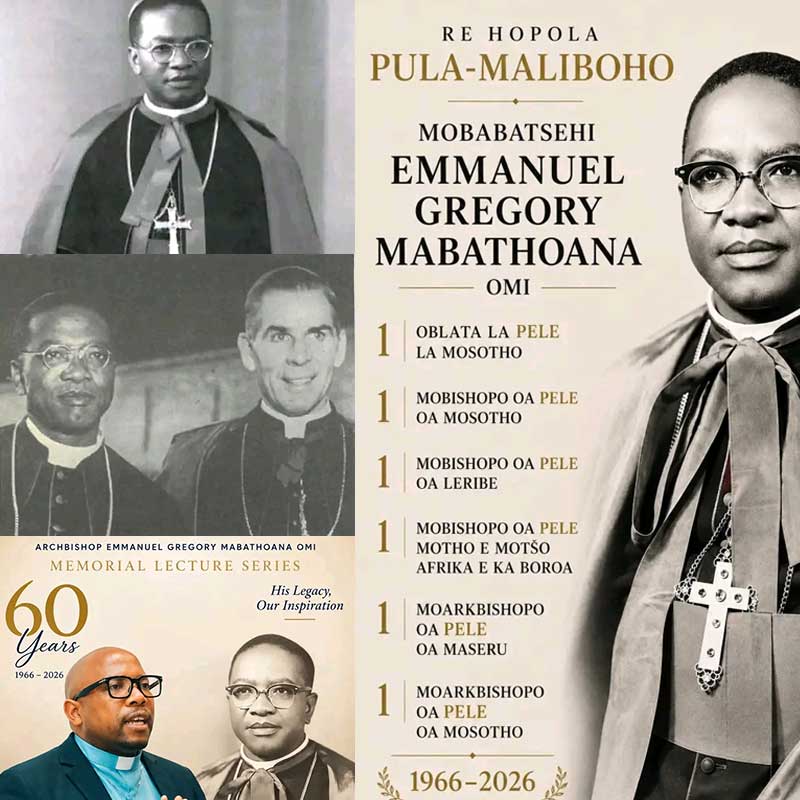
Sixty years on, Archbishop Emmanuel Gregory Mabathoana (OMI) of Lesotho stands as one of the most remarkable figures in the history of the Catholic Church in Southern Africa.
Remembered affectionately as “The Singing Bishop”, Mabathoana was far more than a composer of beloved Sesotho hymns. He was an educator, scholar, linguist, priest, bishop and international Catholic leader whose influence reached from the mountains of Lesotho to Rome, London, the United States and the Second Vatican Council.
The 60th anniversary since his passing in September 2026, celebrated under the theme “His Legacy, Our Inspiration”, offered the Catholic Church in Lesotho an opportunity not simply to remember him, but to rediscover the breadth of his contribution.
The commemorations were spearheaded by the Lesotho Catholic Bishops’ Conference (LCBC) and the Mabathoana Commemoration Committee, with Ms Thuto Matobo serving as a key driving force behind the month-long programme of events.

The anniversary commemorations unfolded throughout September. They included a music festival on 12 September, the ordination of four deacons on 18 September and the ordination of four priests at the 60th anniversary Mass on 19 September. Alongside these events, a four-part Mabathoana Memorial Lecture Series explored different aspects of his life and legacy, with the final lecture taking place on 24 September. Together, the programme brought music, priestly formation, scholarship and the continuing story of the Church Mabathoana helped to build into the anniversary observances.
Mabathoana was born on 29 December 1904 at Mokhokhong near Roma and was a great grandson of King Moshoeshoe I. He entered St Teresa Seminary in 1924, made his Oblate novitiate and was ordained to the priesthood in 1933, becoming the first Mosotho to join the Missionary Oblates of Mary Immaculate and the second Mosotho priest after Fr Raphael Mohasi.
His priestly ministry combined pastoral work with education and scholarship. He taught at St. Theresa’s Minor Seminary and at St. Augustine’s Major Seminary, and later lectured in African languages at Pius XII Catholic University College in Roma. He studied in Rome, London and the United States and developed considerable proficiency in Latin, Greek, Italian and German.
Language was central to his vision of an African Church. He worked on the translation of the Bible into Sesotho and composed hymns for the Catholic Sesotho Hymn Book. His music became so closely associated with him that “The Singing Bishop” became one of his enduring descriptions.
But Mabathoana’s influence extended far beyond music and education. In 1952 he became the first bishop of the newly established Diocese of Leribe and was consecrated on 25 March 1953. In 1961, when Maseru became an archdiocese, he became its first Archbishop and Metropolitan. He was the first African Catholic Archbishop in Southern Africa and the first African to serve on the executive of the Southern African Bishops’ Conference (SACBC).
His international ministry was equally significant. He participated in the Second Vatican Council and served on the Commission on Missions. In 1963, during celebrations marking the centenary of Catholicism in Lesotho, he was made a Commander of the Order of the British Empire (OBE) by Queen Elizabeth II. In 1964 he travelled to Bombay, India for the International Eucharistic Congress, where he preached on the lay apostolate.
A Friendship Across Continents
One of the lesser known aspects of Mabathoana’s story was his relationship with the American Archbishop Fulton J. Sheen. As Bishop of Leribe, Mabathoana travelled extensively through Europe and North America to seek assistance for his young diocese, particularly for the formation of a local clergy and the development of its minor seminary. During these journeys he developed a friendship with Sheen, then national director of the Society for the Propagation of the Faith.
Remembering Through A New Generation
The September commemorations began with a music festival in Mabathoana’s honour on 12 September at Lesotho High School Hall. The night of praise recalled the musical gift that earned Mabathoana the affectionate title “The Singing Bishop”. Mabathoana composed numerous hymns and contributed to the Catholic Sesotho Hymn Book, using music as another way of expressing and strengthening the faith of his people.
On 18 September, the celebrations continued at Mofumahali oa Tlholo in Maseru, where four candidates were ordained to the diaconate. Their ordination offered a fitting image of continuity, a new generation of Basotho clergy beginning its ministry while the Church remembered the pioneer who had devoted so much of his energy to the formation of an indigenous clergy.
The following day, 19 September, at the 60th anniversary Mass at Ha MaJesu in Roma, four deacons, Bartholomy Tsoeunyane, Augustine Ngatane, Sylvester Letlaka and Michael Rantho, were ordained priests. Their priestly ordination on the anniversary of Mabathoana’s death gave the commemoration an especially powerful sense of succession. They were embraced as the “Mabathoana priests”, beginning their priestly ministry on the very day the Church marked the death of the man whose life had done so much to foster an indigenous clergy.
Queen ’Masenate Mohato Seeiso, who attended the Mass, described Mabathoana as a “son of the soil” and said it was important that Basotho children should grow up knowing that he was a pioneer who loved his country.
“Archbishop Mabathoana was a pioneer who loved his country,” she said. “Our children should know the contribution he made to the Church and to Lesotho, because his story reminds us where we come from and the values we should carry forward. His legacy reaches beyond the Catholic Church; it is also part of our national story. We must protect our language and show the world that Lesotho is a peaceful, loving and united country. And as we remember his contribution, I encourage our newly ordained priests to follow his example of faith, service and dedication to the people.”
The president of the Lesotho Catholic Bishops’ Conference (LCBC), Bishop Joseph Sephamola (OMI), described Mabathoana as a global icon and called on the faithful to pursue his legacy and continue praying for his beatification.
A Successor Reflects on the Legacy
For Archbishop Gerard Tlali Lerotholi (OMI), the fourth Archbishop of Maseru and Mabathoana’s successor, remembering the pioneers of the Church is not simply an exercise in looking backwards. Earlier this year, while presiding at the annual pilgrimage honouring Blessed Joseph Gérard at Ha MaJesu in Roma, Archbishop Lerotholi quoted Hebrews 13:7:
“Remember your leaders, who spoke the word of God to you. Consider the outcome of their way of life and imitate their faith.”
He told the faithful that the memory of a righteous person continues to bless future generations and stressed that faith must bear fruit through action. Archbishop Lerotholi was also closely involved in the 60th anniversary commemorations, taking part in several of the activities held throughout the commemoration month.
In August, Archbishop Lerotholi represented the Lesotho Catholic Bishops’ Conference at the Symposium of Episcopal Conferences of Africa and Madagascar (SECAM) conference on Catholic education in Africa in Addis Ababa, Ethiopia. The Southern Cross reported that his participation was in harmony with principles upheld by Mabathoana, whom the bishops were honouring from the beginning of 2026.
A Legacy That Still Speaks
The four-part Memorial Lecture Series examined different dimensions of Mabathoana’s life, formation, pastoral ministry, contribution to the Church and continuing legacy. The series featured panels bringing together lay people, clergy from Lesotho, theologians and church history experts from Lesotho and as far afield as Italy and the United States.
The second seminar, titled “A Mosotho Bishop in the Service of the Universal Church”, was moderated by South African Catholic communicators Sheila Pires, communications manager of the Southern African Catholic Bishops’ Conference (SACBC) and Kati Dijane, editor of the Far East Rand Catholic News.
The final Mabathoana Memorial Lecture took place on 24 September 2026, the fourth and final evening of the lecture series. The lecture offered a retrospective overview of Archbishop Mabathoana’s legacy. It was on this same day, in St Louis, Missouri, USA, that Fulton J. Sheen was beatified as Blessed Fulton Sheen, an unexpected contemporary connection to the American churchman with whom Mabathoana had developed a friendship during his travels.
Mabathoana died on 19 September 1966 while travelling by plane from Maseru to Pretoria, South Africa, to attend a meeting of the Southern African Catholic Bishops’ Conference (SACBC). He was only 61.
Yet, six decades later, his name remains alive in the Church he helped shape. His hymns are still remembered. His scholarship remains part of the story of African Catholic education. His leadership helped establish a new era of African episcopal leadership. His international relationships placed Lesotho within a much wider Catholic story. And the priests and deacons emerging from the Church he helped build continue that story into another generation.
That is the true measure of a legacy. Mabathoana’s story began in Mokhokhong, was formed in Roma, travelled across continents and reached the highest levels of the Catholic Church. Six decades after his passing, Lesotho was still singing his hymns, telling his story, ordaining new clergy and praying that his life might one day be formally recognised through beatification.
Archbishop Lerotholi’s reflection offers a fitting way to understand why his memory endures: remember those who came before, consider the outcome of their lives, and imitate their faith.
From “The Singing Bishop” to a global pioneer, Archbishop Emmanuel Gregory Mabathoana’s legacy is not confined to the past. His voice may have fallen silent, but his song continues to sing through the generations.

- A Final Appeal: Help Take Sister Julia’s Bees to Rome - October 19, 2026
- Take Sister Julia’s bees to Rome - October 12, 2026
- A Catholic Journey to the Sacrament of Marriage - October 3, 2026