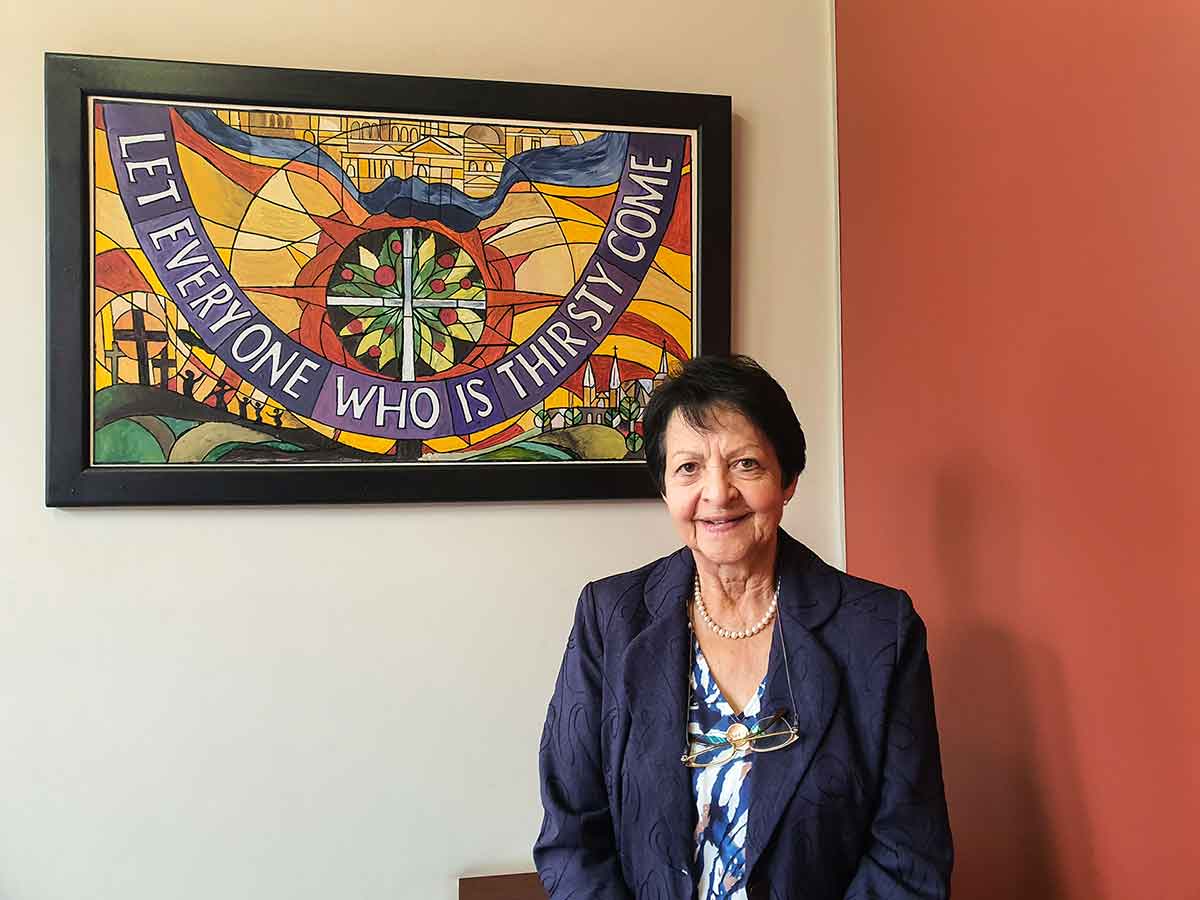
For Rosa Calaca, head of the Catholic Schools Office in Johannesburg, involvement in education is a vocation that can be traced back to her experience as a pupil in a Catholic boarding school. She spoke to Raymond Perrier about her mission and journey in education, and her view of what Catholic schools should be.
It is a piece of advice from a Sister who taught her that Rosa Calaca remembers vividly: “You are reading a book and relaxing — then you remember a task. You get up straight away and do the task. How you feel does not matter. The task on hand is what matters in life.”
These words were spoken by Sr Conrad when Rosa was a pupil at St Dominic’s Convent School in Boksburg more than 65 years ago. They became a guiding principle for a lifetime of service and reflect a spirituality of duty, discipline and commitment that speaks directly to the mission-driven nature of Catholic education itself.
Rosa’s life and work embody this ethos. For the past 20 years she has served as head of the Gauteng Catholic Schools Office (CSO), coordinating and supporting 39 Catholic schools in the archdiocese of Johannesburg (and previously also Pretoria). Her contribution must be understood not only through her personal journey but also within the broader evolution and challenges of Catholic education over the decades.

Rosa recalls early collaboration that took place informally through the Catholic Schools and Teachers Association (CSTA). These gatherings were spaces of mutual support, where teachers and principals shared challenges and learned from one another. Over time, such informal networks evolved into more structured entities, giving rise to Catholic School Boards, Catholic Schools Offices, and other governance structures. These bodies now play a crucial role in ensuring coherence, continuity and accountability across Catholic education.
Rosa’s office, housed in an ageing and unassuming building in Rosebank, stands in stark contrast to the sleek glass towers of the surrounding corporate district. The setting itself serves as a metaphor for Catholic education in contemporary South Africa: rooted in tradition, values and service, yet operating within an increasingly materialistic and market-driven society. Rather than competing on the basis of prestige or profit, Catholic schools seek to challenge prevailing values by holding fast to a deeper vision of human dignity and holistic formation.
Each child formed in the image of God
The uniqueness and giftedness of every child, formed in the image of God, is central to the lesson Rosa consistently passes on to educators: “You are teaching the child and not the class.” She explains: “Each learner arrives at school carrying unique experiences, struggles and gifts, and authentic education requires attentiveness to the whole person, not merely academic performance.”
This conviction was shaped by Rosa’s own experience. In 1960, at the age of eight, she and older sister Ana became boarders at St Dominic’s. Their father, a Portuguese immigrant who had worked on the mines in Boksburg, had seen the school being built decades earlier and resolved that his daughters would one day attend it. Rosa’s experience as a boarder was formative. She thrived in an environment that encouraged academic, sporting and personal development, while also fostering responsibility from a young age. She offers a humorous illustration of this from her role as “porridge monitor” — which conveniently allowed her to avoid a meal she disliked.
After finishing school as headgirl, Rosa pursued tertiary studies at Wits University. Although she initially enrolled in law, she soon realised that the prospect of a courtroom did not inspire her — but a classroom did. Her decision to switch to education proved decisive, not only for her own life but for the generations of learners and educators she has influenced.
Rosa returned to St Dominic’s as a teacher, later becoming head of the primary school and eventually principal in 1987, the first lay person to hold that position. Her leadership coincided with a period of profound change, including the full racial integration of the school.
During her 15 years as principal, she ensured high academic standards while also expanding opportunities beyond the classroom. She was particularly determined that girls should excel in traditionally male-dominated subjects such as mathematics and science. She also introduced a programme that enabled every learner to study a musical instrument from a young age. Such initiatives are hallmarks of a holistic Catholic education.
Rosa’s later experience at an international school in London broadened her perspective, but her sense of vocation remained firmly rooted in South Africa. When the opportunity arose to succeed Mark Honeywell as director of the CSO, Rosa recognised it as the role in which she could best serve the wider Catholic educational community. Her credibility as a former principal, combined with her experience on the board of the Catholic Institute of Education (CIE), equipped Rosa to navigate both school-level realities and the complexities of engagement with government.
Forming a Catholic identity in schools
This ability to operate at the intersection of mission and administration is increasingly vital for our Catholic schools, since one of the most significant contemporary challenges facing Catholic education is the question of identity. The realities that sustained Catholic identity almost effortlessly in earlier generations have largely disappeared. Today, Catholic identity must be consciously articulated, intentionally nurtured, and consistently embodied. It is expressed not only through symbols and rituals, but also through leadership decisions, relationships, and the lived ethos of schools.
Rosa believes this places a particular responsibility on principals and senior leaders. Their role extends far beyond academic and operational management to include stewardship of the Church’s educational mission. Her work at the CSO has focused on forming leaders who are both professionally competent and deeply grounded in the Catholic ethos, capable of holding together faith, excellence and service.
Alongside questions of identity, financial sustainability presents a pressing and sometimes painful reality. While all schools face rising costs and economic pressures, Rosa notes that Catholic schools face the additional challenge of balancing accessibility with quality.
She speaks with anguish about the financial crisis facing diocesan-owned schools, which comply fully with government requirements and maintain financial governance, yet suffer from delayed or reduced state grants. The consequences are severe, at times leaving schools unable to pay teachers.
With the approval of Cardinal Stephen Brislin of Johannesburg, Rosa has championed the Ibhuloho Fund — a “bridge” designed to support schools through cashflow crises.
Another initiative spearheaded by the CSO is a shared marketing platform for all 39 schools in Gauteng. Launched in February, it offers an online map showing the locations of nearby Catholic schools. Parents can click on each school to access key information, explore further details, and even book a tour (csogauteng.org/catholic-schools-johannesburg/).
The closure of two Catholic schools in Johannesburg over the past three years underscores the urgency of this work. For Rosa, sustainability is not an abstract concept but a moral imperative. She hopes that in 60 years’ time, Catholic education will still be characterised by financially sound institutions with a strong ethos and well-formed leaders who understand what makes Catholic schools unique.
Rosa has worked with others to ensure that a range of structures and strategies are in place to support Catholic education. But underlying all these is the faithful service of countless individuals. Rosa particularly pays tribute to the dedication and commitment of staff of the Catholic Schools Offices. She herself stands as a living testament to this spirit of service — shaped by a childhood lesson that taught her to rise, act, and serve when the call comes.
While celebrating strong matric results and academic achievements, Rosa consistently reminds educators and parents that Catholic education is never solely about examination outcomes. Its true measure, she says, lies in the formation of young people who recognise their own dignity, respect others, and are equipped to contribute meaningfully to society.
“Guided by faith, tradition, and a commitment to the Gospel lived in the present, the future of Catholic education, though challenged, remains ours to shape,” she says.
Published in the March 2026 issue of The Southern Cross Magazine

- Lessons from the Saints - October 12, 2026
- No Room for Exclusion - September 7, 2026
- Rose Calaca: The Vocation to Educate - August 18, 2026