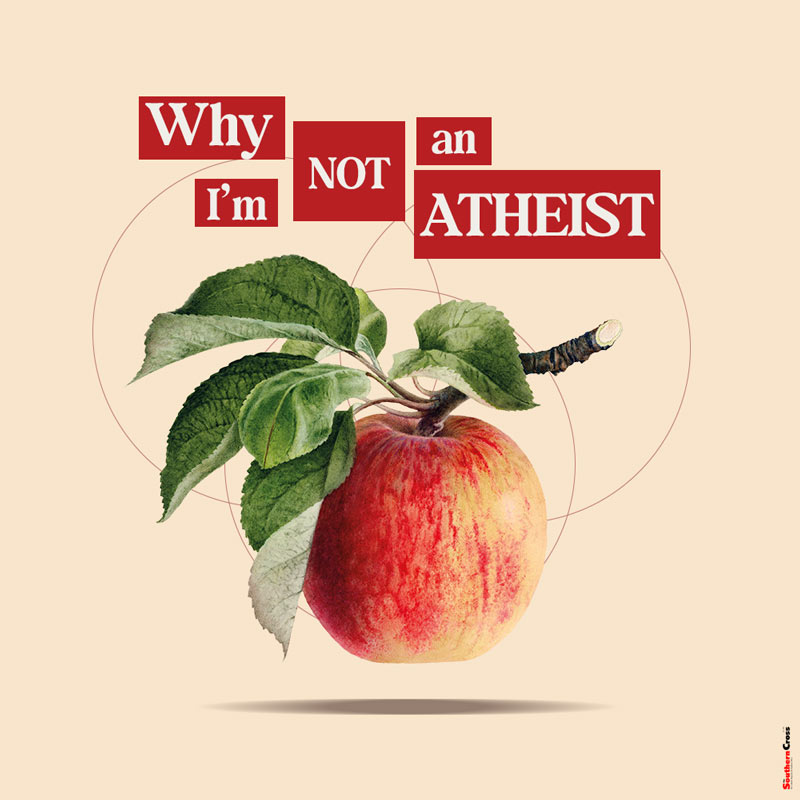
Every convert gets asked what drew him to the Church. Jason Scott’s answer begins one step further back, with the question of God at the root of it all.
Like most converts, I am usually asked what drew me towards Catholicism. The honest answer is that it began further back than the Church. It began with steering away from a sort of passive, indifferent agnosticism towards God.
What follows may be useful to anyone questioning their faith, sharing it, or simply curious about religion. These are far from the only reasons, but they are the three main areas where atheism fails. I call them the Three M’s: Morality, Motion and Maths.
Morality
The most common argument against God is one of the oldest: if God is real, why do such terrible things happen? But notice what the question smuggles in. To call anything in the world terrible, whether it’s a murder, a war, or a child’s suffering, is to measure it against a standard of how things ought to be. CS Lewis, looking back on his atheist years, saw the trap he had been in: “My argument against God was that the universe seemed so cruel and unjust. But how had I got this idea of just and unjust? A man does not call a line crooked unless he has some idea of a straight line.”

Suppose the government passes a law tomorrow to legalise murder. Would you kill anyone? No. You would not, and neither would your neighbours. Because murder is wrong. Not that it’s illegal, not that it’s frowned upon: wrong.
The usual comeback is evolution: that we feel this way because groups that condemned murder outlasted groups that did not. However, that only tells you where the feeling came from, not whether it is true. And “it helped us survive” only counts if survival is good, the very word we were trying to explain.
Philosophers call this the is–ought problem, and no atheist has ever solved it: no amount of describing how the world is can ever tell you how it ought to be.
Evolution can tell you that condemning murder works, since it has kept us alive. But “it works” is not a justification. Works for what? Towards what? Who decides?
So, the wrongness of murder, or of something like rape, is either a truth about reality or it is just a preference, like disliking the taste of olives, binding nobody. Everything in us says it is a truth: binding everywhere, on everyone, at all times. These are universal truths that atheism cannot give an account of.
Motion
The second M is the first of St Thomas Aquinas’s five ways, the five proofs of God in his Summa Theologiae, and it may be the most misunderstood argument in philosophy. St Thomas is asking not what started the universe, but what keeps it going right now.
Take your phone, charging on your desk. The battery fills because a current flows, the current flows because the grid supplies it, the grid supplies it because a turbine is turning somewhere. Nothing in that chain has power of its own, every link only passes on what it receives. Could a chain like that run forever, every member borrowing, none actually having? Try it with a train: carriages roll because an engine pulls them. Take the engine away and couple on more carriages instead, a hundred, maybe a million. Does the train move? Carriages do not pull, they are pulled.
Behind every chain of borrowed existence, then, there must be something that does not borrow, something that simply is, holding everything else in being at this very moment. That is what St Thomas means by the first mover: not the first domino to fall, long ago, but the engine on which the whole train depends, here and now. He ends the argument with a shrug that has annoyed philosophers for eight centuries: “and this everyone understands to be God.”
Maths
Atheism likes to present itself as the scientific position, the one you hold once you have outgrown superstition and learned to follow the evidence. So follow the evidence into mathematics, and ask a question most atheists have never been asked: did we invent mathematics, or did we discover it? Think about what an invention is. An invention does what we tell it, we made it, so we set the rules. Mathematics has never once taken an instruction from us. Nobody decided there would be an infinite number of primes, it was proved, and it would stay true if every human being forgot it tonight.
Mathematicians talk like explorers, not inventors: they discover theorems, they are surprised by them, they get them wrong, and you cannot be wrong about something you are making up. Even Bertrand Russell, the last century’s most famous atheist, admitted that mathematics takes us “into the region of absolute necessity, to which not only the actual world, but every possible world, must conform.”
Now ask the question Augustine asked sixteen centuries ago: if these truths are eternal (true before us, true after us, true whether or not anyone is thinking them), then where do they live? Not in matter. So, what we are left with are truths that behave exactly like thoughts, but thoughts no human being is thinking. And a thought without a thinker is nonsense. An eternal truth requires an eternal mind, so the only alternative is to believe that the universe is mathematical to its bones by sheer blind luck, the mathematics just hanging there, unthought, waiting for someone to trip over it. That, to me, is superstition.
Which Way to the Door?
You will notice that none of this is an argument for Catholicism. The Three M’s might not lead explicitly to Rome, but hopefully they will at least help guide someone towards the God they all point to.
In my next article, we’ll explore why Catholicism is the answer.

- Why I Chose Catholicism: 7 Reasons - October 7, 2026
- Why I Am Not an Atheist: The Three M’s - September 28, 2026
- “Help, the Pope said something I disagree with” - July 20, 2026